What Are Stress Hives? 2026 Stress & Urticaria Guide
Stress hives are raised, red, intensely itchy welts on the skin, medically known as urticaria, that are directly triggered by the release of the stress hormone corticotropin-releasing hormone (CRH) from the brain and the peripheral nerves in the skin, which binds to receptors on dermal mast cells and causes them to release histamine. This is not a histamine response to an allergen like pollen or peanuts. This is a direct neurogenic inflammation where your emotional state chemically inflames your skin.
A 2023 study published in the Journal of the American Academy of Dermatology confirmed that patients with chronic spontaneous urticaria have a significantly higher density of CRH receptors on their skin mast cells compared to healthy controls. The stress hormone is not just floating in your blood. It is physically docking onto immune cells in your skin and commanding them to create the red, itchy welts.
This guide will explain the exact cascade from a stressful thought to a skin welt, show you how to visually distinguish stress hives from an allergic reaction, and provide you with the evidence-based treatment protocol to calm the itching and break the stress-itch-scratch cycle. If you are sitting there, scratching your arms, wondering if your anxiety just made your skin erupt, the answer is yes, and here is exactly how and what to do about it.
If you are in crisis or experiencing thoughts of self-harm, contact the 988 Suicide and Crisis Lifeline by calling or texting 988 at any time. This service is free, confidential, and available 24 hours a day.
what are stress hives
Stress hives are a physical form of urticaria where the wheals, or welts, are caused by the neuroendocrine stress response rather than by an external allergen. They are the visible, tangible evidence of the hypothalamic-pituitary-adrenal (HPA) axis acting on the skin’s immune system. A stress hive looks identical to an allergic hive. The difference is the trigger, which is internal and emotional, not external and environmental.
The hive itself is a localized area of swelling in the superficial dermis. It is caused by the leakage of plasma from dilated blood vessels into the surrounding tissue. The histamine released from the mast cells binds to receptors on the endothelial cells of the small venules, causing them to become permeable. The fluid leaks out, creating the raised welt.
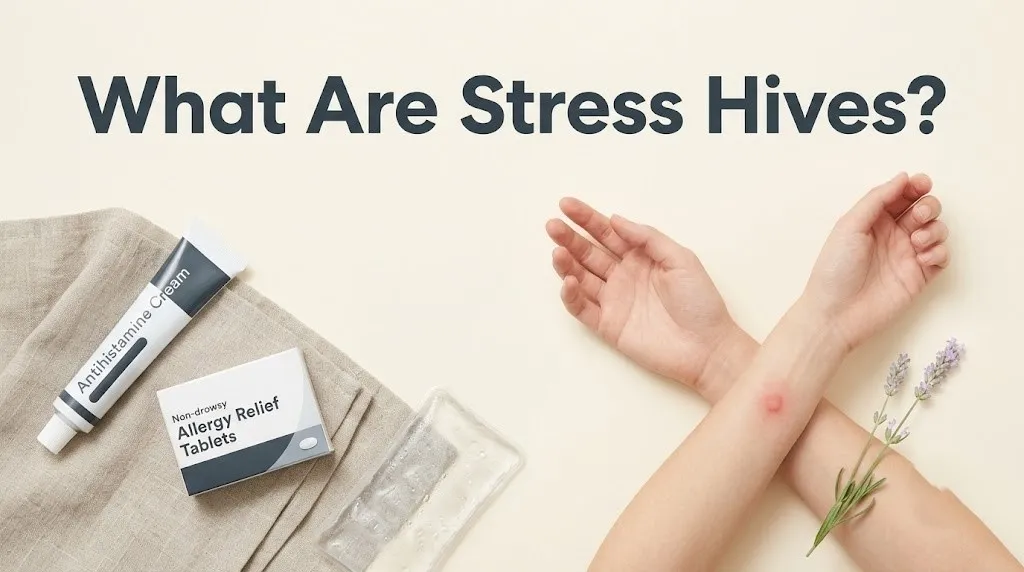
The surrounding redness, the flare, is caused by the dilation of the arterioles, also triggered by histamine. The itching is caused by histamine stimulating the sensory nerve endings in the skin. The entire process is a localized, chemically mediated inflammatory event.
A stress hive can appear anywhere on the body, but it often favors the face, neck, chest, and arms. The welts can be small, like mosquito bites, or they can coalesce into large, irregularly shaped plaques. They are almost always intensely itchy.
Key Takeaway: A stress hive is a physical, histamine-driven welt on your skin that was triggered by your brain’s stress hormones docking onto your skin’s immune cells.
stress hives symptoms and appearance
The symptoms of stress hives are the sudden appearance of raised, pink or red welts on the skin that are intensely itchy, may burn or sting, and blanch when pressed. They can appear anywhere and often migrate, with individual welts fading within 24 hours while new ones appear elsewhere.
The classic appearance is a pale, raised center surrounded by a red flare. When you press on the welt, the center turns white. This is called blanching. The welts can be round, oval, or serpiginous. They can be tiny, like a pinhead, or as large as a dinner plate.
The itching is the most distressing symptom. It can be mild or so intense that it disrupts sleep. The itching is often worse at night, when the body’s natural cortisol levels are at their lowest. The low nighttime cortisol allows the mast cells to become more active.
A stress hive episode typically lasts for minutes to hours, and the entire episode can last for a few hours to a few days. If the hives persist for more than 6 weeks, the condition is diagnosed as chronic spontaneous urticaria, in which stress is a major exacerbating factor.
how does stress cause hives on skin
Stress causes hives on the skin through a direct neuro-immuno-cutaneous pathway. The brain perceives a stressor, the hypothalamus releases CRH , and this CRH travels through the bloodstream and is also released directly from the peripheral nerve endings in the skin.
The skin has its own local stress response system, often called the skin’s HPA axis equivalent. The mast cells in the dermis are positioned right next to the sensory nerve endings.
When CRH is released from the nerve endings, it binds to the CRH-R1 receptors on the mast cells. This binding triggers a signaling cascade inside the mast cell. The mast cell degranulates, releasing pre-formed granules packed with histamine, tryptase, and other inflammatory mediators.
Simultaneously, the sensory nerves release substance P, a neuropeptide that also stimulates mast cell degranulation. The result is a powerful, localized burst of inflammation. The stress signal has been directly translated into a skin lesion.
cortisol and mast cell activation in stress hives
Cortisol plays a paradoxical role in stress hives. In the short term, cortisol is anti-inflammatory and can suppress the mast cells. In chronic stress, the mast cells become resistant to cortisol’s suppressive effects, and they become hyper-reactive to CRH.
Cortisol normally binds to the glucocorticoid receptor on the mast cell and inhibits the release of histamine. This is why the body’s own cortisol surge in the morning suppresses nighttime hives.
However, in a state of chronic stress, the constant exposure to cortisol downregulates the glucocorticoid receptors. The mast cells lose their sensitivity to cortisol’s calming signal. The brake fails.
The mast cells are now primed. A subsequent acute stressor releases a burst of CRH, and the primed mast cells respond with an exaggerated histamine release. The hives are more severe and more prolonged.
stress hives vs allergic reaction rash
A stress hive is triggered by an internal emotional event, while an allergic hive is triggered by an external allergen, such as a food, a medication, or an insect sting. The appearance of the welts is identical. The history and the timing are the key differentiators.
Allergic hives typically occur within minutes to an hour of exposure to the allergen. The patient ate a peanut, took an antibiotic, or was stung by a bee. The timing is clear.
Stress hives occur during or after a period of intense emotional stress. The patient had a panic attack, a heated argument, or a crushing work deadline. The timing is correlated with the emotional event, not with a food or a drug.
A stress hive episode may last for hours to days and may recur with each episode of stress. An allergic hive episode resolves when the allergen is cleared from the body. The key question for the clinician is the history of the preceding stressor.
| Feature | Stress Hives | Allergic Hives |
|---|---|---|
| Trigger | Emotional stressor | Allergen (food, drug, sting) |
| Appearance | Same: raised, red, itchy welts | Same: raised, red, itchy welts |
| Onset | During or after stressor | Minutes to hours after exposure |
| Duration | Hours to days | Resolves as allergen clears |
| Recurrence | With each stress episode | With each allergen exposure |
| Key History | “I broke out during a panic attack.” | “I broke out after eating shrimp.” |
stress hives on face and neck
Stress hives frequently appear on the face and neck because these areas have a high density of mast cells and a rich sensory nerve supply, making them exquisitely sensitive to the neuroendocrine stress response. The face is also a highly visible area, which can compound the psychological distress.
The cheeks, forehead, and around the mouth are common sites. The neck and the upper chest are also frequently involved. The welts can be small and discrete or large and confluent.
The appearance of hives on the face can be socially embarrassing. The patient feels self-conscious, which increases the stress, which worsens the hives. This is a classic vicious cycle.
Cold compresses are particularly effective for facial hives, as the cold constricts the blood vessels and reduces the swelling and the redness.
how long do stress hives last
Individual stress hives typically last for less than 24 hours, but new welts can continue to appear for several days as long as the stress response is active. A single welt will fade within a few hours, but the overall episode can persist.
An acute stress hive episode, triggered by a single, intense stressor, usually resolves within 24 to 72 hours. The stress passes, the CRH levels drop, and the mast cells calm down.
If the stress is chronic, the hives can become chronic. Chronic spontaneous urticaria is defined as hives that persist for more than 6 weeks. In this condition, the mast cells are chronically primed, and the hives wax and wane with the patient’s stress levels.
A single welt that persists in the exact same spot for more than 24 hours is not a hive. It is likely a bruise, a bite, or another skin lesion.
Key Takeaway: A single stress hive fades within hours. The whole episode can last a few days. If the hives are there for more than 6 weeks, it’s chronic urticaria.
the stress itch scratch cycle explained
The stress-itch-scratch cycle is a self-perpetuating feedback loop where stress causes the release of histamine, which causes itching, the scratching further traumatizes the skin and triggers more mast cell degranulation, and the resulting skin damage and discomfort increase the psychological stress.
The itch from a stress hive is a neurogenic itch. It originates from the direct stimulation of the sensory nerve endings by histamine and substance P. Scratching provides temporary relief by creating a counter-stimulus, a mild pain, that temporarily overrides the itch signal in the spinal cord.
But scratching also damages the skin cells. The damaged keratinocytes release more inflammatory mediators. The mast cells are mechanically stimulated by the scratching to release more histamine. The skin becomes even more inflamed and even itchier.
The patient scratches more. The skin becomes raw and excoriated. The appearance of the damaged skin causes more anxiety and stress. The cycle is closed. The treatment must interrupt this loop at multiple points: the stress, the histamine, and the scratching.
immediate treatment for stress hives
The immediate treatment for stress hives is a combination of an oral non-sedating antihistamine, a cold compress applied directly to the welts, and a rapid stress-reduction technique such as diaphragmatic breathing to turn off the CRH release.
The antihistamine blocks the histamine receptors on the blood vessels and the nerves, reducing the swelling and the itching. Second-generation antihistamines like cetirizine (Zyrtec), loratadine (Claritin), or fexofenadine (Allegra) are the first-line treatment.
The cold compress constricts the dilated blood vessels, reducing the leakage of fluid into the tissue. Apply a cold, wet cloth or an ice pack wrapped in a towel to the affected area for 10 to 15 minutes.
The diaphragmatic breathing stops the CRH release at the source. A slow, deep breath in through the nose for a count of four, a slow exhale through the mouth for a count of six. This activates the vagus nerve and reduces the sympathetic output. Do this for 5 minutes.
antihistamines for stress induced hives
Antihistamines are the primary pharmacological treatment for stress-induced hives. They work by competitively blocking the histamine H1 receptors on the endothelial cells and the sensory nerves, preventing histamine from causing the swelling and the itching.
Second-generation H1 antihistamines are preferred because they are non-sedating. Cetirizine has a rapid onset of action and is very effective for urticaria. Fexofenadine is the least sedating.
The antihistamine should be taken at the first sign of the hives. For recurrent stress hives, a daily prophylactic dose may be recommended by a physician. A 2022 study in the British Journal of Dermatology found that daily cetirizine significantly reduced the frequency and severity of stress-related urticaria flares.
If the over-the-counter antihistamine is not controlling the hives, a dermatologist or an allergist can prescribe a higher dose or a combination of antihistamines.
how to calm stress hives quickly
To calm stress hives quickly, apply a cold compress to the area, take an oral antihistamine, and practice a 5-minute session of slow, diaphragmatic breathing. The combination of the physical cold, the pharmacological blockade, and the neuroendocrine quieting is the most effective rapid-response protocol.
Topical anti-itch creams containing pramoxine or calamine can provide temporary relief. Topical antihistamines are generally not recommended for large areas.
A cool oatmeal bath can soothe widespread hives. The oatmeal contains avenanthramides, which have anti-inflammatory and anti-itch properties.
The key is to stop the scratching. Keeping the fingernails short and wearing gloves at night can prevent the mechanical damage from unconscious scratching.
stress management for chronic hives
Stress management for chronic hives is a medical necessity, not a wellness luxury. For patients with chronic spontaneous urticaria, stress is the primary driver of the mast cell hyper-reactivity. Managing the stress is managing the disease.
Cognitive behavioral therapy (CBT) is the gold standard. A 2023 randomized controlled trial published in the Journal of the American Academy of Dermatology found that patients with chronic urticaria who received an 8-week CBT program had a 50 percent reduction in their urticaria activity score compared to the control group.
Mindfulness-based stress reduction (MBSR) teaches the patient to observe the itch without reacting to it. The urge to scratch is a sensation that can be observed and allowed to pass.
Diaphragmatic breathing, practiced daily, increases vagal tone and reduces the sympathetic and HPA axis output that is driving the mast cell activation.
can anxiety cause hives without an allergen
Anxiety can cause hives without any external allergen. The hives are caused by the direct action of the brain’s stress hormones, CRH and substance P, on the skin mast cells. This is a purely neurogenic urticaria.
A patient with an anxiety disorder may develop hives during a panic attack. The panic attack is the trigger. There is no food, no drug, and no insect sting involved.
The hives are real. The histamine is real. The cause is the neurochemical storm of the panic attack. Treating the anxiety with therapy and medication is the definitive treatment for this type of urticaria.
preventing stress hives long term
Preventing stress hives long-term requires a consistent stress management practice that lowers the baseline allostatic load and reduces the reactivity of the skin mast cells. The goal is to raise the threshold for mast cell degranulation.
Daily aerobic exercise, 150 minutes per week, improves the body’s ability to metabolize cortisol and reduces systemic inflammation.
A consistent sleep schedule is essential. The mast cells are most active at night, and sleep deprivation increases the stress response.
A diet rich in omega-3 fatty acids and low in refined sugar reduces systemic inflammation. Some patients find that a low-histamine diet is helpful.
when to see a dermatologist for stress hives
See a dermatologist or an allergist for stress hives when the hives persist for more than 6 weeks, when they do not respond to over-the-counter antihistamines, or when they are accompanied by swelling of the lips, eyelids, or throat (angioedema).
Angioedema is a deeper swelling of the subcutaneous tissue. If it involves the throat, it can compromise the airway and is a medical emergency.
A dermatologist can perform a skin biopsy to confirm the diagnosis of urticaria and rule out other conditions like urticarial vasculitis.
The dermatologist can prescribe higher doses of antihistamines, a combination of antihistamines, or, for severe chronic urticaria, a biologic medication called omalizumab, which targets the IgE receptor on mast cells.
can stress hives be a sign of chronic urticaria
Stress hives that recur frequently over a period of more than 6 weeks are diagnosed as chronic spontaneous urticaria. Stress is the most common trigger for flares in this condition.
Chronic urticaria is an autoimmune or auto-inflammatory condition where the mast cells are intrinsically unstable. Stress pushes the unstable mast cells over the threshold to degranulate.
The treatment is a stepwise approach, starting with high-dose antihistamines and escalating to omalizumab if necessary. Stress management is an integral part of the management plan.
Key Takeaway: If your stress hives keep coming back for more than 6 weeks, you have chronic spontaneous urticaria. Stress management is part of your medical treatment plan.
Frequently Asked Questions About Stress Hives
Can stress really cause hives?
Yes, stress directly causes hives by releasing CRH from the brain and skin nerves, which binds to mast cells and triggers a histamine release.
This is a specific, receptor-level neuroendocrine mechanism, not a vague correlation.
The hives are chemically identical to an allergic hive, but the trigger is internal and emotional.
What do stress hives look like?
Stress hives look like raised, pink or red welts on the skin with a pale center and a red flare around the edge.
They are intensely itchy, can be small or large, and often appear on the face, neck, chest, and arms.
They blanch when pressed and individual welts fade within 24 hours.
How long does it take for stress hives to go away?
An individual stress hive typically fades within a few hours, but the overall episode can last 24 to 72 hours.
If the stress is chronic, the hives can recur daily or persist for weeks.
Hives lasting more than 6 weeks are diagnosed as chronic spontaneous urticaria.
Where do stress hives usually appear?
Stress hives can appear anywhere on the body, but they have a predilection for the face, neck, chest, and arms.
These areas have a high density of mast cells and a rich sensory nerve supply.
The face is particularly sensitive to the neuroendocrine stress response.
Can stress hives happen without an allergy?
Yes, stress hives occur in the complete absence of an external allergen.
The trigger is the brain’s own stress hormones, not a food, a drug, or an insect sting.
This is called neurogenic or stress-induced urticaria.
What is the best antihistamine for stress hives?
Non-sedating, second-generation H1 antihistamines like cetirizine (Zyrtec), loratadine (Claritin), or fexofenadine (Allegra) are the first-line treatment for stress hives.
Cetirizine has a rapid onset and is very effective for urticaria.
If over-the-counter antihistamines are not effective, a dermatologist can prescribe a higher dose or a combination of antihistamines.
The stress hives on your skin are not a mystery. They are the visible endpoint of a clearly mapped biological pathway that starts with a stressful thought and ends with a mast cell dumping histamine into your skin. Your brain and your skin speak a shared chemical language, and the hormone CRH is the word for “panic.” Your skin is not betraying you. It is physically manifesting the stress you are carrying.
The most effective response tonight is a cold washcloth, a Zyrtec from the medicine cabinet, and five minutes of slow, deep breathing on the couch. The cold stops the swelling, the antihistamine blocks the itch, and the breathing turns off the CRH tap at the source. Do not scratch. You know that scratching only makes the histamine release worse.
Your skin is a billboard for your nervous system. When the system is calm, the skin is clear. The work of managing the hives is the work of managing the stress. The breathing, the therapy, the sleep, and the medication if needed are the tools. You are not at war with your body. You are learning its language.