Can Trees Recover From Heat Stress? What to Do in 2026
Yes, many trees can recover from heat stress, but whether your specific tree will depends on the severity of cellular damage, the tree’s prior health history, and how quickly you act. Heat stress is not a single event with a predictable outcome: it is a cascade of physiological failures that unfolds at different rates depending on tree species, soil conditions, and the intensity and duration of the heat exposure.
The scale of the problem is accelerating. Research published in Urban Forestry and Urban Greening reports that urban trees are now experiencing thermal conditions 3 to 12 degrees Celsius above rural ambient air temperatures due to the urban heat island effect, and USDA Forest Service data show that heat and drought combined have become the leading cause of non-pest-related urban tree mortality in North America. Understanding what is actually happening inside a heat-stressed tree changes how you respond, and that response window matters.
This article covers the plant physiology of heat stress from the cellular level through the root system, explains how to distinguish recoverable damage from permanent tissue loss, gives you specific actionable recovery strategies with the evidence behind each one, and tells you exactly when a tree needs a professional assessment rather than a garden hose.
Can Trees Recover From Heat Stress?
Trees can recover from heat stress when the damage is limited to reversible physiological responses rather than permanent cellular or vascular injury. Mild to moderate heat stress, characterized by temporary wilting, partial leaf scorch, and early leaf drop, is frequently reversible when the tree receives adequate water, a protected root zone, and time.
Recovery probability depends on several factors that are specific to each tree and its situation. A mature oak with an established root system that experienced one week of extreme heat is in a very different position from a two-year-old maple planted six weeks ago in compacted urban soil during a three-week heat wave. Both are under heat stress. Their recovery trajectories are not comparable.
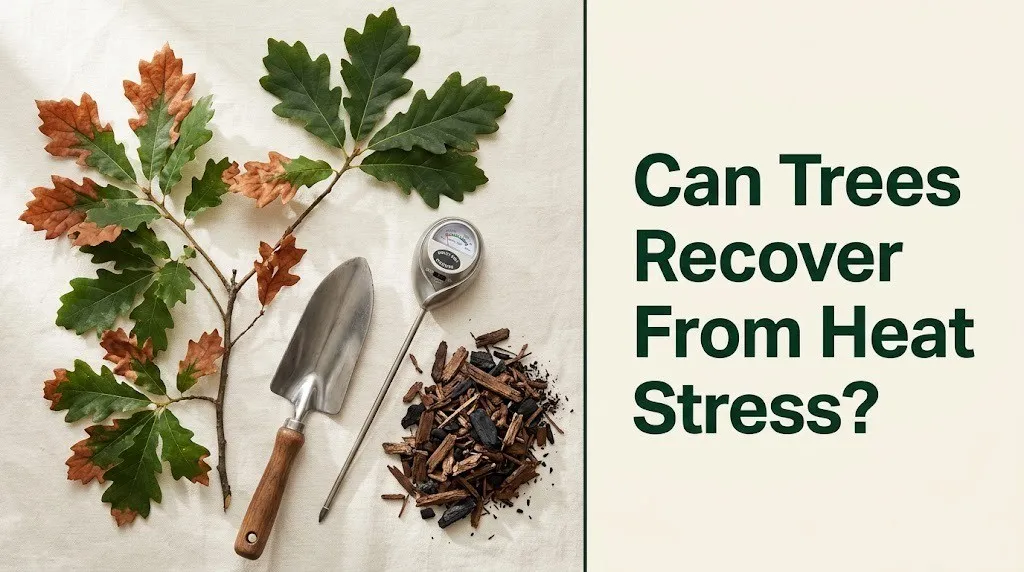
According to the International Society of Arboriculture, trees that retain more than 50 percent of their functional canopy after a heat event and show no evidence of cambium death (the thin green layer just beneath the bark) have a reasonable prognosis for recovery over one to three growing seasons. Trees that have lost more than 60 percent of their canopy or show brown, dry cambium tissue when bark is gently scratched have suffered damage that often proves fatal regardless of aftercare.
| Damage Category | Observable Signs | Recovery Likelihood |
|---|---|---|
| Mild heat stress | Wilting, temporary droop, minor scorch at leaf margins | High with prompt watering |
| Moderate heat stress | Partial leaf scorch, early leaf drop, reduced vigor | Moderate with sustained care over one season |
| Severe heat stress | Canopy dieback over 40% of crown, bark cracking, full leaf loss | Low to poor; arborist assessment needed |
| Irreversible damage | Dead cambium, structural cracks, root zone collapse | Removal often necessary |
The honest answer is that the tree in front of you right now is recoverable, marginal, or past saving. That distinction requires you to understand what heat actually does to a tree internally, not just what it looks like on the outside.
How Heat Stress Damages Trees at the Cellular Level
Heat stress damages trees through four simultaneous physiological processes: xylem cavitation, reactive oxygen species accumulation, chloroplast denaturation, and heat shock protein induction. These are not metaphors. They are measurable events happening inside the tree’s cells and vessels.
Xylem cavitation is the most immediately dangerous. Xylem vessels are the tubes that carry water from roots to leaves. Under extreme heat, transpiration (water vapor leaving the leaves) accelerates dramatically. When transpiration outpaces root water uptake, tension in the water column increases until air bubbles form inside the xylem. Those bubbles, called emboli, interrupt the water column and block transport. Research published in Tree Physiology describes this hydraulic failure as the primary cause of rapid shoot dieback and leaf death in heat-stressed trees.
Reactive oxygen species (ROS) including superoxide radical, hydrogen peroxide, and hydroxyl radical accumulate in chloroplasts and mitochondria when the photosynthetic system becomes overloaded by heat. These molecules are chemically aggressive and damage cell membranes, proteins, and DNA. Trees have antioxidant defense enzymes including superoxide dismutase and catalase to scavenge ROS, but those enzymes are themselves heat-sensitive. At leaf temperatures above 40 degrees Celsius, their protective capacity declines.
Chloroplast denaturation occurs when the proteins of the photosynthetic apparatus, particularly Rubisco and the thylakoid membrane complexes, lose their three-dimensional structure under thermal load. Once denatured, these proteins cannot carry out photosynthesis. The Calvin cycle stalls. Carbon fixation stops. The tree cannot produce the carbohydrates it needs for growth or repair.
Simultaneously, heat shock proteins (HSPs), particularly HSP70 and HSP90 in plant cells, are rapidly synthesized to act as molecular chaperones: they stabilize partially unfolded proteins and prevent aggregation. HSP induction is actually evidence that the tree’s protective systems are still active, which is a positive prognostic sign if the heat event ends before resources are exhausted.
Young trees with lower root-to-shoot ratios and trees with pre-existing root damage have less reserve capacity to sustain these protective responses.
Signs and Symptoms of Heat Stress in Trees
The visible signs of heat stress in trees follow from the cellular mechanisms described above, and recognizing what each symptom indicates helps you assess the severity of the situation.
Early symptoms appear first at the leaf margins, because leaf edges have the least efficient water supply from the xylem. Mid-season wilting that recovers overnight is an early warning sign of water stress rather than confirmed heat damage. Wilting that persists into the morning or does not recover after watering suggests xylem cavitation has already occurred in some branches.
Leaf symptoms range from reversible to permanent:
- Leaf margin scorch: Brown, crispy edges on otherwise green leaves. Caused by localized water deficit at the leaf periphery. Often reversible if the tree receives consistent water before full leaf death occurs.
- Interveinal chlorosis: Yellowing between leaf veins with green veins remaining. Indicates disrupted nutrient and water transport.
- Premature leaf drop: The tree shedding leaves in midsummer. This is an adaptive response: by reducing its leaf area, the tree reduces transpiration demand and protects the root and stem system. It looks alarming but is often a survival strategy.
- Canopy dieback: Branches dying from the tips inward. Indicates hydraulic failure in those branch sections. Unlike leaf scorch, dieback represents structural loss that does not reverse.
- Bark cracking and sunscald: Particularly on the southwest-facing side of thin-barked species like beech, maple, and birch. Direct radiant heat from the sun heats bark to temperatures far above ambient air, killing cambium tissue underneath.
- Needle browning in conifers: Browning from the tips downward in pines, spruces, and firs. Can indicate both heat stress and the early stages of pest activity that follows stressed conifers.
Conifers often show delayed symptoms. Brown needles may not appear until weeks or even the following spring after a severe summer heat event, because conifer tissue takes longer to express vascular failure visibly.
Leaf Scorch vs. Permanent Tree Damage: How to Tell the Difference
Leaf scorch is a surface symptom; permanent damage is a structural event, and distinguishing between the two determines whether your tree needs care or removal planning. The key diagnostic is the scratch test.
Scratch a small area of bark on an affected branch with a fingernail or the edge of a coin. If the tissue immediately beneath the bark is bright green or cream-white and moist, the cambium is alive and the branch retains vascular function. If the tissue is brown, dry, or stringy, the cambium is dead in that section.
Research published in Arboriculture and Urban Forestry notes that cambium viability testing, combined with visual canopy assessment, is the most accessible and reliable field indicator of a tree’s recovery potential available to homeowners and generalist property managers.
| Test | Positive Result | Negative Result |
|---|---|---|
| Scratch test on branch | Green, moist tissue beneath bark | Brown, dry tissue beneath bark |
| Overnight wilt recovery | Wilting improves by morning | No recovery after 24 hours |
| New growth emergence | New buds or shoots appear within 4 to 6 weeks | No budding after sustained watering |
| Root zone probe | Soil moist at 8 to 12 inch depth | Bone-dry or hydrophobic soil at depth |
Leaf scorch alone, without cambium death and without canopy dieback exceeding 30 percent, is generally a recoverable condition. A tree that has lost its leaves but retains green cambium throughout its branch structure can re-leaf in the same season or return vigorously the following spring. A tree with dead cambium in its primary scaffold branches cannot regenerate those structural limbs regardless of watering.
Species-specific note: Sugar maples (Acer saccharinum) and American beeches (Fagus grandifolia) are particularly prone to severe leaf scorch and premature defoliation under heat stress but have demonstrated strong recovery when their root zones are intact and well-maintained.
Key Takeaway: The scratch test is the single most useful tool a non-professional has for assessing tree recovery potential: green moist cambium under the bark means the tree is alive and worth sustained care; brown dry cambium means structural loss has occurred in that section.
How Long Does Tree Heat Stress Recovery Take?
Recovery from heat stress in trees takes anywhere from several weeks to three full growing seasons, depending on the severity of the initial damage and the quality of aftercare. There is no single timeline that applies across species, tree ages, and damage levels.
Mild heat stress with temporary wilting and minor leaf scorch typically resolves within two to four weeks of consistent, deep watering. The tree will often push new growth if the heat event occurs before mid-July in most temperate climates, because sufficient growing season remains for secondary bud break.
Moderate heat stress with partial canopy loss generally requires one full growing season for visible recovery and a second season to return to pre-stress canopy density. The University of California Cooperative Extension notes that trees recovering from significant leaf loss prioritize root and vascular repair over shoot growth, which means the canopy may appear sparse for a full year before recovery becomes visible in the crown.
Severe heat stress with substantial canopy dieback and confirmed cambium loss in primary branches does not follow a predictable recovery timeline because the tree is, structurally speaking, a different tree after that loss. Secondary branches may fill in over two to three seasons, but the original canopy architecture is not restored.
| Damage Level | Initial Signs | Realistic Recovery Timeline |
|---|---|---|
| Mild (leaf scorch, wilting) | 2 to 4 weeks with watering | One season |
| Moderate (30% canopy loss) | 4 to 12 weeks with sustained care | One to two growing seasons |
| Severe (over 40% canopy dieback) | Variable | Two to three seasons if recovery occurs |
| Irreversible (cambium death in scaffold branches) | No measurable recovery | Tree decline and removal likely |
Setting realistic expectations matters for the care decisions you make. A homeowner who expects visible recovery within two weeks may abandon a watering program too early. Sustained, appropriate aftercare through the remainder of one full growing season and into the next is the minimum commitment for trees with moderate damage.
Acute vs. Chronic Heat Stress in Trees
Acute heat stress refers to damage caused by a single short-duration extreme heat event. Chronic heat stress refers to cumulative damage that builds over multiple seasons of above-average temperatures, intermittent drought, and consistently elevated nighttime temperatures that prevent cellular repair.
The distinction matters enormously for prognosis. A tree that experiences one severe heat wave in an otherwise well-watered season has a substantially better recovery outlook than a tree entering its fourth consecutive summer of heat stress and soil water deficit. The second tree has progressively depleted its non-structural carbohydrate reserves: the stored sugars and starches trees use to fund wound repair, root growth, and immune defense against pests and pathogens.
Research published in Plant Cell and Environment documents that chronic heat and drought stress deplete non-structural carbohydrate (NSC) reserves in a measurable, progressive pattern. Trees with severely depleted NSC reserves cannot sustain the metabolic cost of heat shock protein production or antioxidant enzyme synthesis. They become physiologically exhausted in a way that no single watering event can reverse.
The practical implication: a tree that looked fine last summer but is showing severe symptoms after what seems like a moderate heat event this summer may have been accumulating silent physiological debt for years. Its apparent collapse is not sudden. It is the visible result of cumulative damage crossing a threshold.
Chronic heat stress also disrupts the phenological timing of trees: the seasonal sequence of bud break, flowering, leaf expansion, and dormancy entry. Trees under chronic heat stress often show disrupted autumn coloration, premature dormancy entry, or confused spring bud break. These phenological signals are diagnostically useful indicators of chronic rather than acute stress.
Older trees in urban settings with restricted root zones are disproportionately affected by chronic heat stress because their ability to extend roots into cooler, moister soil is physically limited by pavement, utilities, and compaction.
Key Takeaway: A tree showing severe symptoms after a moderate heat event is likely carrying years of accumulated physiological debt from chronic stress, not responding disproportionately to a single event: that context changes both prognosis and the long-term care commitment needed.
Heat Stress in Newly Planted and Young Trees
Newly planted and young trees are significantly more vulnerable to heat stress than established trees, and the physiological reasons for this vulnerability are specific and important to understand. A tree that was installed within the last one to three years has not yet established a root system that extends beyond its original root ball.
The root-to-shoot ratio of a newly planted tree is severely imbalanced. The canopy (the shoot system) is making transpiration demands that a limited, recently disturbed root system cannot meet even under normal summer conditions. Add extreme heat and a vapor pressure deficit that accelerates water loss through the leaves, and the mismatch between supply and demand becomes acute very quickly.
According to the International Society of Arboriculture’s planting and establishment standards, newly planted trees typically require three to five years to fully establish their root systems in the surrounding soil. During that establishment period, supplemental irrigation is not optional: it is the primary determinant of whether the tree survives.
Newly planted trees also lack the mycorrhizal fungal networks that established trees develop over time. Mycorrhizal fungi extend a tree’s effective root surface area by an order of magnitude and dramatically improve water and phosphorus uptake. Inoculating planting soil with appropriate mycorrhizal species at installation time is supported by evidence from controlled nursery research as a meaningful intervention for improving establishment under heat stress conditions.
Quick Tip:
- Water newly planted trees at the root ball directly, not at the trunk, three to four times per week in temperatures above 32 degrees Celsius
- Inspect soil moisture at 6-inch depth before each watering by pushing a screwdriver into the soil: if it goes in easily and comes out moist, defer watering
- Young trees under two inches in caliper benefit from temporary shade cloth on the south and west sides during heat events above 38 degrees Celsius; remove shade cloth after the heat event ends to avoid creating humidity problems
Urban Tree Heat Stress and Compacted Soil
Urban trees face heat stress conditions that are categorically more severe than trees growing in natural or suburban settings, and soil compaction is the underlying reason why urban heat stress so frequently proves fatal rather than survivable.
Compacted soil presents two compounding problems. First, it physically restricts root expansion: tree roots require oxygen to function, and compacted soil has greatly reduced pore space, limiting the oxygen available to roots and the volume of soil the tree can access for water. Second, compacted soil in urban settings is often covered by impervious surfaces (pavement, asphalt, compacted gravel) that both heat the soil dramatically and prevent rainfall infiltration.
Research published in Urban Forestry and Urban Greening found that soil temperatures beneath pavement in urban settings can exceed 50 degrees Celsius at the surface and remain above 35 degrees Celsius at the 15-centimeter depth during heat events: temperatures that cause direct root mortality in most temperate tree species. The same research found that urban trees with access to structural soil systems or suspended pavement technologies showed significantly lower heat mortality rates than trees in standard compacted tree pits.
The urban heat island effect adds a further layer. USDA Forest Service research documents that urban ambient air temperatures 3 to 12 degrees Celsius above rural temperatures are now measured consistently in mid-sized to large American cities, meaning urban trees are experiencing thermal loads their root physiology was not selected to tolerate.
Practical interventions for urban trees with compacted soil:
- Aerate the root zone extending to the drip line using a compressed air tool (air spade) operated by a qualified arborist to fracture compaction without cutting roots
- Apply 3 to 4 inches of organic mulch across the entire root zone to insulate soil and moderate temperature swings
- Install a deep root watering system or use a tree gator bag to deliver water slowly at depth where roots are located
- Advocate with property managers or municipal authorities for structural soil installations when pavement replacement occurs near tree pits
Trees in street pits smaller than 30 square feet of open soil surface are operating at the physiological limit of what that species can sustain. No amount of surface watering compensates for chronic root zone restriction at that scale.
Drought and Heat Stress Combined in Trees
Drought and heat stress are physiologically distinct but almost always co-occur, and their combination is substantially more damaging than either stressor alone. Heat accelerates transpiration, drought removes the water supply needed to sustain it, and the intersection of the two drives hydraulic failure faster than either condition would alone.
Abscisic acid (ABA) is the plant hormone that coordinates the response to both stressors. Under combined heat and drought, ABA production increases dramatically in root and leaf tissue. ABA signals stomatal guard cells to close, reducing water loss through the leaves. This is protective in the short term. But closed stomata also prevent CO2 entry, stopping photosynthesis. A tree that has closed its stomata for days or weeks under a combined heat-drought event is simultaneously dehydrating, starving, and accumulating reactive oxygen species.
The USDA Forest Service has documented that the combination of heat and drought reduces tree growth, measured as annual ring width, more than either factor measured in isolation. In a study of western North American conifers, combined heat and drought in a single growing season produced growth reductions equivalent to what either stressor alone would require three consecutive seasons to produce.
Soil type interacts critically here. Sandy soils drain rapidly and dry out faster, creating drought stress even when rainfall occurs at normal intervals during heat events. Clay soils retain water longer but become hydrophobic when severely dried: water applied to a dried clay soil initially runs off rather than infiltrating, creating a paradox where irrigation appears to be occurring but root zone moisture is not increasing.
| Soil Type | Drought Risk Under Heat | Irrigation Response |
|---|---|---|
| Sandy loam | High: water drains rapidly | Responds well to deep, frequent watering |
| Clay | Moderate: holds water but can become hydrophobic | Water slowly; check infiltration before adding more |
| Compacted urban fill | Very high: poor infiltration and high surface temperature | Requires aeration before irrigation is effective |
| Amended loam with mulch | Low to moderate: best retention profile | Standard deep watering schedule |
Key Takeaway: When drought and heat occur together, the tree’s protective stomatal closure becomes a double-edged mechanism: it prevents immediate dehydration but shuts down photosynthesis and fuel production simultaneously, so combined stress events require faster intervention than heat or drought alone.
Deep Watering and Root Zone Care for Heat-Stressed Trees
Deep watering is the single most evidence-supported intervention for heat-stressed trees, and how you water matters as much as how much you apply. Surface watering that wets only the top two to three inches of soil encourages shallow root growth and provides no relief to the feeder roots that are doing the actual work of water uptake.
Feeder roots, the fine hair-like roots responsible for water and nutrient absorption, are concentrated in the top 18 to 24 inches of soil but extend laterally to the drip line of the tree (the outer edge of the canopy) and often well beyond. Water delivered at the trunk base does not reliably reach these feeder roots. Water needs to be applied throughout the root zone.
To deep water a heat-stressed tree effectively:
- Calculate the watering radius: measure from the trunk to the drip line. Water delivery should cover that full area, not just the trunk zone.
- Set a soaker hose or drip system to deliver water at a rate the soil can absorb without runoff. For most loam and clay soils, one to two gallons per inch of trunk diameter per watering session is a reasonable starting point used by many Cooperative Extension programs.
- Water for 30 to 45 minutes at low flow, then probe soil moisture at 10 to 12 inches depth with a long screwdriver or soil probe. The goal is to wet the soil to that depth.
- Allow soil to partially dry between waterings. Consistently waterlogged soil starves roots of oxygen and creates conditions for root rot pathogens. The interval between waterings depends on soil type and temperature: every two to three days during extreme heat for established trees, every one to two days for newly planted trees.
- Water in the early morning when possible. Evening watering in humid climates can promote fungal disease on bark and foliage.
- Check water delivery effectiveness monthly by digging a small test hole six inches deep at the drip line. Consistent moisture at that depth confirms your watering is reaching the root zone.
People with disabilities or physical limitations can achieve deep watering effectively using tree gator bags (slow-release bags that clip around the trunk and deliver 15 to 25 gallons over 5 to 9 hours), which require only periodic refilling rather than managing a hose.
Mulching Trees for Heat Stress Recovery
Mulching is the most cost-effective and evidence-supported passive intervention for tree heat stress, and the International Society of Arboriculture identifies it as a foundational practice in heat and drought stress management for both newly planted and established trees.
Organic mulch reduces soil temperature by insulating the root zone from radiant heat from the sun. Research cited by the University of Minnesota Extension found that a 3-inch layer of wood chip mulch reduced soil temperature at 4-inch depth by up to 10 degrees Fahrenheit compared to bare soil under identical ambient conditions. That temperature reduction directly protects feeder roots from heat-induced mortality.
Mulch also conserves soil moisture by reducing evaporation from the soil surface, which meaningfully extends the interval between necessary waterings. A properly mulched root zone retains measurably more soil moisture for longer during a heat event than bare or turf-covered soil.
How to mulch a heat-stressed tree correctly:
- Use coarse wood chips (arborist chips, not dyed bark nuggets). Research from Washington State University Cooperative Extension found that arborist wood chip mulch outperforms commercially processed bark mulch for temperature moderation and moisture retention.
- Apply mulch to a depth of 3 to 4 inches. Shallower mulch provides inadequate insulation. Deeper than 4 to 5 inches can restrict gas exchange and create anaerobic conditions at the root zone.
- Extend mulch to the drip line, or as far as practical. Most homeowners mulch only a small ring around the trunk: this is largely ineffective because feeder roots are located at and beyond the drip line, not at the trunk base.
- Keep mulch pulled back 3 to 4 inches from the trunk flare. Mulch piled against the trunk (called a “mulch volcano”) creates chronic moisture retention against the bark, promoting fungal disease, cambium rot, and bark beetle entry.
- Replenish mulch annually in early spring before heat season begins, not in response to heat damage after it has occurred.
Freshly chipped green wood chip mulch applied immediately after a heat event is acceptable. The nitrogen drawdown associated with green wood chip mulch decomposition occurs primarily at the soil surface and does not measurably affect established tree roots at depth.
Pruning and Fertilizing Heat-Stressed Trees
Pruning and fertilizing heat-stressed trees are areas where well-intentioned interventions frequently make matters significantly worse, and the plant physiology of why is not intuitive.
Pruning generates wounds that require the tree to allocate carbohydrate reserves to form callus tissue and seal the wound against pest and pathogen entry. A tree that is already depleted of non-structural carbohydrate reserves due to heat stress cannot fund that wound response adequately. Pruning a severely heat-stressed tree imposes a metabolic demand the tree is not equipped to meet.
The ISA’s pruning standards are clear: avoid pruning a stressed tree except to remove branches that pose an immediate safety risk (those that are dead, structurally compromised, or at risk of falling on people or structures). Cosmetic pruning, crown thinning, and any elective structural pruning should be deferred until the tree has recovered over at least one full growing season.
Fertilization during or immediately after a heat stress event carries similar risks. Nitrogen fertilization stimulates new shoot growth. New growth requires water, and a tree under water stress from heat cannot support vigorous new shoot growth without diverting water from established tissue. According to University of California Cooperative Extension guidance, fertilizing a stressed tree during or immediately after a heat event can accelerate decline rather than aid recovery.
What to do and avoid:
- Do remove confirmed dead branches by cutting back to live tissue, making a clean cut at the branch collar
- Do not apply granular or liquid fertilizer to the root zone of a heat-stressed tree from spring through late summer of the damage year
- Do consider a light application of balanced slow-release fertilizer in early fall of the recovery year, after temperatures moderate and the tree has shown signs of re-establishment
- Do not apply wound sealants or pruning paint to cut surfaces: ISA standards confirm these products do not improve wound closure and can trap moisture that promotes decay
Young trees under three years in the ground are most vulnerable to ill-timed pruning. An ISA-certified arborist should make the decision about whether and what to prune on any tree showing more than 20 percent canopy dieback.
Key Takeaway: Pruning and fertilizing a heat-stressed tree feels productive but is often harmful: both interventions demand resources from a tree that is already depleted, so defer all non-safety pruning and all fertilization until the tree has visibly stabilized over at least one growing season.
Anti-Transpirant Sprays for Trees in Extreme Heat
Anti-transpirant sprays are products applied to leaf surfaces to form a thin film that reduces water loss through the stomata, and they occupy a genuinely contested space in arboricultural evidence. They work under specific conditions and provide no benefit or can cause harm when misapplied.
The mechanism is physical rather than biochemical: products containing pinolene (a pine resin derivative) or kaolin clay form a flexible polymer film over leaf surfaces that partially occludes stomatal openings. This reduces transpirational water loss by 20 to 40 percent under controlled conditions, according to trials conducted at several university extension programs.
The limitation is significant. Stomata serve two functions: water regulation and gas exchange. Partially occluding stomata also partially reduces CO2 uptake, which means photosynthesis declines. In a tree that is already under heat and drought stress with compromised carbohydrate reserves, reducing photosynthetic capacity further is not necessarily beneficial.
Evidence from the Cooperative Extension system suggests anti-transpirant sprays are most appropriately used in two specific contexts:
- Newly transplanted trees in the first season after installation, where the root-to-shoot imbalance makes transpiration demand genuinely dangerous before root establishment
- As a pre-treatment before a forecast extreme heat event, applied before heat stress begins rather than after symptoms appear
Anti-transpirant sprays applied to already scorched or wilted leaves provide no meaningful benefit. The leaves are already damaged. The protective value is preventive, not restorative.
Application note: Follow manufacturer dilution rates precisely. Over-concentrated application creates a film that does not allow the leaf to flex normally, which can cause additional physical leaf damage. Spray in the early morning or evening, not in direct midday sun, to prevent phytotoxicity from the spray carrier drying too rapidly on hot leaf surfaces.
Homeowners with trees in containers or with very restricted root zones, such as trees in small planting pits surrounded by pavement, may find the most consistent benefit from these products used as a pre-heat-event preventive measure.
When a Heat-Stressed Tree Cannot Be Saved
Some heat-stressed trees cannot be saved, and recognizing that reality early allows you to make a sound decision about removal timing, replacement planning, and safety management rather than investing months of care in a tree that is in irreversible decline.
The following are evidence-informed indicators that a tree’s prognosis is poor and that professional assessment for possible removal is warranted:
- Canopy dieback exceeding 50 percent of the total crown, with dead branches distributed throughout the crown rather than confined to one section
- Scratch test revealing dead cambium (brown, dry tissue) in multiple primary scaffold branches
- Bark splitting or sloughing over a significant portion of the trunk, particularly if the underlying wood is dry and discolored
- No evidence of new bud formation or shoot growth within six to eight weeks of sustained watering in mid-growing season
- Development of fruiting bodies (mushrooms or bracket fungi) at the trunk base, indicating active wood decay
- Presence of extensive bark beetle galleries or borer emergence holes, indicating secondary pest colonization that typically occurs after a tree’s defensive resin production has failed
- Significant structural lean that was not present before the heat event, or cracking in major crotch unions
When any of these signs are present, an ISA-certified arborist or a member of the American Society of Consulting Arborists should conduct a formal visual tree assessment (VTA). In cases where internal decay is suspected, resistograph drilling or electrical resistance tomography can assess the integrity of internal wood structure without requiring destructive sampling.
Removing a tree before it fails is not a defeat. It is the management decision that protects your property, your neighboring trees, and the people who occupy the space. A dead standing tree in decline becomes a safety hazard within one to three years. Planned removal is always less expensive and less dangerous than emergency removal after structural failure.
Species replacement planning: selecting a regionally appropriate, heat-adapted species for the replacement planting is the single best long-term investment after losing a tree to heat stress. An ISA-certified arborist or local university extension can guide species selection for your USDA Hardiness Zone and site conditions.
Protecting Trees From Future Heat Stress Events
Building heat resilience into your trees before extreme heat arrives is more effective than any recovery intervention applied after damage has occurred. The framework for heat resilience addresses the root zone, species selection, soil biology, and irrigation infrastructure.
The most consistently supported long-term intervention across arboricultural research is maintaining a deep, wide mulch ring year-round, extended to the drip line. This single practice insulates soil, retains moisture, moderates temperature, suppresses competing turf grasses, and provides a substrate for beneficial soil fungi. Research published in Arboriculture and Urban Forestry found that trees growing in mulched root zones showed measurably lower indicators of heat and drought stress compared to trees in maintained turf under identical conditions over a five-year observation period.
Species selection for future plantings should prioritize trees with documented heat and drought tolerance appropriate to your region. In the eastern United States, options with strong heat tolerance include bur oak (Quercus macrocarpa), chinkapin oak (Quercus muehlenbergii), Kentucky coffeetree (Gymnocladus dioicus), and swamp white oak (Quercus bicolor). In the southwestern and south-central regions, desert willow (Chilopsis linearis), Texas mountain laurel (Sophora secundiflora), and Texas live oak (Quercus fusiformis) offer regionally proven heat resilience. Consult your local university Cooperative Extension office for species lists calibrated to your specific USDA zone and soil conditions.
Soil biology deserves attention as a long-term investment. Research from plant science literature consistently shows that mycorrhizal fungal networks improve tree water and nutrient access significantly under heat and drought conditions. Avoiding herbicide application to the root zone, reducing tillage around trees, and maintaining organic mulch all support mycorrhizal community health.
Installing a drip irrigation or deep root watering system before heat season provides the ability to respond to extreme heat forecasts rapidly rather than scrambling with a garden hose after damage has already begun. Even a basic drip system on a programmable timer represents a meaningful investment in tree longevity relative to the cost and loss of replacing an established tree.
Frequently Asked Questions About Tree Heat Stress Recovery
Can a tree with all its leaves scorched actually survive?
A tree with fully scorched leaves can survive if the cambium tissue beneath the bark remains alive and the root system is intact and functional.
Many trees shed scorched leaves and re-leaf partially within the same season or return fully the following spring after adequate watering through the remainder of the growing season.
Conduct a scratch test on multiple branches: green, moist tissue beneath the bark is the most reliable field indicator that the tree has viable vascular function and recovery potential.
How do I know if my tree is dead from heat stress or just dormant?
A dormant tree retains green, moist cambium tissue when the bark is scratched and will show bud swelling in early spring.
A dead tree shows brown, dry, or papery cambium throughout its branch structure and no bud development when temperatures warm.
If you are uncertain after conducting scratch tests on multiple branches at different heights, an ISA-certified arborist can conduct a formal assessment and give you a specific prognosis.
How often should I water a heat-stressed tree?
Established trees in extreme heat typically need deep watering every two to three days, delivering water throughout the root zone to a depth of 10 to 12 inches.
Newly planted trees may need watering every one to two days at the root ball during temperatures above 35 degrees Celsius.
Use a soil probe or screwdriver pushed to 6-inch depth before each watering session: if it comes out moist, defer watering to avoid waterlogging the root zone.
Can newly planted trees survive extreme heat in their first summer?
Newly planted trees can survive extreme heat in their first summer with consistent, targeted deep watering at the root ball two to four times per week during heat events.
Their limited root systems cannot buffer water stress the way established trees can, making supplemental irrigation the primary factor in first-season survival.
Temporary shade cloth on the south and west sides of small trees during heat events above 38 degrees Celsius measurably reduces leaf surface temperature and transpiration demand.
Does mulching really help a tree recover from heat stress?
Yes, organic mulch applied 3 to 4 inches deep over the root zone measurably reduces soil temperature at root depth by up to 10 degrees Fahrenheit compared to bare soil, according to research cited by the University of Minnesota Extension.
Mulch also retains soil moisture significantly longer between waterings, reducing the physiological water deficit that drives xylem cavitation and leaf scorch.
Extend mulch to the drip line rather than just around the trunk, and keep it pulled back 3 to 4 inches from the trunk flare to prevent bark rot.
When should I call an arborist about a heat-stressed tree?
Call an ISA-certified arborist when canopy dieback exceeds 30 to 40 percent of the crown, when you observe bark sloughing, structural cracking, or significant lean that developed after a heat event, or when scratch tests reveal dead cambium in multiple primary branches.
You should also seek professional assessment if the tree is large enough to reach a structure, vehicle, or area where people gather if it were to fail.
A consulting arborist from the American Society of Consulting Arborists can provide a written risk assessment and specific recovery or removal recommendations based on a formal visual tree assessment.
What You Now Know and What to Do Next
Whether a tree recovers from heat stress comes down to three things: the severity of vascular and cellular damage, the quality and consistency of the care it receives in the weeks and months that follow, and the physiological reserves the tree had going into the event. That last factor, the prior health of the root zone and the soil biology supporting it, is the one most homeowners have the most influence over before a heat event happens.
Start with the scratch test today if you have a tree you are concerned about. Green cambium means the tree is alive and your job is sustained deep watering, a proper mulch ring to the drip line, and patience across at least one full growing season. Dead cambium in multiple scaffold branches means you need an ISA-certified arborist’s assessment before investing further care in a tree that may pose a safety risk as it declines.
The trees that survive extreme heat events in 2026 and beyond will be the ones with healthy, oxygenated root zones, species selection matched to regional climate reality, and owners who understand that recovery is a physiological process measured in growing seasons, not weeks.