How to Tape a Stress Fracture on Foot: 2026 Guide
To tape a stress fracture on the top of the foot, you must use a rigid, non-elastic zinc oxide tape applied in a specific “offloading” pattern that pulls the extensor tendons away from the injured metatarsal bone, thereby reducing the tensile force that pulls the fracture apart with every step. Taping is not a cure. It is a mechanical unloading technique that provides symptom relief and proprioceptive feedback for a low-grade stress reaction (Fredericson Grade 1 or 2) while the bone heals.
A 2023 clinical commentary in the American Journal of Sports Medicine emphasized that taping for a stress fracture should only be used as an adjunct to activity modification, not as a means to continue high-impact training. The tape does not bypass the biological reality that a fractured bone requires weeks of reduced loading to remodel. However, applied correctly, tape can make the necessary walking of daily life less painful and reduce the risk of the fracture progressing to a complete cortical break.
This guide will give you the specific, step-by-step protocol for taping a dorsal metatarsal stress fracture, explain the biomechanics of why it works, and clearly define the safety line where you must stop taping and see an orthopedic surgeon. We will also connect the tape on your foot to the cortisol in your blood, because managing psychological stress is a direct, physiological intervention for bone healing.
how to tape a stress fracture on top of foot
To tape a stress fracture on the top of the foot, start with a hypoallergenic underwrap to protect the skin, then apply rigid zinc oxide tape in a U-shaped loop that starts on the outside of the forefoot, pulls the skin and extensor tendons downward and inward across the top of the foot, and anchors on the inside of the foot. The goal is not compression. It is a directional pull that shifts the tension away from the painful metatarsal.
The most common site for a stress fracture on the top of the foot is the shaft of the second or third metatarsal. The dorsal cortex, the top surface of the bone, is under tension during push-off. The extensor tendons that lift your toes run directly over this area. When you tape, you are mechanically “unloading” these tendons, reducing their pull on the inflamed periosteum covering the fracture. The tape effectively substitutes for the overlying soft tissue in absorbing some of the tensile stress.
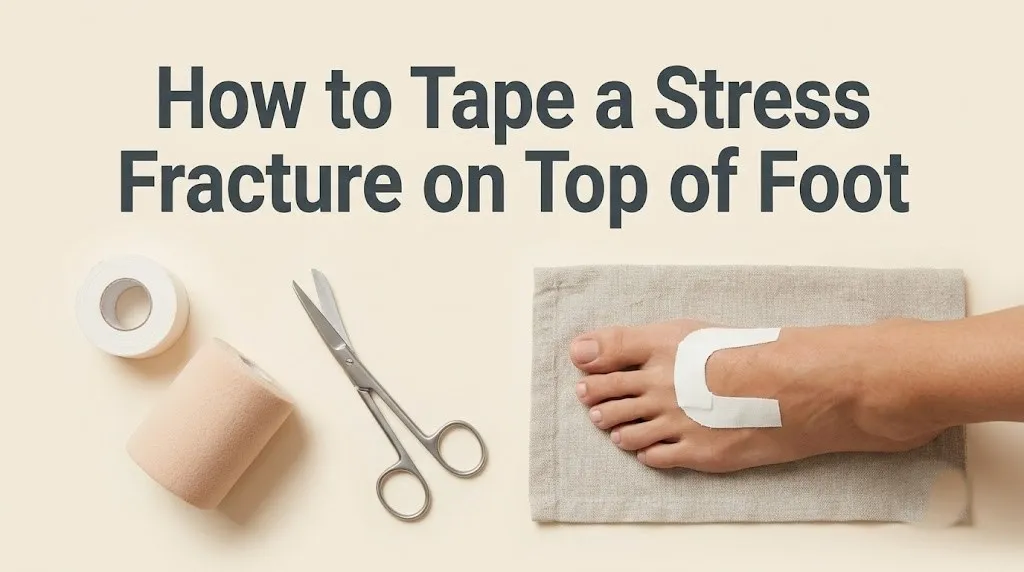
You need the right materials. Rigid zinc oxide tape, such as Leukotape or Zonas, is the standard. It does not stretch. Elastic kinesiology tape does not provide the mechanical offloading required for a bone injury. You need a roll of 1-inch or 1.5-inch tape. You also need a foam underwrap to protect the skin from the aggressive adhesive of the zinc oxide. Cutting the tape into strips of about 6 to 8 inches is sufficient.
The skin must be clean, dry, and free of oils or lotion. Do not shave the foot immediately before taping, as micro-abrasions increase the risk of skin tearing. Apply the underwrap from the midfoot to the forefoot, covering the dorsal and plantar surfaces. The taping is then applied directly to the underwrap. The technique is a modified low-dye arch support with a specific dorsal offloading strip.
Key Takeaway: Use rigid zinc oxide tape, not stretchy kinesiology tape. The goal is to pull the soft tissues away from the bone, not to compress the foot.
how to tape foot for stress fracture
To tape a foot for a stress fracture, you must follow a specific sequence: assess the fracture grade, prepare the skin, apply the underwrap, anchor the tape, and apply the offloading strips. The technique varies slightly for dorsal (top) and lateral (side) injuries, but the principle is the same: reduce tensile stress on the injured cortex.
The assessment is the first and most critical step. If you have not had an MRI, you do not know if you have a stress reaction or a true cortical fracture. The taping protocol described here is appropriate for a stress reaction (Grade 1-2) where the bone is bruised but not cracked through the cortex. If you have a Grade 3-4 fracture with a visible fracture line, taping is insufficient. You need a walking boot or a cast.
The anchor is the first strip of tape. It is applied around the midfoot, encircling the arch, to provide a base for the offloading strips. This anchor should be snug but not constricting. You should be able to slide a finger between the tape and your skin. If the toes turn white or blue, the tape is too tight and must be removed immediately.
The offloading strips are then applied. For a dorsal metatarsal fracture, the strips are applied in a U-shape, pulling the tissue from the outside of the foot, over the top, and anchoring on the inside. A second strip may be applied overlapping the first by 50 percent. The foot should be in a neutral, relaxed position during application. Do not point the toe or flex the foot, as this will overtighten the tape when you stand.
how to tape a stress fracture on side of foot
To tape a stress fracture on the side of the foot, typically a fifth metatarsal injury, the taping strategy shifts from a dorsal offload to a lateral compression and support, often using a figure-eight pattern that encircles the midfoot and anchors around the ankle. The goal is to limit the expansion of the forefoot during weight-bearing, which places a bending stress on the lateral metatarsals.
The fifth metatarsal is a high-risk site, particularly at the base where the Jones fracture occurs. This fracture has a notoriously poor blood supply and a high non-union rate. Taping a lateral foot stress fracture is intended for symptomatic relief during protected weight-bearing in a boot, or for a very low-grade stress reaction at the distal shaft.
The application begins with an underwrap and an anchor strip around the midfoot. The offloading strip is then applied, starting on the inside of the arch, running under the foot, pulling up firmly on the outside of the foot over the fifth metatarsal, and anchoring on the front of the ankle. This creates a sling that lifts and supports the lateral column of the foot.
A second strip can be applied in a figure-eight pattern, crossing over the dorsum of the foot and then under the arch. Buddy taping, where the fifth toe is taped to the fourth toe, can also provide a subtle reduction in the pull of the peroneus brevis tendon, which attaches to the base of the fifth metatarsal and is a deforming force on a Jones fracture.
how to wrap a stress fracture on top of foot
To wrap a stress fracture on the top of the foot, you can use an elastic cohesive bandage for mild compression and edema control, but this is distinct from the rigid offloading taping. A wrap provides a different, less targeted biomechanical effect. An elastic wrap reduces swelling and provides proprioceptive feedback, but it does not offload the extensor tendons with the same specificity as zinc oxide tape.
The wrap is applied starting at the toes and moving proximally toward the ankle, with a 50 percent overlap of each spiral. The tension should be light to moderate. The foot is a confined compartment. Wrapping too tightly can cause neurovascular compromise. The toes should be visible and pink.
A compression wrap is most useful in the acute phase of a stress reaction when there is palpable edema. The wrap can be worn during the day and removed at night. It can be combined with intermittent icing, 15 minutes on, 15 minutes off, to reduce the bone marrow edema.
The wrap should not be relied upon as the sole support for ambulation. A patient who feels they need to wrap their foot tightly just to walk is likely under-treating the injury. The sensation of instability or severe pain when the wrap is removed is a red flag for a higher-grade fracture.
when to tape vs boot a stress fracture
You should tape a stress fracture when you have a confirmed, low-grade (Fredericson Grade 1 or 2) stress reaction in a low-risk location (distal metatarsal shaft) and you are compliant with significant activity modification. You should use a walking boot when you have a higher-grade fracture (Grade 3 or 4), a fracture in a high-risk location (fifth metatarsal base, navicular), or when pain persists despite taping.
The boot is a pneumatic walking brace with a rigid rocker bottom. It offloads the foot far more effectively than any tape. The rigid sole eliminates the bending stress on the metatarsals during toe-off. The tape is an adjunct. The boot is a primary treatment.
A common mistake is to tape a fracture that needs a boot. The patient feels “better” with the tape, increases their activity, and the fracture progresses to a complete break or a non-union. The tape masked the pain, but it did not offload the bone sufficiently to allow healing.
A clinical decision rule is the hop test. If you can hop without pain with the tape on, the injury is stable enough for taped weight-bearing. If hopping produces sharp pain even with the tape, you need a boot. An orthopedist or a sports medicine physician should make this determination.
how does taping help a metatarsal stress fracture
Taping helps a metatarsal stress fracture by providing mechanical offloading of the overlying soft tissues, reducing the tensile strain on the dorsal cortex of the bone, and providing proprioceptive feedback that limits the magnitude of the push-off force during gait. It does not heal the bone. It creates a more favorable local mechanical environment for the body’s own osteoblastic healing to occur.
The extensor tendon mechanism is the key. The extensor digitorum longus and brevis tendons run directly over the metatarsal shafts. During the propulsive phase of gait, these tendons bowstring across the top of the foot, exerting a tensile force. If the underlying bone is cracked, this tendon pull separates the fracture edges. Taping redirects this force.
The proprioceptive effect is also important. The tape provides constant sensory input to the skin. This feedback allows the brain to unconsciously adjust the gait pattern, shortening the stride and reducing the push-off force. This is a central nervous system-mediated reduction in loading.
The tape also provides a mild compression that can reduce the localized edema in the periosteum. This reduces the pain. Reducing pain is not just a comfort measure. Reduced pain allows the patient to walk with a more normal gait pattern, which distributes forces more evenly across the foot.
Key Takeaway: The tape is a tendon-redirecting, gait-modifying device. It changes the local mechanical forces so the bone crack can close and heal.
step by step taping for dorsal foot stress fracture
To apply the step-by-step taping for a dorsal foot stress fracture, follow this specific sequence. The fracture is over the second or third metatarsal on the top of the foot.
Step 1: Prepare the skin. Clean the foot with soap and water. Dry thoroughly. Do not apply lotion. Apply a single layer of hypoallergenic foam underwrap from the base of the toes to the mid-arch. This protects the skin from the zinc oxide adhesive.
Step 2: Create the plantar arch support. Using 1.5-inch rigid zinc oxide tape, apply a strip from the outside of the foot, under the arch, to the inside of the foot. This lifts the arch and shortens the foot slightly, reducing the metatarsal load.
Step 3: Apply the dorsal offloading strip. Start the tape on the top of the foot, just behind the toes, on the outside edge. Pull the tape diagonally across the top of the foot, directly over the fracture site, and anchor it on the inside of the arch. The pull should be firm, shifting the skin and the underlying tendons inward.
Step 4: Apply a second, overlapping strip. Start the second strip just behind the first, overlapping by 50 percent, and pull across in the same direction. The goal is to create a continuous lateral-to-medial pull across the entire dorsal metatarsal region.
Step 5: Lock the strips. Apply a final anchor strip around the midfoot, directly over the offloading strips, to secure them in place. Check the capillary refill of the toes. They should be pink.
low dye taping technique for stress fractures
The low-dye taping technique is a classic athletic taping method that supports the plantar fascia and the arch, indirectly offloading the metatarsal heads and providing mechanical relief to a dorsal stress fracture. It is a foundational technique that can be modified with additional dorsal strips.
The traditional low-dye is applied as follows. An anchor strip is placed around the heel. A second anchor is placed around the forefoot, just behind the toes. Connecting strips are then applied from the heel anchor, under the arch, to the forefoot anchor, creating a supportive sling for the plantar fascia.
For a dorsal stress fracture, the low-dye base is applied first. This reduces the splay and the elongation of the foot during weight-bearing, which in turn reduces the tensile stress on the dorsal metatarsals. The specific dorsal offloading strips are then applied over the low-dye base.
This combination is more effective than either technique alone. The low-dye supports the foot from below, and the dorsal strips offload the tension from above. This technique is appropriate for a recreational athlete returning to walking.
kinesiology tape for foot stress fracture
Kinesiology tape is not the first-line tape for a foot stress fracture because it lacks the rigid, mechanical offloading capacity of zinc oxide tape. Kinesiology tape is designed to lift the skin and provide proprioceptive input, which is useful for reducing edema and for sensory feedback, but it cannot prevent the bony deformation of a metatarsal during push-off.
Kinesiology tape can be used as an adjunct. It can be applied directly to the skin, without underwrap, in a fan pattern over the dorsal foot to reduce superficial swelling. The tape’s elastic recoil gently lifts the skin, creating a negative pressure that facilitates lymphatic drainage.
For the specific mechanical offloading required by a stress fracture, kinesiology tape should not be used alone. A patient who uses only kinesiology tape and continues to run is at high risk of progressing the fracture. The appropriate use of kinesiology tape for this injury is as a secondary, edema-control layer, applied after the rigid zinc oxide taping is removed for the day.
buddy taping for metatarsal stress fractures
Buddy taping, where the toe proximal to the fractured metatarsal is taped to the adjacent toe, is a simple, effective adjunct for a distal metatarsal stress fracture. It provides a small but meaningful reduction in the muscular pull on the metatarsal head and increases the stability of the forefoot.
For a second metatarsal stress fracture, the second and third toes are taped together. A small piece of foam or cotton is placed between the toes to prevent maceration. A strip of 1-inch athletic tape is then wrapped around both toes, snugly but not tightly.
The mechanism is the reduction of the inter-metatarsal ligament strain and the partial immobilization of the flexor and extensor tendons. The toes move as a unit, which reduces the independent bending of the injured metatarsal. Buddy taping is never the sole treatment for a stress fracture, but it is a useful addition to the dorsal offloading taping protocol.
zinc oxide taping for stress fractures
Zinc oxide tape is the standard of care for the rigid taping of a stress fracture because it is non-elastic, has a powerful adhesive, and resists shear forces. It is the tape that provides the mechanical offloading. Leukotape, Zonas, and Jaylastic are common brands.
The tape is applied directly over the foam underwrap. The edges should be smoothed down to prevent rolling. The tape should never be applied directly to the skin of the dorsal foot, as the adhesive can cause blistering and tearing of the fragile skin.
Zinc oxide tape can be worn for 24 hours but should ideally be changed daily to check the skin integrity and to allow the foot to breathe. The tape should be removed if the foot becomes wet, as moisture trapped under the tape macerates the skin.
The tape’s rigidity decreases over time as body heat softens the adhesive. The offloading effect is strongest in the first few hours after application. For this reason, it is best to apply the tape in the morning before the day’s activities.
safety and risks of taping a foot stress fracture
The primary safety risk of taping a foot stress fracture is masking the pain of a high-grade fracture, which allows the patient to over-exert and progress the injury to a complete fracture or a non-union. Taping is a symptomatic adjunct, not a definitive treatment.
The specific risks include skin tearing from the aggressive adhesive of zinc oxide tape, allergic reactions to the adhesive or the underwrap, and neurovascular compromise if the tape is applied too tightly. The tape should be removed immediately if the toes become numb, tingle, or change color.
For diabetic patients, taping is relatively contraindicated. Peripheral neuropathy prevents the patient from feeling if the tape is too tight. Peripheral vascular disease means any skin breakdown from the tape can become a non-healing wound.
stress fracture taping recovery protocol
A stress fracture taping recovery protocol involves a multi-week, phased approach where the tape is worn daily during the initial 2 to 4 weeks of relative rest, combined with protected weight-bearing in a stiff-soled shoe, and then used as a weaning tool during the gradual return to activity.
Week 1 to 2: Pain-free rest. No running. Tape is worn daily for walking. A walking boot may be used if pain is present in the shoe.
Week 3 to 4: Taped walking. The pain should be resolved. The tape remains on. Cross-training, such as swimming or deep-water running, begins.
Week 5 to 6: Taped return to walking. The tape is removed for short periods. A walking program begins.
Week 7 to 8: Taped return to sport. The tape is worn for the first few weeks of running.
The protocol is guided by pain. If pain returns at any stage, the activity is scaled back.
how stress affects bone healing and taping
Psychological stress, through the elevation of cortisol, directly impairs the bone healing that the tape is trying to facilitate. Cortisol inhibits osteoblast activity, reducing the formation of new bone at the fracture site. A patient who is highly stressed is biochemically sabotaging their recovery.
Taping addresses the mechanical stress on the bone. Stress management addresses the biochemical stress. The two interventions are synergistic. A 2023 study in Psychoneuroendocrinology found that mindfulness-based stress reduction improved bone healing markers in patients with fractures.
The practical implication is that the recovery protocol for a stress fracture should include daily stress reduction. The 10 minutes spent applying the tape each morning can be a ritual of mindful breathing. The mechanical and the psychological are treated simultaneously.
when to see a doctor for a foot stress fracture
You should see an orthopedic surgeon or a sports medicine physician when you have focal, point tenderness on a metatarsal bone, a positive hop test, pain that persists for more than a few days of rest, or pain that wakes you from sleep. Do not self-tape an undiagnosed fracture.
The specific warning signs are a palpable lump on the top of the foot, severe swelling, and an inability to bear weight at all. These are signs of a complete or displaced fracture.
A delay in diagnosis can result in a non-union. A fifth metatarsal base fracture that goes to non-union is a surgical case.
can you walk on a taped stress fracture
You can walk on a taped, low-grade stress reaction if walking is pain-free with the tape. You should not walk on a taped, high-grade fracture. Pain is the guide.
The tape does not make a broken bone strong enough to walk on. It makes a bruised bone less painful during the necessary ambulation of daily life. If the tape eliminates the pain, the injury is likely stable enough for protected walking.
If the tape does not eliminate the pain, you need a boot.
Frequently Asked Questions About Taping a Foot Stress Fracture
Can you tape a stress fracture and keep running?
You should not tape a stress fracture and keep running because the repetitive impact forces will overwhelm the mechanical offloading capacity of the tape.
The bone needs a period of unloading to heal. Running on a taped stress fracture will likely progress the injury.
Taping is for symptom relief during daily walking, not for enabling continued high-impact activity.
Is it better to tape or boot a stress fracture?
A walking boot is better for high-grade, painful fractures because it provides rigid, complete offloading that tape cannot match.
Taping is appropriate for low-grade, pain-free stress reactions where only a mild mechanical offload is needed.
An orthopedic surgeon should make this determination based on the MRI grade.
How tight should I tape a stress fracture?
The tape should be snug enough to create a visible shift in the skin and soft tissues, but not so tight that it causes numbness, tingling, or color change in the toes.
You should be able to slide a finger between the tape and your foot.
Remove the tape immediately if you feel throbbing, coldness, or loss of sensation.
Can I use regular athletic tape for a stress fracture?
Regular white athletic tape is less rigid and has a weaker adhesive than zinc oxide tape, making it less effective for the mechanical offloading required.
Zinc oxide tape is the standard for this specific application.
Elastic kinesiology tape does not provide adequate offloading.
How long should I tape my stress fracture each day?
The tape can be worn for up to 24 hours, but it should be removed daily to inspect the skin and allow the foot to breathe.
The offloading effect is strongest in the first few hours after application.
Apply a fresh tape each morning.
Does taping a stress fracture speed up healing?
Taping does not directly speed up the biological healing of the bone, but it creates a mechanical environment that is more favorable for healing.
By reducing the tensile strain on the fracture, the tape allows the osteoblasts to bridge the crack.
Managing psychological stress and ensuring adequate nutrition are the direct biological accelerants.
The tape on your foot is a mechanical tool that redirects the forces pulling your bone apart. Applied correctly, it reduces the pain and helps create the stability your osteoblasts need to do their job. But the tape is only one half of the equation. The other half is the stress you carry in your mind, the deadline pressure, the sleepless nights, the cortisol flooding your bloodstream and telling your bone cells to stop building. You cannot tape that. You have to breathe it out, sleep it off, and let it go.
Your next step is to check the tape, check the pain, and check your stress. Apply the rigid zinc oxide tape using the offloading technique described. Walk around the house. If the pain is gone, you have bought yourself some symptomatic relief while the bone heals. If the pain persists, the injury is above the pay grade of tape, and you need to make the call to the sports medicine clinic.
Treat the foot with the respect it deserves. It carries the weight of your entire life. Give it the mechanical support of the tape and the biochemical support of a calm, restorative parasympathetic state. The bone will knit. The pain will fade. The lesson will remain.