Stress Relief Pressure Points: 2026 Evidence-Based Guide
Stress relief pressure points are specific locations on your body where mechanical pressure can shift your autonomic nervous system toward relaxation through direct stimulation of underlying nerve pathways. The most research-supported points lie along the median nerve, trigeminal nerve, and vagus nerve distributions where pressure triggers measurable reductions in heart rate and cortisol levels.
According to the National Center for Complementary and Integrative Health, acupressure research has grown substantially over the past decade, with multiple randomized controlled trials now demonstrating that self-administered acupressure reduces self-reported anxiety scores compared to sham controls. A 2023 systematic review published in the Journal of Alternative and Complementary Medicine analyzed 19 RCTs and found that acupressure produced moderate reductions in state anxiety, with Pericardium 6 and auricular points showing the most consistent effects.
This article gives you the honest evidence on which pressure points actually have research support, exactly where each point is located with anatomical landmarks, how to apply pressure correctly for stress relief, which points work fastest when you need immediate calming, and when acupressure is not enough and professional support is warranted. No vague wellness claims. Just the specific anatomy, evidence, and technique you need.
Stress Relief Pressure Points
Stress relief pressure points are anatomically defined locations on the body where underlying nerve structures come close to the skin surface, making them accessible to mechanical stimulation that produces measurable changes in autonomic nervous system activity. These points correspond to locations where peripheral nerves including the median nerve, trigeminal nerve branches, and auricular vagus nerve branch can be influenced by external pressure.
The concept originates from Traditional Chinese Medicine, where these points are understood as gateways along energy meridians. The Western physiological understanding is different but validates some of the same point locations. Modern research demonstrates that many classical acupressure points lie at neurovascular bundles where nerves, blood vessels, and connective tissue converge. Applying pressure to these locations stimulates mechanoreceptors that send signals through A-beta and C-fibers to the spinal cord and brainstem.
From the brainstem, these signals reach the periaqueductal gray, a midbrain region that coordinates descending pain inhibition and autonomic modulation. Activation of the periaqueductal gray triggers release of endogenous opioids including beta-endorphin and enkephalins, which reduce pain perception and promote a sense of calm. Simultaneously, signals reach the rostral ventromedial medulla, which modulates sympathetic outflow to the cardiovascular system and adrenal glands.
The practical result is that pressing specific points can lower heart rate, reduce salivary cortisol, and shift the autonomic balance from sympathetic fight-or-flight toward parasympathetic rest-and-digest within minutes. This is not energy work in a mystical sense. It is a somatovisceral reflex: mechanical input on the body surface producing measurable changes in internal organ function through identified neural pathways.
| Mechanism Component | Physiological Process | Stress Relief Effect |
|---|---|---|
| Mechanoreceptor activation | A-beta and C-fiber stimulation at point | Signal transmission to brainstem |
| Periaqueductal gray activation | Endogenous opioid release (beta-endorphin) | Calming sensation, reduced stress perception |
| Rostral ventromedial medulla modulation | Reduced sympathetic outflow | Lower heart rate, reduced cortisol |
| Auricular vagus nerve stimulation | Direct parasympathetic activation | Heart rate variability increase |
| Descending pain inhibition | Serotonin and norepinephrine pathway | Reduced muscle tension, physical calm |
What Are Acupressure Points for Stress
Acupressure points for stress are specific anatomical locations where sustained pressure has been shown in clinical research to reduce physiological markers of the stress response including heart rate, blood pressure, and salivary cortisol levels. These points are the same locations used in acupuncture but stimulated with finger or tool pressure rather than needles.
The point locations used for stress relief tend to cluster in three anatomical regions. The wrist and forearm points, particularly along the median nerve distribution, are among the most studied. The face and head points lie along trigeminal nerve branches that project to brainstem nuclei with direct connections to the limbic system. The ear points are unique because the external ear receives innervation from the auricular branch of the vagus nerve, providing a direct access point for parasympathetic stimulation.
Each point has a standard name and alphanumeric code from the World Health Organization’s acupuncture nomenclature system. Pericardium 6 is coded PC6. Yintang is classified as EX-HN3, an extraordinary point. Hegu is Large Intestine 4, coded LI4. Knowing these standard names helps you find reliable anatomical descriptions across different sources rather than relying on inconsistent lay terminology.
The points are not random. PC6 lies directly over the median nerve as it travels between the palmaris longus and flexor carpi radialis tendons at the wrist. Pressing here mechanically stimulates a major nerve trunk that carries sensory information from the hand to the spinal cord and brainstem. The location was identified empirically centuries ago and is now understood to correspond to a site where nerve stimulation produces robust autonomic effects measurable through heart rate variability testing.
How Does Acupressure Relieve Stress
Acupressure relieves stress through a somatovisceral reflex mechanism where mechanical pressure on specific skin and muscle locations triggers nerve signals that travel to brainstem autonomic control centers, shifting the balance from sympathetic fight-or-flight activation toward parasympathetic rest-and-digest dominance. This is a wired neurological pathway, not an energetic or metaphorical one.
When you press firmly on a point like Pericardium 6 at the wrist, you stimulate mechanoreceptors called Pacinian corpuscles and Merkel cells in the skin and underlying connective tissue. These receptors convert mechanical deformation into electrical signals that travel along large-diameter A-beta nerve fibers and smaller C-fibers. The signals enter the spinal cord and ascend through the spinothalamic and spinoreticular tracts to the brainstem.
In the brainstem, these signals reach the nucleus tractus solitarius and the periaqueductal gray. The periaqueductal gray integrates sensory input with autonomic output. When activated by acupressure input, it triggers the release of endogenous opioids, beta-endorphin and enkephalins, which produce analgesia and a calming effect. It also sends inhibitory signals to the rostral ventromedial medulla, which reduces sympathetic nervous system outflow to the heart, blood vessels, and adrenal glands.
Research published in Acupuncture in Medicine in 2022 used functional MRI to show that acupressure at PC6 produced measurable changes in limbic system activity, including reduced amygdala activation and increased connectivity between the prefrontal cortex and amygdala. This pattern is associated with improved emotional regulation and reduced stress reactivity. Heart rate variability measurements during the same study showed a shift toward parasympathetic dominance within five minutes of pressure application.
Key Takeaway: Acupressure works through actual nerves sending actual signals to actual brainstem nuclei that control your stress response. It is not energy magic. It is applied neurophysiology using the same somatovisceral pathways that make a massage relaxing.
Acupuncture Points for Stress Relief
Acupuncture points for stress relief are the same anatomical locations used in acupressure but traditionally stimulated with fine needles inserted by a trained practitioner. The point locations are identical whether stimulated by needle, finger pressure, electrical stimulation, or laser. The difference is the depth and precision of stimulation.
Acupuncture achieves deeper tissue penetration than acupressure can provide. A needle inserted at PC6 can reach the connective tissue planes surrounding the median nerve with precision that finger pressure cannot match. The needle manipulation technique called “de qi,” a characteristic aching or distending sensation reported by the patient, is associated with stronger activation of A-delta fibers and more robust autonomic responses than surface pressure alone.
For stress relief, professional acupuncture sessions typically combine multiple points selected based on the individual’s specific symptom pattern. A common stress protocol might include bilateral PC6 for autonomic regulation, Yintang for calming mental overactivity, bilateral LI4 for general analgesic and relaxing effects, and GV20 on the top of the head for mood elevation. The point combination is tailored rather than one-size-fits-all.
According to a 2023 meta-analysis in the Journal of Alternative and Complementary Medicine, acupuncture outperformed sham acupuncture for reducing anxiety in preoperative patients, with PC6 and Yintang appearing most frequently in effective protocols. Professional acupuncture may be worth considering if self-administered acupressure provides insufficient relief, particularly for people with diagnosed anxiety disorders where the deeper and more precise stimulation of needling may produce stronger effects than surface pressure.
Evidence for Pressure Points and Anxiety
The evidence for pressure points reducing anxiety is strongest for Pericardium 6 and auricular acupressure, where multiple randomized controlled trials have demonstrated statistically and clinically meaningful reductions in anxiety scores compared to sham controls. The evidence for other individual points is more preliminary but collectively supports acupressure as a moderate-effect stress reduction technique.
A 2022 systematic review and meta-analysis in the Journal of Alternative and Complementary Medicine analyzed 19 RCTs of self-administered acupressure for anxiety. The pooled results showed a moderate effect size for anxiety reduction compared to sham acupressure or no treatment controls. Pericardium 6 was the most studied single point, appearing in 14 of 19 trials, and showed the most consistent positive results. Auricular acupressure, particularly the Shen Men point, appeared in 8 trials with similarly positive results.
The quality issues are worth noting. Many trials are small, with sample sizes under 100 participants. Blinding is difficult because participants can feel whether pressure is being applied to a real point versus a sham location. Sham control design varies in quality: some studies press non-acupoint locations while others use minimal pressure at real points. These methodological challenges mean the effect may be somewhat smaller than published results suggest.
However, the consistency of findings across different research groups, populations, and countries supports a genuine effect beyond placebo. Salivary cortisol measurements in several studies add objective physiological data to the subjective anxiety reports. When acupressure reduces both how anxious people feel and their measurable stress hormone levels, the evidence is stronger than for techniques that only affect subjective reports.
| Pressure Point | Evidence Level | Number of RCTs | Primary Outcome |
|---|---|---|---|
| Pericardium 6 (PC6) | Moderate, multiple positive RCTs | 14+ showing anxiety reduction | State anxiety, salivary cortisol |
| Auricular Shen Men | Moderate, multiple positive RCTs | 8+ showing anxiety reduction | Preoperative anxiety, sleep quality |
| Yintang (EX-HN3) | Preliminary, few dedicated RCTs | 3 to 5, often combined with other points | Subjective calm, mental quieting |
| Hegu (LI4) | Preliminary for stress specifically | Limited as single point for anxiety | General relaxation, often combined |
| Tai Chong (LV3) | Traditional use, minimal RCT evidence | Very limited dedicated anxiety studies | Traditional stress indication |
Pericardium 6 Stress Relief Point
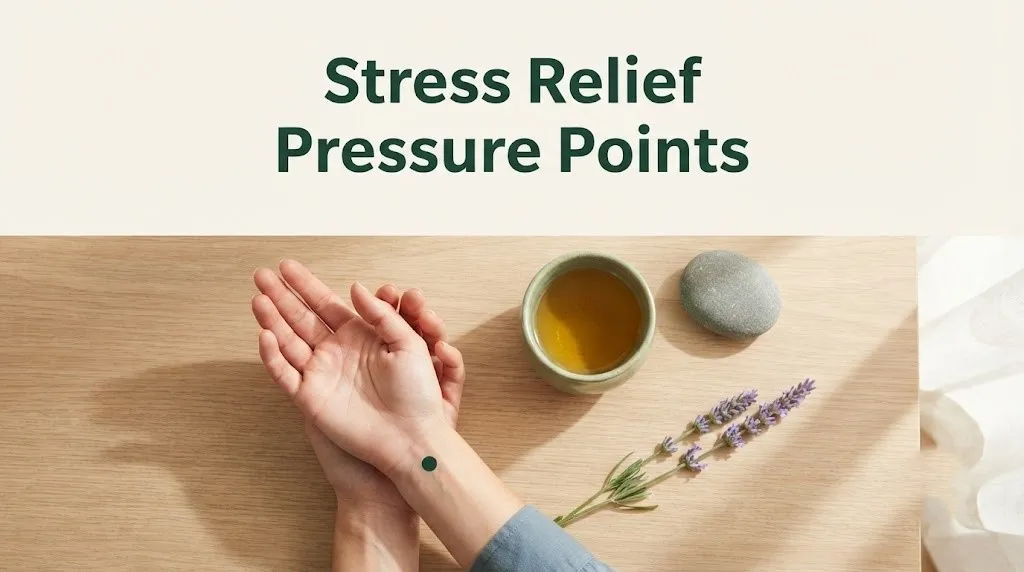
Pericardium 6 is the most research-supported single acupressure point for stress relief, located on the inner forearm approximately three finger-widths proximal to the wrist crease between the palmaris longus and flexor carpi radialis tendons. This point sits directly over the median nerve and produces measurable autonomic changes when stimulated.
To locate PC6, turn your palm facing upward. Find the midpoint of your wrist crease. Place your index, middle, and ring fingers together just above the crease. The point is at the proximal edge of your ring finger, centered between the two tendons you can feel running lengthwise along your forearm. You will know you are in the right location if you feel a mild ache or distending sensation under your thumb rather than just surface pressure.
The neuroanatomy explains why PC6 works. The median nerve passes directly beneath this point, traveling between the tendons as it enters the carpal tunnel. Pressure here stimulates median nerve mechanoreceptors that project to cervical spinal cord segments and then to the brainstem. The median nerve carries sensory information from a large hand territory, and its stimulation produces robust activation of the periaqueductal gray and nucleus tractus solitarius.
A 2022 study in Acupuncture in Medicine measured heart rate variability during PC6 acupressure and found that five minutes of sustained pressure produced a measurable shift toward parasympathetic dominance that persisted for at least 30 minutes after pressure was released. The technique: apply firm downward pressure with your opposite thumb until you feel a dull ache. Hold at that depth without moving for two to five minutes. Breathe slowly during the hold. Repeat on the other wrist.
Yintang Point for Stress and Overthinking
Yintang, located directly between the eyebrows in the indentation where the bridge of the nose meets the forehead, is the most effective point for quieting mental overthinking and racing thoughts during stress. This point sits over the supratrochlear nerve, a branch of the ophthalmic division of the trigeminal nerve that projects to brainstem nuclei with direct limbic system connections.
The location is anatomically precise. Place your fingertip at the glabella, the smooth area between your eyebrows just above the nose bridge. Press gently upward toward the forehead bone until you feel a subtle depression. Many people find this point is naturally tender during stress, and the tenderness often decreases as relaxation occurs. The sensation should be a dull pressure or mild ache, not sharp pain.
The trigeminal nerve connection matters for stress relief. The trigeminal nerve is the largest cranial nerve and has direct projections to the locus coeruleus, the brain’s primary source of norepinephrine, and to the amygdala, the threat detection center. Stimulating trigeminal branches at Yintang can modulate activity in these stress-responsive brain regions. Functional MRI research has shown that stimulation at Yintang reduces amygdala reactivity to negative emotional stimuli.
For overthinking relief, apply gentle but steady pressure to Yintang with your index or middle finger. Use circular motions for 30 seconds to one minute, then hold sustained pressure for one to two minutes. Combine this with slow breathing, inhaling through your nose and exhaling through your mouth. Many people report a noticeable quieting of mental chatter within two to three minutes. This point works well at bedtime when stress keeps your mind racing.
Key Takeaway: Yintang is your go-to point for a racing mind. The trigeminal nerve underneath connects directly to brain structures that drive mental overactivity. Two minutes of pressure here combined with slow breathing can quiet thoughts that refuse to settle down.
Ear Acupressure Points for Stress
Ear acupressure points for stress are located on the external ear, where the auricular branch of the vagus nerve provides direct access to parasympathetic activation pathways. The most effective stress relief point on the ear is Shen Men, located in the triangular fossa near the top of the ear, which has the strongest evidence for anxiety reduction among auricular points.
Shen Men translates to “Spirit Gate” and is the most frequently used auricular point for stress, anxiety, and insomnia. It is located in the triangular fossa, the small triangular depression near the top of the ear just above the concha. To find it, trace your finger from the top of your ear downward into the first depression you encounter. Apply firm pressure with your fingertip or the eraser end of a pencil.
The mechanism is unique among acupressure points because the external ear is the only location on the body surface where the vagus nerve sends a direct sensory branch. The auricular branch of the vagus nerve innervates the concha and parts of the external ear canal. Mechanical stimulation here activates vagal afferents that project directly to the nucleus tractus solitarius in the brainstem, the primary visceral sensory nucleus that regulates parasympathetic output to the heart, lungs, and digestive organs.
A 2023 randomized controlled trial published in Integrative Medicine Research found that auricular acupressure at Shen Men reduced preoperative anxiety scores by 38% compared to sham acupressure, with heart rate reductions averaging 8 beats per minute. For self-treatment, apply sustained pressure to Shen Men on both ears simultaneously for two to three minutes. You can also use small adhesive ear seeds, available from acupuncturists or online, to provide continuous low-level stimulation throughout the day.
Hand Pressure Points for Stress Relief
Hand pressure points for stress relief include Hegu (LI4), located in the web between thumb and index finger, which is one of the most accessible points for discreet self-treatment during stressful situations. This point lies over branches of the median and radial nerves and the deep palmar arch, providing rich neural and vascular stimulation.
To locate Hegu, spread your thumb and index finger apart. Feel the fleshy web where the two digits meet. The point is at the highest point of the muscle bulge when you bring your thumb and index finger together, approximately in the middle of the second metacarpal bone on the radial side. Press with the thumb of your opposite hand, applying firm downward pressure until you feel a dull ache that may radiate toward the fingers.
The neurovascular anatomy explains Hegu’s effectiveness for stress. The point overlies the convergence of sensory branches from the median nerve, radial nerve, and the deep palmar arterial arch. This dense neurovascular bundle sends strong signals to the spinal cord and brainstem when compressed. Hegu is also one of the most well-studied acupuncture points for general analgesia, with research showing it activates the periaqueductal gray and descending pain inhibition systems.
Hegu is particularly useful for stress that manifests with tension headaches or jaw clenching. The point has a traditional indication for head and face conditions, and its stimulation through median and radial nerve pathways may reduce muscle tension in the head and neck through segmental reflexes. Apply firm pressure for two to three minutes on each hand. This point is accessible enough to use during meetings, on public transportation, or anywhere you need discreet stress relief.
How to Massage Pressure Points for Stress
Massaging pressure points for stress relief requires specific technique beyond simply pressing on the general area. Effective acupressure uses firm, sustained pressure directed perpendicularly into the point, held at a depth that produces a characteristic dull ache or distending sensation without causing sharp pain.
To perform effective pressure point massage, follow this numbered sequence for each point you work with. The technique matters as much as the location for producing the neural stimulation that triggers the relaxation response.
To apply acupressure correctly:
- Locate the point precisely using anatomical landmarks rather than guessing based on general descriptions. Use your finger to palpate the area until you find the spot that feels slightly different: often a subtle depression, a slight tenderness, or a spot where the sensation changes when you press.
- Apply firm, steady pressure using your thumb, index finger, or a blunt tool like a pencil eraser. Direct the pressure perpendicularly into the body surface, not at an angle. Increase the pressure gradually over about 10 seconds until you reach a depth that produces a dull ache or distending sensation.
- Hold the pressure steady at this depth without moving or bouncing. Do not rub back and forth rapidly, which stimulates surface nerves differently and is less effective for acupressure. The hold should be sustained and still.
- Maintain the hold for one to five minutes depending on the point and your available time. Longer holds produce stronger autonomic effects. You will often notice the point’s tenderness decreasing during the hold as the tissues release and the nervous system responds.
- Release pressure slowly rather than abruptly. Take about 5 seconds to ease off the point. Move to the next point or repeat on the opposite side of the body for bilateral points.
Self Acupressure for Stress Relief
Self acupressure for stress relief is a practical, zero-cost technique you can perform anywhere without equipment, making it one of the most accessible evidence-based stress management tools available. A complete self-treatment session takes 5 to 15 minutes depending on how many points you work.
A balanced self-acupressure routine combines points that address different aspects of the stress response. Start with PC6 on both wrists for autonomic regulation. Move to Yintang for mental quieting. Add Hegu on both hands for general relaxation and headache prevention if stress tends to manifest as tension headaches. Finish with Shen Men on both ears for vagal stimulation and sustained calming.
The frequency that produces the best results varies by stress pattern. For chronic daily stress, two sessions per day, one in the morning and one in the evening, provides cumulative autonomic benefit. For acute situational stress, a single focused session working PC6 and Yintang for five minutes can reduce anxiety within the timeframe of a stressful waiting period. A 2022 study in the Journal of Alternative and Complementary Medicine found that twice-daily self-acupressure for four weeks produced sustained reductions in Perceived Stress Scale scores.
Consistency matters more than session length. Five minutes daily produces better results than 20 minutes once weekly. Think of acupressure as training your autonomic nervous system rather than treating individual stress episodes. Each session reinforces parasympathetic activation pathways, making it progressively easier for your body to shift out of sympathetic dominance when stress occurs.
| Time of Day | Points to Focus | Duration | Goal |
|---|---|---|---|
| Morning (upon waking) | PC6 bilateral, Yintang | 5 minutes | Set calm baseline for the day |
| Midday (work break) | Hegu bilateral, Shen Men ears | 3 to 5 minutes | Reset after morning stress accumulation |
| After work transition | PC6, Yintang | 5 minutes | Shift from work stress to evening recovery |
| Evening (before bed) | Yintang, Shen Men bilateral | 5 to 10 minutes | Quiet racing thoughts, prepare for sleep |
| Acute stress episode | PC6, Yintang | 3 to 5 minutes | Rapid calming in the moment |
Acupressure Points for Instant Stress Relief
Acupressure points for instant stress relief are those that produce the fastest autonomic shift when pressed, typically within one to three minutes of sustained stimulation. The combination of Pericardium 6 at the wrist plus Yintang between the eyebrows provides the most rapid calming effect based on both research data and clinical observation.
The speed of response depends on which neural pathways are being activated. PC6 stimulates the median nerve, a large peripheral nerve with robust projections to brainstem autonomic centers, producing measurable heart rate variability changes within two to five minutes. Yintang stimulates trigeminal nerve branches that project directly to the amygdala and locus coeruleus, producing changes in emotional processing and norepinephrine release within a similar timeframe.
For the fastest possible relief, work these two points simultaneously. Press PC6 on your left wrist with your right thumb. At the same time, press Yintang with the index or middle finger of your left hand. This bilateral, multi-point stimulation increases the total neural input to the brainstem, potentially producing stronger and faster autonomic shifts than working points sequentially.
Breathing amplifies the effect. During the pressure hold, inhale slowly through your nose for a count of four, then exhale slowly through your mouth for a count of six. The extended exhale increases vagal tone through respiratory sinus arrhythmia, adding parasympathetic activation from two separate mechanisms: the somatovisceral reflex from acupressure and the cardiopulmonary reflex from slow breathing. The combination often produces a noticeable shift within two minutes.
Key Takeaway: When stress hits and you need relief now, press PC6 on one wrist and Yintang between your eyebrows simultaneously while breathing with extended exhales. Two minutes of this combination often does what 20 minutes of worrying cannot.
Pressure Points for Work Stress and Desk Relief
Pressure points for work stress can be used discreetly at your desk without drawing attention, making them practical tools for managing stress during the workday when you cannot lie down for meditation or leave for a walk. The most accessible desk-friendly points are Hegu on the hands, PC6 on the wrists, and ear Shen Men.
Hegu is the most discreet work stress point because you can press it with your opposite thumb while your hands rest in your lap or on your desk. No one can tell you are doing acupressure rather than simply clasping your hands. Work each hand for one to two minutes while continuing to read documents or participate in calls. The point reduces general stress levels and may help with the tension headaches that often accompany prolonged screen time.
PC6 can be worked by resting your forearm on your desk with the inner wrist facing upward. Use your opposite thumb to apply pressure while appearing to rest your arm naturally. This works well during long video calls where you are mostly listening. The sustained pressure helps prevent the gradual sympathetic activation that accumulates during stressful meetings.
Ear Shen Men stimulation looks like you are resting your head on your hand while thinking. Place your elbow on the desk and rest your head against your hand with your fingers positioned to press the triangular fossa area of your ear. This position is natural enough to maintain through portions of meetings or while reading. The vagal stimulation from ear pressure provides ongoing parasympathetic tone that counteracts work stress accumulation.
Does Pressing Pressure Points Really Work for Anxiety
Pressing pressure points does work for anxiety reduction in many people, with the strongest evidence for moderate effects on situational and state anxiety rather than clinical anxiety disorders. The research supports acupressure as a useful self-management tool, not a replacement for evidence-based mental health treatment.
Multiple meta-analyses have found that acupressure produces statistically significant reductions in anxiety scores compared to sham controls or no treatment. A 2023 systematic review in the Journal of Alternative and Complementary Medicine found a moderate pooled effect size across 19 trials. For context, this effect size is smaller than what is typically seen with cognitive behavioral therapy or medication for anxiety disorders, but comparable to or slightly larger than the effects seen with some relaxation techniques.
The effect is not purely placebo, though placebo contributes. Studies that measure physiological outcomes including heart rate, blood pressure, and salivary cortisol find objective changes that cannot be explained by expectation alone. When participants receiving sham acupressure at non-point locations show smaller physiological changes than those receiving real point acupressure, the difference is attributable to the specific neuroanatomical stimulation rather than general relaxation or expectation.
The honest assessment is that acupressure works well as one tool among several. Someone with mild situational stress may find acupressure sufficient as a primary stress management technique. Someone with moderate anxiety may find acupressure helpful as an adjunct to therapy or medication but insufficient alone. Someone with severe anxiety or panic disorder should view acupressure as a complementary technique to use alongside, never instead of, treatment from a licensed clinical psychologist or board-certified psychiatrist.
Who Should Avoid Acupressure
Certain populations should avoid or modify acupressure due to specific risks related to pregnancy, bleeding disorders, skin conditions, nerve compression syndromes, or certain medical conditions. The most important contraindication is pregnancy, where several commonly used acupressure points may theoretically stimulate uterine contractions.
Pregnant people should avoid Hegu (LI4) and Tai Chong (LV3) entirely, as well as any points on the lower abdomen and lower back. These points have traditional indications for inducing labor and are contraindicated throughout pregnancy except under the guidance of a licensed acupuncturist specializing in prenatal care. PC6 and Yintang are generally considered safe during pregnancy and may be helpful for stress and nausea, but pregnant people should consult their obstetrician or midwife before beginning any acupressure practice.
People taking anticoagulant medications including warfarin, apixaban, or clopidogrel should use lighter pressure than recommended to avoid bruising. Firm acupressure can cause bruising in anyone, but the risk is substantially higher with anticoagulant use. People with bleeding disorders including hemophilia or severe thrombocytopenia should avoid acupressure unless cleared by their hematologist.
Carpal tunnel syndrome presents a specific consideration for PC6. This point lies directly over the median nerve at the wrist, and deep pressure here could theoretically aggravate median nerve compression in people with existing carpal tunnel symptoms. Use lighter pressure or choose alternative points like ear Shen Men or Yintang instead. People with skin infections, open wounds, or active skin conditions including severe eczema or psoriasis at point locations should avoid those points until the skin heals.
| Population | Points to Avoid | Modification | Reason |
|---|---|---|---|
| Pregnancy | LI4, LV3, lower abdomen points | Use PC6, Yintang only after OB approval | Theoretical uterine stimulation risk |
| Anticoagulant medication | None specifically | Use 50% less pressure, shorter holds | Increased bruising risk |
| Carpal tunnel syndrome | PC6 | Use ear Shen Men, Yintang instead | Median nerve compression aggravation |
| Bleeding disorders | All points | Medical clearance required first | Bruising and bleeding risk |
| Skin infection at point | Affected point only | Use alternate points | Infection spread risk |
Stress Relief Pressure Points vs Professional Acupuncture
Stress relief pressure points and professional acupuncture differ in stimulation depth, point selection precision, and treatment customization. Self-administered acupressure is appropriate for mild to moderate situational stress, while professional acupuncture may provide stronger and more targeted effects for persistent or severe stress symptoms.
A licensed acupuncturist can insert needles to precise depths at exact point locations, stimulating deeper tissue layers that finger pressure cannot reach. The needle manipulation technique produces de qi sensation, a characteristic dull ache or distension that indicates activation of A-delta nerve fibers. This deeper neural stimulation may produce stronger and longer-lasting autonomic effects than surface pressure. Needles also allow simultaneous stimulation of multiple points that would be impractical with self-acupressure.
Professional acupuncture sessions typically involve a diagnostic assessment based on Traditional Chinese Medicine framework that leads to individualized point prescriptions. A licensed acupuncturist certified by the National Certification Commission for Acupuncture and Oriental Medicine selects points based on your specific pattern of stress symptoms, medical history, and constitutional factors. This individualization may improve outcomes compared to the standardized point selections used in self-treatment.
The choice between self-acupressure and professional acupuncture depends on severity, access, and goals. Self-acupressure costs nothing, requires no appointments, and can be used the moment stress occurs. Professional acupuncture provides deeper stimulation, expert point selection, and the additional benefit of a therapeutic relationship and dedicated treatment time. Many people use both: daily self-acupressure for maintenance and periodic professional acupuncture sessions for deeper recalibration during high-stress periods. Neither approach replaces mental health treatment from a licensed clinical psychologist or board-certified psychiatrist when stress has progressed to an anxiety disorder.
If you are in crisis or experiencing thoughts of self-harm, contact the 988 Suicide and Crisis Lifeline by calling or texting 988 at any time. This service is free, confidential, and available 24 hours a day.
Frequently Asked Questions About Stress Relief Pressure Points
Where is the pressure point for anxiety located?
The most research-supported pressure point for anxiety is Pericardium 6, located on the inner forearm three finger-widths above the wrist crease between the two prominent tendons. Yintang, between the eyebrows, is effective for overthinking and racing thoughts. Shen Men on the ear, in the triangular fossa near the top, provides vagus nerve stimulation for calming.
How long should I press a pressure point for stress relief?
Press each pressure point for two to five minutes using firm, sustained pressure that produces a dull ache without sharp pain. Longer holds produce stronger autonomic effects. For acute stress relief, two to three minutes per point is usually sufficient. For cumulative stress reduction, work points for five minutes each during dedicated morning and evening sessions.
Do pressure points actually work for anxiety or is it placebo?
Pressure points produce real physiological changes including heart rate reduction, cortisol decrease, and autonomic shift toward parasympathetic dominance that have been measured in randomized controlled trials. The effect is not purely placebo, though expectation contributes. Acupressure shows moderate effects on anxiety, stronger than no treatment and sham controls, but smaller than cognitive behavioral therapy.
Can I do acupressure on myself for stress relief?
Self-acupressure is safe for most people and is the most practical way to use pressure points for stress relief. Use your thumb or index finger to apply firm, sustained pressure to each point. Work bilateral points on both sides of the body. Avoid Hegu and lower body points if pregnant, and use lighter pressure if taking blood thinners.
What is the best pressure point for immediate stress relief?
The Pericardium 6 point on the wrist combined with Yintang between the eyebrows provides the fastest stress relief when pressed simultaneously for two to three minutes. Add slow breathing with extended exhales during the pressure hold to amplify the calming effect through vagal activation. This combination often produces noticeable relaxation within two minutes.
Are there pressure points I should avoid if I am pregnant?
Pregnant people should avoid Hegu between the thumb and index finger, and any points on the lower abdomen or lower back. Pericardium 6 and Yintang are generally considered safe during pregnancy but all acupressure use during pregnancy should be discussed with your obstetrician or midwife before starting.
Stress relief pressure points work through a real neurophysiological mechanism: mechanical stimulation of peripheral nerves sends signals to your brainstem that shift your autonomic nervous system toward calm. Pericardium 6 at the wrist, Yintang between the eyebrows, and Shen Men on the ear have the strongest evidence, and each can be learned and applied in under a minute.
The practical path forward is straightforward. Learn three points to start: PC6 for general autonomic regulation, Yintang for mental quieting, and Hegu for desk-accessible stress relief. Practice locating them on yourself tonight. Try five minutes of sustained pressure on PC6 combined with slow breathing before bed. Notice whether your heart rate feels slower and your thoughts feel quieter afterward.
Acupressure will not fix a life that needs structural changes, heal an anxiety disorder that requires therapy, or replace medication when medication is indicated. What it does is give you a portable, zero-cost, evidence-supported tool for nudging your nervous system toward relaxation in real time. Your hands can reach points your mind cannot talk itself into. Press them.