What Happens If You Fail a Stress Test? 2026 Guide
Failing a stress test does not mean your heart has failed. It means the test detected a potential reduction in blood flow to your heart muscle during exertion, a condition called ischemia, and the next step is a careful, evidence-based escalation of testing and treatment, starting with a conversation with a cardiologist. The word “fail” is a misnomer. You did not fail a test. The test did its job by identifying a possible problem that can now be precisely diagnosed and managed.
The American Heart Association guidelines specify a tiered response to an abnormal stress test. A 2023 study published in the Journal of the American College of Cardiology found that approximately 60 to 70 percent of patients who proceed to an invasive coronary angiogram after an abnormal stress test are found to have a flow-limiting blockage. This means a substantial minority have a false-positive result or non-obstructive disease. The road ahead is a diagnostic pathway, not a verdict.
This guide will walk you through exactly what happens after that phone call, from the specific questions you must ask your cardiologist to the detailed process of an angiogram, the reality of false positives, and the critical lifestyle changes that are now your strongest medicine. If you are sitting with a racing heart, having just heard the word “abnormal,” this is your roadmap. You are not alone, and the information here is designed to replace your catastrophic fear with a clear plan.
If you are in crisis or experiencing thoughts of self-harm, contact the 988 Suicide and Crisis Lifeline by calling or texting 988 at any time. A medical diagnosis can be profoundly distressing. This service is free, confidential, and available 24 hours a day.
what happens if you fail a stress test
If you fail a stress test, the immediate next step is a consultation with a cardiologist to determine the severity of the abnormality and to decide whether you need further imaging, such as a coronary CT angiogram or an invasive coronary angiogram, or whether you can be managed with aggressive medical therapy and lifestyle changes. The pathway is not the same for everyone. It depends on how abnormal the test was.
A stress test is not a simple pass-fail exam. The result is reported as a spectrum. A small, mild defect in a low-risk area of the heart may be managed with medication and risk factor control. A large, severe defect in a high-risk area, especially if accompanied by symptoms like chest pain or a drop in blood pressure during the test, will likely lead to a prompt invasive angiogram.
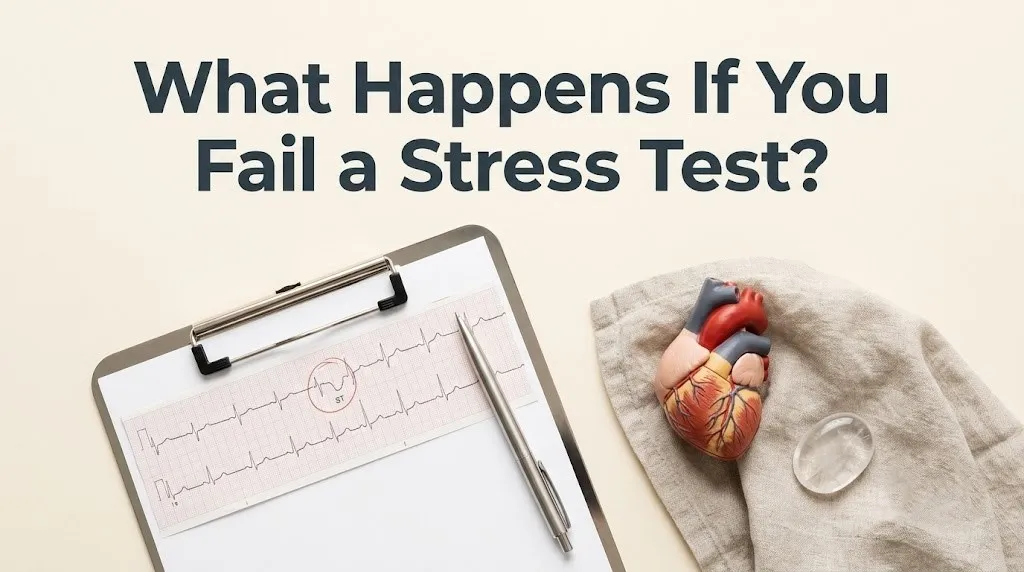
The cardiologist will review the raw data of your test. For a nuclear stress test, they will look at the perfusion images. For a stress echo, they will look at the wall motion. They will classify the result as mildly, moderately, or severely abnormal.
A 2022 study in the Journal of the American College of Cardiology found that patients with a severely abnormal stress test who underwent prompt angiography and revascularization had a lower rate of subsequent cardiac events. The key is the appropriate triage of the result. The “fail” is a piece of data. The response to that data is what determines the outcome.
Key Takeaway: Failing a stress test initiates a diagnostic process, not a treatment. The next step is a conversation with a cardiologist to map out the specific pathway for your specific result.
what is the next step after an abnormal stress test
The next step after an abnormal stress test is a shared decision-making conversation with your cardiologist. During this conversation, you will review the specific findings, discuss your symptoms, and decide together whether to proceed to an anatomical imaging test, usually a CT coronary angiogram or an invasive coronary angiogram, or to manage the findings with medical therapy.
The decision depends on several factors. The first is the size and severity of the perfusion defect. A large defect suggests a significant area of the heart is at risk. The second is your symptoms. Are you having chest pain or shortness of breath with activity? The third is your baseline risk profile. A patient with diabetes and a strong family history of early heart disease is at higher risk.
If the decision is to proceed with an invasive angiogram, the procedure is typically scheduled within a few days to a week for a stable patient. An urgent angiogram may be scheduled for the same day or the next day if the stress test was highly abnormal or the patient is unstable.
If the decision is to pursue a CT angiogram first, this can often be done as an outpatient and provides a non-invasive way to see the coronary anatomy. If the CT angiogram is normal or shows mild disease, an invasive angiogram may be avoided entirely. This is a critical “off-ramp” that many patients do not know exists.
what happens when you fail a stress test
When you fail a stress test, you will likely feel a wave of fear. This is normal. The word “fail” is a terrible word for a medical test result. You did not fail. Your body produced a signal that requires further investigation. The next steps are a series of logical, evidence-based decisions.
The first decision is the imaging test. An invasive coronary angiogram is a procedure where a thin catheter is threaded through an artery in your wrist or groin to your heart. Contrast dye is injected, and X-ray images are taken. A CT coronary angiogram is a non-invasive CT scan that also uses contrast dye to visualize the arteries.
The second decision is the treatment, which depends on what the angiogram shows. If the angiogram shows a significant blockage that is causing ischemia, the cardiologist may place a stent to open the artery during the same procedure. If the blockages are too extensive for stents, coronary artery bypass grafting surgery may be recommended.
If the angiogram shows only mild, non-obstructive plaque, or is completely normal, the treatment is medical. This includes aspirin, a statin to lower cholesterol, and medications to control blood pressure and heart rate.
what does an abnormal stress test mean
An abnormal stress test means the test detected an area of your heart muscle that was not receiving enough blood flow during the stress portion of the test compared to the resting portion. This is called inducible ischemia. It is a sign of a possible coronary artery blockage.
However, an abnormal result is not a definitive diagnosis of a blockage. It is a screening test. The abnormal result can be caused by a true flow-limiting blockage, by microvascular disease, by a false-positive artifact from soft tissue attenuation, or by a prior heart attack scar.
The specific words on the report matter. A “small, mild, fixed defect” is often a scar. A “moderate, reversible defect in the anterior wall” is highly concerning for a blockage in the left anterior descending artery.
Understanding the specific language of your report is the most important step you can take before the cardiology consultation.
borderline stress test result next steps
A borderline stress test result, sometimes called “equivocal,” means the findings are not clearly normal or clearly abnormal. The next steps are often the most nuanced and require the most careful decision-making. A CT coronary angiogram is an excellent next step for a borderline result.
A borderline result might be a small, mild defect that is only visible on one view. Or it might be an EKG change without a corresponding perfusion defect.
For these patients, an invasive angiogram is often unnecessary. The CT angiogram can rule out a significant blockage with high accuracy. If the CT is normal, the patient can be reassured, and the focus shifts to risk factor management.
A PET stress test, which provides quantitative blood flow data, is another excellent option for a borderline result. It can measure the coronary flow reserve and determine if the mild defect is truly causing a flow limitation.
false positive stress test what now
A false-positive stress test means the test was abnormal, but the subsequent angiogram shows no significant blockages. This is a relatively common outcome, occurring in about 20 to 30 percent of invasive angiograms performed for an abnormal stress test.
The most common cause of a false positive is breast tissue attenuation in women on a nuclear stress test. The breast tissue absorbs the tracer and creates a shadow on the heart.
If your angiogram is normal, the good news is that your large coronary arteries are open. The next step is to investigate for microvascular disease. A normal angiogram after an abnormal stress test is not a dead end. It is a diagnosis of exclusion that points toward microvascular dysfunction.
The treatment for microvascular disease is aggressive risk factor control and medications like beta-blockers and ranolazine.
coronary angiogram after abnormal stress test
A coronary angiogram is the gold standard test for visualizing the coronary arteries. It is an invasive procedure performed in a cardiac catheterization laboratory. A cardiologist inserts a catheter into an artery and injects contrast dye directly into the coronary arteries.
The procedure takes about 30 to 60 minutes. The patient is awake but sedated. The cardiologist can see the exact location and severity of any blockages.
If a significant blockage is found, the cardiologist can often perform a percutaneous coronary intervention, or PCI, during the same procedure. A balloon is inflated to open the blockage, and a stent, a small mesh tube, is placed to keep the artery open.
The angiogram is both a diagnostic test and, potentially, a therapeutic procedure. A 2023 study in the Journal of the American College of Cardiology confirmed that PCI for a flow-limiting stenosis identified by an abnormal stress test improves angina and quality of life.
Key Takeaway: The angiogram is the definitive test that answers the question raised by your stress test. It is the moment of clarity in the diagnostic pathway.
CT coronary angiogram vs invasive angiogram
A CT coronary angiogram is a non-invasive CT scan that provides a detailed 3D image of the coronary arteries. It is an excellent first step after an abnormal stress test, especially for patients with a borderline or moderate abnormality. It is not therapeutic; if a blockage is found, a separate invasive angiogram is needed.
The advantage of a CT angiogram is that it is low risk. It involves an IV injection of contrast dye and a quick CT scan. There is no catheter in the artery, and the risk of bleeding or vascular injury is eliminated.
The disadvantage is that it cannot be used to place a stent. It is a diagnostic-only test. It is also limited in patients with a lot of calcium in their arteries, as the calcium causes a blooming artifact that can obscure the lumen.
A 2022 randomized trial published in Circulation found that a CT-first strategy for patients with stable chest pain and an abnormal stress test reduced the rate of invasive angiograms by 50 percent compared to a direct-to-invasive-angiogram strategy, without any difference in cardiac outcomes.
medications after an abnormal stress test
After an abnormal stress test, you will almost certainly be prescribed a statin to lower your cholesterol and aspirin to prevent blood clots, regardless of whether you receive a stent. These medications are the foundation of medical therapy for coronary artery disease.
A high-intensity statin, such as atorvastatin 40-80 mg or rosuvastatin 20-40 mg, is the standard. The goal is to lower the LDL cholesterol to less than 70 mg/dL, and ideally less than 55 mg/dL for very high-risk patients.
Aspirin 81 mg daily is the standard antiplatelet therapy. If a stent is placed, a second antiplatelet medication, such as clopidogrel or ticagrelor, is added for 6 to 12 months to prevent the stent from clotting.
Beta-blockers and ACE inhibitors may be added to control blood pressure and reduce the workload on the heart. These medications are not a substitute for lifestyle change. They are a complement.
cardiac stents after a failed stress test
A cardiac stent is a small, expandable mesh tube that is placed in a narrowed coronary artery during an invasive angiogram. If the angiogram reveals a flow-limiting blockage that correlates with the abnormality on the stress test, a stent is often placed.
The stent is delivered on a balloon catheter. The balloon is inflated to compress the plaque and expand the stent. The balloon is then deflated and removed, leaving the stent in place to hold the artery open.
The ISCHEMIA trial, a landmark 2020 study, demonstrated that for patients with stable coronary artery disease, stenting does not reduce the risk of death or heart attack compared to optimal medical therapy alone, but it does significantly improve angina symptoms.
The stent is a symptom-relief procedure, not a life-extension procedure, for stable patients. This is a critical concept to discuss with your cardiologist.
bypass surgery after an abnormal stress test
Coronary artery bypass grafting, or CABG, is a surgical procedure where a blood vessel from another part of the body, usually the leg or the chest, is used to bypass a severely blocked coronary artery. CABG is recommended for patients with severe multi-vessel disease or a blockage in the left main coronary artery.
CABG is a major surgery that requires a hospital stay of 5 to 7 days and a recovery period of 6 to 12 weeks. It is more invasive than stenting, but it provides a more durable long-term result for patients with extensive disease.
A 2022 meta-analysis in the Lancet found that CABG was associated with a lower risk of long-term death and heart attack compared to PCI in patients with multi-vessel disease and diabetes.
lifestyle changes after failing a stress test
An abnormal stress test is a powerful catalyst for lifestyle change. The core interventions are a Mediterranean diet, regular aerobic exercise, smoking cessation, and stress management. These changes can halt the progression of the atherosclerosis and, in some cases, induce plaque regression.
The Mediterranean diet is rich in vegetables, fruits, whole grains, legumes, fish, and olive oil. It is low in red meat, processed foods, and saturated fats. The PREDIMED trial demonstrated a 30 percent reduction in major cardiovascular events with this diet.
Aerobic exercise, 150 minutes per week of moderate-intensity activity like brisk walking, improves endothelial function, lowers blood pressure, and reduces inflammation. A cardiac rehabilitation program provides a medically supervised environment to begin this safely.
cardiac rehabilitation after a stress test
Cardiac rehabilitation is a medically supervised program of exercise, education, and counseling that is designed to help patients recover from a cardiac event or procedure and to make lasting lifestyle changes. It is recommended for all patients who have had a stent, bypass surgery, or a diagnosis of stable angina.
The program typically lasts 12 weeks and includes three sessions per week. The exercise is tailored to the individual’s fitness level and is monitored with an EKG. The education component covers diet, stress management, and medication adherence.
A 2023 systematic review in the Cochrane Database of Systematic Reviews found that participation in cardiac rehabilitation reduced cardiovascular mortality by 25 percent.
stress test failure psychological impact
The psychological impact of being told you failed a stress test is profound and under-recognized. Patients frequently experience a spike in anxiety, a sense of vulnerability, and a fear of sudden death. This psychological stress is itself a cardiac risk factor.
It is essential to reframe the language. You did not fail a test. Your test provided a signal that allowed your medical team to intervene. The abnormal stress test is an early warning system that has worked.
If the anxiety is interfering with your sleep or your daily function, a consultation with a licensed clinical psychologist who specializes in cardiac psychology can be very helpful.
when to get a second opinion on a stress test
You should seek a second opinion when the stress test result is borderline, when there is a discrepancy between the test result and your symptoms, or when the recommended next step is not clear.
A second opinion can be obtained from a cardiologist at a different institution. The raw images of the stress test can be sent for a re-read.
A second opinion is also valuable when an invasive angiogram is recommended but you have a low pre-test probability of disease.
questions to ask your cardiologist after an abnormal stress test
To ask your cardiologist after an abnormal stress test, prepare a list of specific questions. The first is to ask to see the images and have the specific abnormality explained.
What is the size and severity of the defect? Where is it located? What is my pre-test probability of having a significant blockage? Is a CT angiogram an appropriate alternative to an invasive angiogram?
What are the goals of the angiogram? What are the options if a blockage is found? What is the plan for medical management regardless of the angiogram result?
Key Takeaway: You are an active participant in the diagnostic pathway. Write down your questions. Bring a family member to the appointment. The decision is yours, made in partnership with your cardiologist.
Frequently Asked Questions About Failing a Stress Test
Does failing a stress test mean I have heart disease?
Failing a stress test means there is a strong possibility of a blockage, but it is not a definitive diagnosis.
About 20 to 30 percent of abnormal stress tests are false positives.
The diagnosis is confirmed by a coronary angiogram or a CT angiogram.
What is the first thing that happens after you fail a stress test?
The first thing that happens is a consultation with a cardiologist to review the specific findings and create a plan.
The plan may be a CT angiogram, an invasive angiogram, or aggressive medical therapy.
You should not be rushed into a procedure without a clear explanation.
Can you fail a stress test and still have healthy arteries?
Yes, you can have a false-positive stress test and have perfectly open arteries on the angiogram.
This is often due to breast tissue artifact in women or a technical artifact.
Microvascular disease can also cause an abnormal stress test with open large arteries.
What percent of failed stress tests lead to stents?
Approximately 60 to 70 percent of invasive angiograms performed after an abnormal stress test find a flow-limiting blockage that may be treated with a stent.
The remaining 30 to 40 percent have non-obstructive disease or normal arteries.
A CT angiogram can be used to avoid unnecessary invasive procedures.
How should I feel after an abnormal stress test?
Feeling anxious, scared, and overwhelmed is a normal and expected response.
The word “fail” is psychologically damaging and inaccurate.
The stress test is a tool that has identified a potential problem that can now be managed.
Can stress and anxiety cause me to fail a stress test?
Anxiety can cause EKG changes that may be interpreted as an abnormality on a treadmill stress test.
However, the imaging component of a nuclear stress test or a stress echo is less likely to be affected.
A false-positive EKG stress test is a well-documented phenomenon in patients with anxiety.
The phone call telling you that your stress test was abnormal is a moment your heart sinks. But it is not the end. It is the beginning of a clearly mapped-out pathway that will lead to a precise diagnosis. You did not fail a test. The test detected a signal, and that signal is now a problem to be solved with the help of your cardiologist.
Tonight, write down your questions. What type of stress test did I have? What specifically was abnormal? What is the next step, and why? Bring a trusted family member or friend to your appointment. You will need a second set of ears.
Your heart has been whispering a warning through the stress test. You have heard it. Now, you will follow the evidence-based path to quiet that warning, with lifestyle change, medical therapy, and, if needed, a precise mechanical fix. You are in control of the response. The fear will pass, but the knowledge you gain from this moment will protect you for the rest of your life.