How Does Homework Cause Stress? 2026 Student Stress Guide
Homework causes stress by activating the body’s primary stress response system, the hypothalamic-pituitary-adrenal (HPA) axis, through a combination of time pressure, performance anxiety, loss of personal autonomy, and sleep deprivation, which together create a state of chronic allostatic load that can impair the very cognitive functions the homework is supposed to build. The irony is physiologically precise: the stress of too much homework releases cortisol, which in turn impairs the function of the hippocampus and the prefrontal cortex, the brain regions responsible for the memory consolidation and executive function needed to complete the homework successfully.
A landmark 2024 study published in the Journal of Adolescent Health found that high school students who reported more than three hours of homework per night had significantly elevated bedtime cortisol levels and impaired declarative memory recall the following day compared to students with less than one hour of homework. The work was not just making them tired. It was chemically undermining their ability to learn from it.
This guide will map out the exact neuroendocrine cascade from a heavy backpack to a stressed-out brain, teach you to distinguish between the healthy, growth-promoting stress of a challenge and the toxic, damaging stress of overload, and provide specific, evidence-based strategies for students and parents to bring the allostatic load back down to a functional level.
If you are in crisis or experiencing thoughts of self-harm, contact the 988 Suicide and Crisis Lifeline by calling or texting 988 at any time. Academic stress can be overwhelming. This service is free, confidential, and available 24 hours a day.
how does homework cause stress
Homework causes stress by shifting the student’s autonomic nervous system from a state of parasympathetic calm to a state of sympathetic hyperarousal, driven by the perception of an inescapable, high-stakes demand with insufficient time and resources. The math worksheet itself is not a predator, but the brain’s amygdala, primed by pressure, can respond to it as if it were.
The stress response begins with a cognitive appraisal. The student looks at the pile of assignments. The prefrontal cortex makes a rapid, often unconscious calculation: the demands exceed the available coping resources. This is the core definition of a stressor according to the transactional model of stress developed by Lazarus and Folkman.
The amygdala is activated. It signals the hypothalamus to release corticotropin-releasing hormone (CRH) . CRH triggers the pituitary gland to release adrenocorticotropic hormone (ACTH) . ACTH travels through the bloodstream and tells the adrenal glands, located on top of the kidneys, to release cortisol and epinephrine.
The heart rate increases. The muscles tense. The attention narrows. This is the physiological state of doing homework under stress. The problem is that this state is designed for short-term physical threats, not for sustained cognitive tasks like writing an essay or solving a calculus problem. The prefrontal cortex, which needs a calm, focused state to function optimally, is partially hijacked by the amygdala’s panic signal.
Key Takeaway: Homework stress is not “all in your head.” It is a measurable, physical cascade of cortisol and epinephrine that your body releases because your brain has interpreted the unfinished assignment as a threat.
how can homework cause stress
Homework can cause stress through several specific, interacting pathways: the sheer volume of work creating time scarcity, the pressure to achieve a perfect grade, the lack of autonomy over how the time is spent, the conflict it creates in the family, and the sacrifice of sleep and physical activity that are essential for stress resilience.
Time scarcity is the most direct stressor. The student is given a fixed amount of homework and a finite number of evening hours. The hours are also needed for dinner, family time, extracurricular activities, and, crucially, sleep. The feeling of not having enough time is a powerful psychological stressor that activates the HPA axis.
Performance pressure, often internalized as perfectionism, adds a layer of threat. The homework is not just a task to be completed. It is a test of the student’s worth. A mistake is a catastrophe. This perfectionistic cognitive style is a direct, potent activator of the stress response.
The loss of autonomy is a key factor. Self-determination theory, a well-established psychological framework, identifies autonomy as a fundamental human need. When a student’s entire afternoon and evening are dictated by an external assignment, the sense of autonomy is crushed. This creates a motivational deficit and a stress response.
homework and the hpa axis cortisol stress response
The HPA axis is the body’s primary stress response system, and chronic, excessive homework directly causes its dysregulation. The normal diurnal cortisol rhythm, which is high in the morning and low at night, becomes flattened. The bedtime cortisol level is elevated, which interferes with sleep onset and the crucial memory consolidation that occurs during deep sleep.
The hippocampus, the brain’s memory center, is exquisitely sensitive to cortisol. It has a high density of glucocorticoid receptors. Acute, moderate stress can briefly enhance hippocampal function. This is the “good stress” of a manageable challenge.
But chronic, sustained elevation of cortisol causes dendritic retraction in the hippocampal neurons. The cells shrink. The connections are lost. The student becomes less able to consolidate new information into long-term memory. The harder they work, the less they retain.
A 2023 study in Psychoneuroendocrinology measured the salivary cortisol of medical students during exam periods. The students with the highest cortisol levels had the poorest performance on a standardized memory test. The stress hormone was directly impairing their ability to recall the material they were studying.
adolescent brain development and academic stress
The adolescent brain is uniquely vulnerable to the effects of chronic stress because the prefrontal cortex, the region responsible for emotional regulation and executive function, is still undergoing a major period of development. Chronic cortisol exposure during this critical window can have lasting effects on the brain’s structure.
The prefrontal cortex is the last part of the brain to fully mature, a process that continues into the mid-20s. It is highly plastic and highly sensitive to the hormonal environment. Chronic stress delays the maturation of the prefrontal cortex and strengthens the amygdala’s fear circuits.
The adolescent brain is already operating with a heightened amygdala response and a relatively underdeveloped prefrontal brake. Adding a chronic, high-stakes stressor like excessive homework pushes this imbalance further toward emotional reactivity and cognitive shutdown.
A 2022 longitudinal study in Child Development found that adolescents who reported high levels of academic stress had a thinner prefrontal cortex at age 18 compared to their low-stress peers. The stress was physically remodeling their brain’s control center.
allostatic load and homework in students
Allostatic load is the cumulative physiological wear and tear on the body caused by repeated or chronic stress. For a student with excessive homework, the allostatic load can be measured in the flattened cortisol rhythm, the elevated heart rate, the increased blood pressure, and the suppressed immune system. The student is not just “stressed out.” Their body is paying a biological price.
The concept of allostatic load was developed by Bruce McEwen to describe how the body’s stress response systems, which are protective in the short term, become damaging when activated chronically.
A student with a high allostatic load is more susceptible to infections, experiences more frequent headaches and stomachaches, and has a higher baseline level of systemic inflammation. The immune cells, bathed in cortisol, become less responsive to pathogens.
The allostatic load model explains why some students seem to thrive under pressure while others get sick and burn out. The difference is not just mental toughness. It is the cumulative physiological burden that has been placed on the body.
Key Takeaway: Every night of stressed-out homework is a deposit into the body’s allostatic load account. When the account is overdrawn, the body breaks down.
loss of autonomy and homework stress
The loss of autonomy is a powerful, specific stressor. When a student’s time is completely controlled by an external force, the homework assignment, the basic psychological need for self-determination is thwarted. This creates a state of learned helplessness and resentment that fuels the stress response.
The student has no control over the volume, the timing, or the content of the work. The entire evening is a forced march through someone else’s priorities. This lack of control is a direct, potent activator of the amygdala.
A 2021 study in the Journal of Educational Psychology found that students who perceived their homework as controlling and autonomy-thwarting had higher levels of academic anxiety and lower levels of intrinsic motivation.
Restoring a sense of autonomy, even in small ways, such as allowing the student to choose the order in which they complete the assignments, or where they sit, can significantly reduce the stress response.
perfectionism and homework anxiety
Perfectionism is a personality trait characterized by setting excessively high standards and engaging in harsh self-criticism. For a perfectionistic student, every homework assignment is a high-stakes performance that defines their worth. A single mistake is a catastrophic failure that triggers a full-blown amygdala response.
The perfectionistic student is not working toward a goal. They are working to avoid the terrifying possibility of a flaw. This is a fear-driven motivational system. The stress response is activated not by the work itself, but by the constant threat of self-criticism.
A 2023 study in the Journal of Adolescent Health found that maladaptive perfectionism was a significant predictor of homework-related anxiety and the development of generalized anxiety disorder in high-achieving high school students.
The treatment for this specific stress pathway is cognitive behavioral therapy, which helps the student to identify and challenge the catastrophic thinking patterns.
sleep deprivation from homework stress
Sleep deprivation is both a consequence and a cause of homework stress. The heavy homework load forces the student to stay up late, cutting into the essential 8 to 10 hours of sleep that adolescents need. The resulting sleep deprivation impairs the prefrontal cortex, increases the amygdala’s reactivity, and elevates the next day’s cortisol levels.
The student gets less sleep. The next day, the student is more emotionally reactive, less able to focus, and less able to regulate the stress response. The homework takes longer because the brain is tired. The student stays up even later. The cycle accelerates.
Sleep is when the hippocampus consolidates the day’s learning into long-term memory. A sleep-deprived student is literally unable to retain the information from the homework they just completed.
A 2024 study in Child Development found that a single night of shortened sleep significantly reduced the next day’s academic performance and increased the levels of stress hormones in adolescent students.
physical symptoms of homework stress
The physical symptoms of homework stress are the somatic manifestations of the chronic HPA axis activation: tension headaches, stomachaches, jaw pain from clenching, muscle tightness in the neck and shoulders, and a suppressed immune system leading to frequent colds.
The gut-brain axis is directly affected. The stress hormones alter the motility of the gut, causing nausea, irritable bowel syndrome symptoms, and stomach pain. The “stomachache before a test” is a real, physiologically driven phenomenon.
The musculoskeletal system is held in a state of chronic low-grade contraction. The shoulders are elevated. The jaw is clenched. The neck is stiff.
These physical symptoms are not imagined. They are the direct result of the neuroendocrine cascade. They are the body’s way of saying that the stress load has exceeded the system’s capacity.
homework stress vs healthy challenge eustress
Eustress is a manageable, growth-promoting stress that occurs when a challenge is perceived as difficult but achievable, and the individual has the resources and the support to meet it. Homework stress, in the pathological sense, is the distress that occurs when the demands consistently exceed the resources. The distinction is critical.
A moderate amount of challenging homework can induce a state of eustress. The student is engaged, focused, and the reward of solving the problem releases dopamine. The HPA axis is briefly activated, and then it returns to baseline. The brain learns and grows.
But when the volume is too high, when the pressure is too intense, and when the support is absent, the eustress flips into distress. The HPA axis stays on. The cortisol remains elevated. The brain stops learning and starts surviving.
The goal of a healthy homework policy is to find the sweet spot on the Yerkes-Dodson inverted-U curve, where the arousal level is optimal for the performance. Too little arousal, and the student is bored. Too much, and the student is panicked.
| Feature | Eustress (Healthy Challenge) | Distress (Toxic Homework Stress) |
|---|---|---|
| Perception | Manageable, exciting | Overwhelming, threatening |
| Cortisol | Brief spike, quick recovery | Sustained elevation, flattened rhythm |
| Performance | Enhanced focus and memory | Impaired focus and memory |
| Motivation | Intrinsic, curious | Fear-driven, avoidant |
| Physical State | Energized | Exhausted, somatic symptoms |
| Outcome | Growth, mastery | Burnout, learned helplessness |
parental pressure and student mental health
Parental pressure is a powerful amplifier of homework stress. The child’s homework becomes the parent’s performance metric. The parent’s anxiety about the child’s future is communicated through tone, body language, and the high-stakes emphasis placed on every grade.
The child internalizes the parent’s anxiety. The homework is no longer just about learning. It is about not disappointing the parents. The HPA axis is activated not just by the task, but by the fear of losing parental love and approval.
A 2022 study in the Journal of Family Psychology found that parental pressure was a stronger predictor of adolescent academic anxiety than the actual volume of the homework.
Parents who can manage their own anxiety and create a supportive, low-stakes environment at home provide a powerful buffer against the stress response.
extracurricular overload and homework stress
Extracurricular overload compounds the time scarcity. The student rushes from school to sports practice to music lessons, and then starts the homework at 9 p.m. The stress is not just the homework. It is the unrelenting schedule that offers no downtime.
The brain needs unstructured time to process, to daydream, and to consolidate memory. This is called the default mode network. A relentless schedule of structured activities, followed by homework, starves the default mode network.
The result is a brain that is chronically in task-positive mode, unable to shift into the reflective, integrative mode that is essential for creativity and emotional regulation.
The solution is not necessarily to drop all activities, but to build in sacred, un-scheduled time.
how to manage homework stress for students
To manage homework stress, students must build specific, evidence-based skills: breaking the work into small, timed chunks using the Pomodoro method, scheduling the most difficult tasks for the time of day when they have the most energy, and deliberately interrupting the stress response with a brief session of diaphragmatic breathing.
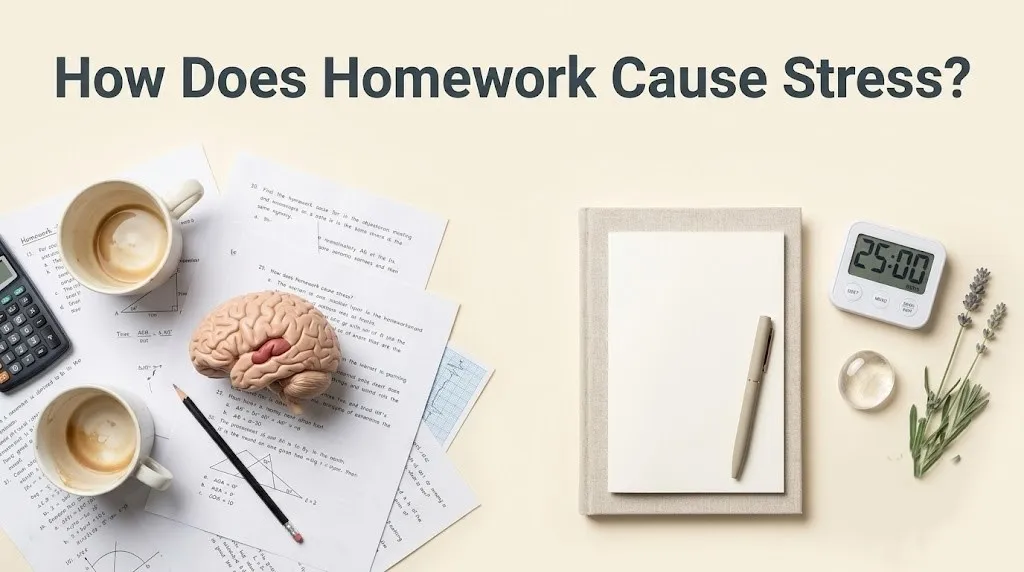
The Pomodoro method involves setting a timer for 25 minutes of focused work, followed by a 5-minute break. This prevents the cognitive fatigue and the feeling of endlessness that drive the stress response.
Diaphragmatic breathing, 5 minutes of slow, deep breathing with a long exhale, can reset the autonomic nervous system from a sympathetic panic state back to a parasympathetic calm state.
Sleep must be treated as a non-negotiable biological necessity, not a luxury to be sacrificed for a few more math problems.
stress management techniques for homework
The most effective stress management technique for homework is to create a consistent, predictable routine that includes clear transitions, designated work spaces, and planned breaks. The brain is a pattern-recognition machine. A predictable routine signals safety and reduces the amygdala’s reactivity.
The student should have a designated, uncluttered workspace that is used only for studying. The brain associates the environment with the task.
The routine should include a transition ritual, such as a brief walk or a snack, that marks the shift from school mode to homework mode.
A timer should be used to provide a clear endpoint to the work. The work will expand to fill the time available. A time limit forces focus and reduces the feeling of endlessness.
when homework stress becomes a clinical anxiety
Homework stress becomes a clinical anxiety disorder when the fear and avoidance generalize beyond the homework itself, when the physical symptoms are present even on non-school days, when the student experiences panic attacks, and when the stress causes a significant decline in academic or social functioning.
The threshold for seeking professional help is crossed when the student cannot turn off the worrying, when the sleep is chronically disrupted, and when the student expresses feelings of hopelessness or suicidal ideation.
A licensed clinical psychologist or a board-certified child and adolescent psychiatrist can diagnose the specific anxiety disorder and provide evidence-based treatment, typically cognitive behavioral therapy.
long term effects of academic stress on health
The long-term effects of chronic academic stress during adolescence can include an increased risk for anxiety disorders, depression, metabolic syndrome, and a permanently sensitized stress response system in adulthood. The allostatic load incurred during the formative years can program the body for a lifetime of hyper-reactivity.
A 2023 longitudinal study that followed adolescents into adulthood found that those who reported high levels of academic stress in high school had a significantly higher incidence of major depressive disorder and elevated C-reactive protein, a marker of systemic inflammation, at age 30.
The homework stress of today is not just a phase. It is a biological investment in the future health of the student.
Key Takeaway: The allostatic load from years of school stress can program a child’s body for a lifetime of physical and mental health challenges.
Frequently Asked Questions About Homework and Stress
Why does homework cause so much stress?
Homework causes stress because it creates a perceived demand that exceeds the available time and resources.
This perception activates the HPA axis, releasing cortisol and epinephrine.
The combination of time pressure, performance anxiety, and loss of autonomy drives the stress response.
Can homework cause physical health problems?
Yes, chronic homework stress can cause physical symptoms including tension headaches, stomachaches, a suppressed immune system, and sleep deprivation.
These are the somatic manifestations of the chronic activation of the HPA axis.
The stress hormones directly affect the gut, the muscles, and the immune cells.
How much homework is too much?
According to the National PTA and the National Education Association, the recommended guideline is 10 minutes of homework per grade level per night.
A high school senior should have no more than 120 minutes.
Beyond this threshold, the research suggests that the academic benefits level off and the stress costs rise sharply.
What are the signs of homework-related stress?
The signs include changes in mood, irritability, crying over homework, procrastination, avoidance, physical complaints on school days, and disrupted sleep.
The student may report feeling constantly tired and unable to concentrate.
These are signs that the allostatic load has exceeded the student’s coping capacity.
Is some homework stress good for students?
A moderate, manageable challenge, eustress, is beneficial and promotes growth and learning.
The key is the perception of the stressor as manageable and the presence of adequate support.
When the stress becomes overwhelming and unrelenting, it becomes toxic distress.
How can parents help with homework stress?
Parents can help by creating a supportive, low-stakes environment, focusing on effort rather than grades, and advocating for the child with the school if the volume is excessive.
Parents should manage their own anxiety about the child’s academic performance.
Helping the child to build time management and stress reduction skills is more effective than solving the homework for them.
The pile of worksheets on your child’s desk is not just a to-do list. It is a physiological challenge to their developing nervous system. The pressure to complete it, the lack of time, and the fear of a bad grade activate a chemical cascade that over time can wear down their body and change their brain. The irony is that the stress designed to make them work harder is often the very thing that shuts down their ability to learn.
The solution is not to eliminate all homework, but to restore the sense of autonomy, to cap the volume at a reasonable level, and to protect the sleep that the brain needs to consolidate the learning. Teach your child the Pomodoro method. Insist on a consistent bedtime. Advocate with the school.
Your child’s mental health is the foundation upon which all academic success is built. A stressed brain is a brain in survival mode. A calm brain is a brain that can learn, create, and thrive. The homework is important. The brain that does the homework is more important.