What Should a Woman Wear for a Stress Test in 2026
For a cardiac stress test, a woman should wear a comfortable two-piece athletic outfit, a supportive non-underwire or sports bra, and well-fitting athletic shoes with socks. The right clothing matters because technicians need unobstructed access to your chest for electrode placement, and your outfit directly affects the quality of the electrical signals the test records.
Cardiac stress tests are one of the most commonly ordered diagnostic procedures for women with suspected heart disease. According to the American Heart Association, women often present with atypical symptoms of coronary artery disease compared to men, making accurate stress test results especially important for correct diagnosis. Clothing and skin preparation choices are among the few variables entirely within the patient’s control, and getting them wrong can lead to rescheduled appointments, repeated testing, or inaccurate readings.
This guide covers everything a woman needs to know before her stress test: the right garments, which bras work and which do not, what to do with your skin, how preparation differs across test types, and what to ask your cardiologist before the day of the appointment.
What Should a Woman Wear for a Stress Test
A woman attending a cardiac stress test should wear a loose, comfortable two-piece outfit that allows easy access to the chest and upper abdomen without requiring her to undress completely.
The technician performing the test will place adhesive electrodes directly on your skin in multiple locations across the chest. This process is much faster and more accurate when your top can be opened at the front or lifted without difficulty. Button-front shirts, front-zip athletic tops, or loose-fitting T-shirts work well for most women.
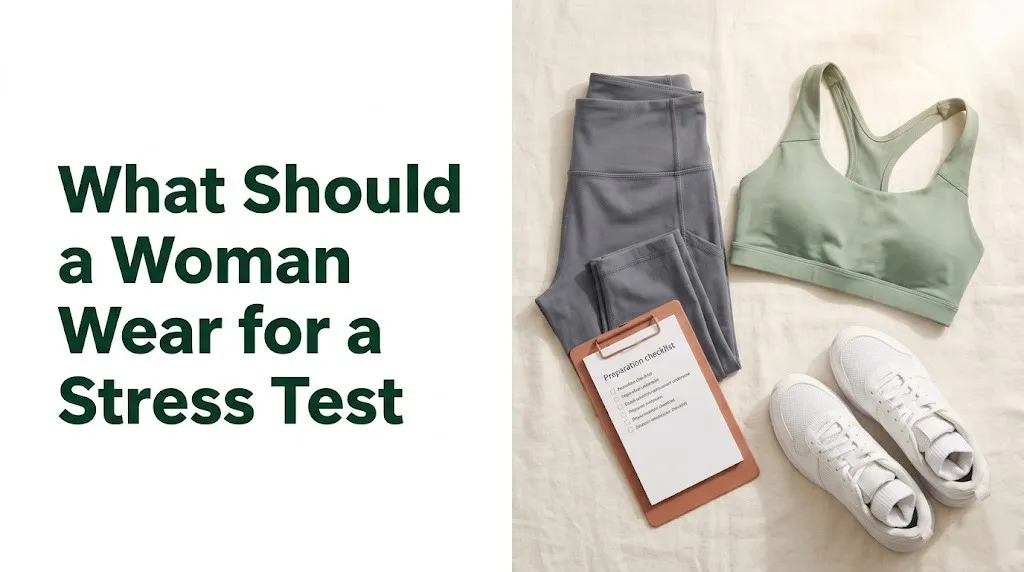
The key is access, not style. Tight pullover tops, turtlenecks, or anything with complex layering will slow the setup and may need to be removed entirely before the electrodes can be placed. A two-piece outfit, meaning a separate top and bottom, is almost always the better choice over a one-piece dress or jumpsuit.
According to the Cleveland Clinic, wearing comfortable athletic or exercise clothing is the standard preparation recommendation for exercise-based stress testing. Women who arrive in office or formal clothing can complete the test, but setup takes longer and they often feel less comfortable during the exercise portion.
For women with mobility limitations or who know they cannot walk briskly on a treadmill, a two-piece comfortable outfit is still appropriate, since the pharmacological alternative to exercise testing also requires electrode placement.
What Is a Cardiac Stress Test and Why Clothing Matters
A cardiac stress test measures how well your heart performs under physical or pharmacological stress, and clothing matters because it determines how quickly and cleanly the monitoring electrodes can be placed on your skin.
During an exercise stress test, you walk on a treadmill while a 12-lead ECG records your heart’s electrical activity. The test specifically looks for ST-segment changes on the ECG trace, which indicate reduced blood flow to part of the heart muscle during increased demand. Your heart rate trajectory, blood pressure response, and exercise capacity in metabolic equivalents (METs) are also tracked throughout.
Each of the 12 ECG leads corresponds to a specific electrode placed on your skin. The chest leads (V1 through V6) are positioned across the front of your chest and require direct skin contact, no fabric between the electrode and the skin. Your top must allow the technician to reach these sites quickly and position each electrode precisely.
Poor electrode contact produces what cardiac technicians call “artifact,” meaning interference on the ECG trace that can obscure the very changes the test is designed to detect. The American College of Cardiology notes that technical quality of the ECG recording is one of the key factors that determines whether a stress test result is interpretable. An outfit that slows setup or compromises electrode adhesion increases the risk of an inconclusive or repeated test.
For women specifically, breast tissue can also complicate electrode placement at V3, V4, and V5. A cooperative patient in the right clothing makes the technician’s job significantly easier at those sites.
What to Wear to a Stress Test: The Core Checklist
The ideal stress test outfit for a woman combines easy chest access, comfort during exercise, and skin that is clean and free of products that interfere with electrode adhesion.
Here is the complete clothing checklist:
Clothing items to bring or wear:
- A loose two-piece outfit: separate top and bottom
- A front-opening, front-zip, or easily lifted top (not a pullover if possible)
- A non-underwire sports bra or a soft-cup bra (details in the bra sections below)
- Athletic leggings, loose gym pants, or athletic shorts
- Well-fitting athletic or walking shoes with non-slip soles
- Clean socks (ankle or crew length both work)
- A front-opening cardigan or zip-up if you want a layer for the waiting room
Items to leave at home or in your bag:
- Jewelry, especially necklaces and bracelets that could interfere with leads or get in the way during exercise
- Body lotion, moisturizer, or oils applied to the chest, torso, or arms that morning
- Heavy antiperspirant or deodorant (light application may be acceptable; detailed guidance in a later section)
- Fragranced body sprays applied heavily to the chest
The Mayo Clinic recommends arriving dressed and ready for exercise, with clean, dry skin on the chest and torso. The more prepared your skin and clothing are before you arrive, the shorter your setup time and the cleaner your ECG signal.
Key Takeaway: The single most important clothing choice for a woman attending a stress test is a two-piece outfit with a top that opens easily at the front, paired with a non-underwire bra and supportive athletic shoes.
Can You Wear Leggings to a Stress Test
Yes, leggings are an excellent choice for a cardiac stress test. They are comfortable during treadmill walking, do not restrict your stride, and pose no interference with electrode placement on the chest.
The electrodes for a 12-lead ECG are placed on the chest and upper abdomen, not on the legs. Limb lead electrodes are placed on the wrists and ankles, outside any legging fabric. Your leg covering choice is therefore primarily about comfort during exercise rather than any clinical requirement.
Compression leggings and standard athletic leggings are both acceptable. If you tend to run warm during exercise, lighter-weight leggings will keep you more comfortable during the walking or running phases of the test. Some women prefer loose gym pants or athletic shorts, and those work equally well.
One practical note: avoid leggings with wide, tight waistbands that sit high on the abdomen. Some cardiac technicians place limb electrodes near the lower torso depending on the protocol, and a very high waistband can occasionally be in the way. A standard mid-rise or low-rise athletic waistband creates no problems.
Women with lower extremity lymphedema or compression garment prescriptions should wear their usual compression stockings or socks. The ECG ankle leads can be applied over or around standard compression wear, and cardiac technicians are accustomed to making these adjustments.
What Kind of Shoes to Wear for a Stress Test
Wear well-fitting athletic or walking shoes with non-slip soles and good ankle support for an exercise stress test. You will be walking and potentially jogging on a treadmill that gradually increases in speed and incline.
The treadmill used in most exercise stress tests follows the Bruce protocol or the modified Bruce protocol, which starts at a slow walking pace (1.7 mph at a 10% grade in the standard Bruce) and increases every three minutes. By stage three, most patients are at a brisk walk or slow jog. Shoes that fit securely without slipping are genuinely important for safety on an inclined treadmill surface.
Avoid the following footwear:
- Open-toed sandals or flip-flops (unsafe on a moving treadmill)
- High heels or wedge shoes (obvious incline incompatibility)
- Slip-on shoes without secure heel backing (heel-slip risk on incline)
- Heavy boots (restrict ankle movement and add unnecessary metabolic load)
- Bare feet or socks without shoes (never permitted on treadmill equipment)
Running shoes, cross-trainers, and walking shoes with rubber soles all work well. The shoe does not need to be brand-new or high-performance. It needs to fit well, stay on your foot, and have a non-slip sole.
For women with foot conditions such as plantar fasciitis or custom orthotics, bring your orthotics if they fit in your usual athletic shoes. Let the cardiac technician know you are wearing orthotic inserts so the pace and incline progression can be managed accordingly if needed.
If you are scheduled for a pharmacological or nuclear stress test where you will not be exercising on a treadmill, comfortable flat shoes or even supportive casual shoes are acceptable since treadmill walking is not required.
Can You Wear an Underwire Bra to a Stress Test
You should not wear an underwire bra to a cardiac stress test. The metal underwire sits precisely in the zone where several precordial ECG electrodes must be placed, specifically the V3, V4, and V5 leads positioned across the mid and lower chest.
The underwire is not only a placement obstacle. Metal is electrically conductive, and the proximity of metal to active ECG electrodes can introduce electrical interference that appears on the ECG trace as artifact or noise. In a test designed to detect subtle changes in the ST segment of the ECG waveform, this is a meaningful problem.
According to cardiac technician protocols published by the American College of Cardiology, patients should not wear underwire bras to cardiac stress testing appointments. This is one of the most consistent preparation instructions across major cardiac testing centers.
Practically, the issue is also one of access. Even when a technician can work around an underwire, the bra often needs to be unhooked or removed to place the lower precordial leads, which adds time and can feel uncomfortable for the patient.
The solution is straightforward: wear a soft-cup bra or a sports bra with no underwire. These provide the support you want for the waiting room and the exercise phase while giving the technician full access to all electrode sites.
Women who feel they need more support during the exercise phase should know that most cardiac exercise tests last 6 to 12 minutes. A well-fitted non-underwire sports bra handles that duration with no difficulty for most breast sizes.
Key Takeaway: Underwire bras interfere directly with the electrode placement zones for V3, V4, and V5 precordial leads, which are the same leads that detect the ST-segment changes the test is designed to find.
Sports Bra for a Stress Test: What Works Best
A sports bra with no underwire, no underwire channel, and no metallic clasps across the front or back is the best bra choice for a cardiac stress test. Front-clasping sports bras without metal hardware work especially well because the technician can open them for electrode access without removing the bra entirely.
Not all sports bras are equally suitable. Here is a comparison of the most common types:
| Sports Bra Type | Suitable for Stress Test | Reason |
|---|---|---|
| No-wire, no-clasp pull-over style | Yes | No metal, full chest access with upward lift |
| No-wire, front-zip style | Yes, ideal | Easy front access, no metal hardware |
| No-wire, hook-and-eye back closure (non-metal hooks) | Generally yes | Rear access is acceptable |
| Underwire sports bra | No | Metal wire crosses V3-V5 electrode zone |
| Front-clasp sports bra with metal clasps | Caution | Metal hardware near V3-V4; discuss with technician |
| Racerback with no wire | Yes | Clean chest access, no interfering metal |
| Full-coverage compression bra without wire | Yes | Easily lifted for electrode placement |
Most women find that a medium-support pull-over sports bra without any wire or front hardware is the simplest and most practical choice. You will likely be asked to lift or lower the front of the bra at some point during setup. A soft, flexible bra fabric makes this quick and straightforward.
Larger-breasted women sometimes wonder whether they will have enough support without an underwire. For the 6 to 12 minutes of treadmill activity during the test, a well-fitted non-underwire compression or encapsulation sports bra provides adequate support for virtually all breast sizes.
Can You Wear Deodorant to a Stress Test
You should avoid applying deodorant or antiperspirant to your underarm or chest area on the morning of a stress test. Antiperspirant products contain aluminum-based compounds that can interfere with ECG electrode adhesion on the torso.
The concern is not about the smell. It is about skin conductance. Antiperspirant is specifically designed to block sweat gland output by forming a gel plug at the skin surface. This same property reduces the electrical conductivity of the skin. When the skin beneath or near an electrode site has antiperspirant residue, the electrode’s ability to pick up the heart’s electrical signals cleanly is reduced.
Standard roll-on and stick antiperspirants are the most problematic. Light application of a non-antiperspirant deodorant (a product that does not contain aluminum salts) to the underarms only, well away from the electrode sites on the chest, is generally acceptable. If you are uncertain which type of product you use, check the active ingredients: “aluminum chlorohydrate,” “aluminum zirconium,” or any aluminum compound means it is an antiperspirant.
The Mayo Clinic specifically lists avoiding lotions, powders, and antiperspirants on the chest as a standard preparation instruction for cardiac stress testing.
For women with hyperhidrosis (excessive sweating), discuss this with the cardiac technician before the appointment. Technicians can use specialized high-tack electrodes or a preparation spray designed to maximize adhesion in high-moisture skin conditions. Do not apply extra antiperspirant thinking it will help: it will create the opposite effect on electrode signal quality.
Should You Shave or Prep Your Skin Before a Stress Test
You do not need to shave your chest or body before a stress test, but the technician will lightly prepare the electrode sites on your skin before placing the electrodes. For women, this preparation is usually minimal.
The reason skin preparation matters is skin impedance. The outermost layer of skin, the stratum corneum, is relatively resistant to electrical current. ECG electrodes measure extremely small electrical signals from the heart, and anything that increases the resistance between the electrode and the deeper, more conductive layers of skin reduces signal quality.
For this reason, cardiac technicians typically use a lightly abrasive skin preparation wipe or a small amount of electrode preparation gel on each electrode site before applying the adhesive electrode. This removes dead skin cells and any surface oils that have accumulated.
For women, the chest and upper abdomen areas where electrodes are placed tend to have minimal hair. The technician will assess each site individually. If there is any hair in an electrode location that would prevent adhesion, a small area will be shaved using a disposable razor the facility provides. You do not need to do this at home.
What you should do at home is shower on the morning of the test and skip any moisturizing products on your chest, abdomen, and arms. Clean, product-free skin gives the technician the best starting point. Avoid applying body lotion, body oil, or any topical skin treatment to your torso on the morning of the appointment.
Women using prescription topical medications on the chest or torso (such as topical hormone patches or medicated creams) should inform the cardiac technician and their ordering cardiologist in advance.
Key Takeaway: You do not need to shave before a stress test, but you should shower on the morning of the test and skip all lotions, oils, and body products on your chest and torso.
What Not to Wear to a Stress Test
Certain clothing items reliably create problems during cardiac stress test setup, and knowing what to avoid saves you from a delayed appointment or, in some cases, a rescheduled test.
Garments that cause the most common problems:
- Underwire bras: Metal sits directly over electrode placement zones. This is the single most common clothing-related preparation issue in women attending stress tests.
- One-piece dresses or jumpsuits: Require more extensive undressing to allow chest access. Not impossible, but inconvenient and slower.
- Compression sport tops with built-in shelf bras containing underwire: Marketed as athletic wear but contain the same problematic wire as structured bras.
- Tops with heavy metal decorations or metallic thread across the chest: Foil-print logos, chain details, or metallic embroidery across the chest can interfere with electrode placement and occasionally with ECG signal.
- Tight-fitting turtlenecks or high-neck athletic tops: Make access to upper chest electrode sites awkward and slow.
- Excessive layering: Multiple tops over each other mean multiple items to manage during setup. One top is enough.
Jewelry to remove before or at the test:
- Necklaces (sit in electrode territory)
- Bracelets and bangles (sit near or on limb lead sites)
- Large rings may be worn but are occasionally removed for patient comfort during exercise
The facility will provide a changing area if needed. If you arrive in clothing that is not ideal, the technician can work with you, but arriving prepared saves time and reduces any awkwardness during setup.
Women with body modifications such as chest or nipple piercings should remove these before the appointment if possible, or inform the technician. Small-gauge jewelry in locations away from electrode sites is usually manageable, but the technician needs to know.
Nuclear Stress Test: What to Wear
For a nuclear stress test, the clothing recommendations are similar to a standard exercise stress test, but with a few additional considerations specific to the imaging component of the procedure.
A nuclear stress test combines exercise (or pharmacological) cardiac stress with nuclear imaging using a radioactive tracer such as technetium-99m or thallium-201. You will undergo ECG monitoring during the exercise phase and then lie still under a gamma camera for imaging. The imaging phase can last 15 to 45 minutes in some protocols.
| Phase | What Happens | Clothing Consideration |
|---|---|---|
| Pre-test preparation | IV line placed, resting ECG | Easy arm/hand access; avoid tight long sleeves |
| Exercise or pharmacological phase | Treadmill or drug infusion with ECG | Two-piece outfit, sports bra, athletic shoes |
| Rest imaging | Lying under gamma camera (30-45 min) | Comfortable, nothing tight around chest or abdomen |
| Stress imaging | Same as rest imaging but after exercise/drug | Same; you may want a light layer for waiting |
The nuclear imaging component means you may be at the facility for 3 to 4 hours, including waiting time between injections and imaging. Wear something comfortable enough to sit and wait in for an extended period.
Avoid wearing any metallic items into the imaging room. Necklaces, underwire bras, and metallic embellishments on clothing need to be removed before lying under the gamma camera, as metal creates artifacts on nuclear images in the same way it creates artifacts on CT or MRI scans.
Women who are pregnant or breastfeeding must discuss nuclear stress testing with their ordering cardiologist before the appointment. Radiation exposure from nuclear cardiac tracers is low but non-trivial, and the risk-benefit decision is made by the physician, not the patient independently.
Pharmacological Stress Test Clothing Guide
A pharmacological stress test does not require treadmill exercise, so athletic shoes and exercise clothing are not strictly necessary. However, comfortable, accessible clothing is still important because electrode placement and an IV line are required.
Pharmacological stress tests use medications such as adenosine, regadenoson, or dobutamine to increase heart rate and cardiac workload artificially, mimicking the effect of exercise. These tests are ordered for women who cannot safely complete a treadmill test due to orthopedic limitations, severe arthritis, neurological conditions, severe deconditioning, or other mobility issues.
What to wear for a pharmacological stress test:
- A loose, comfortable two-piece outfit: still the best choice for electrode access
- A non-underwire bra: the same electrode placement requirements apply
- Comfortable flat shoes: no treadmill means no athletic shoe requirement, but wear something you can walk short distances in
- Loose sleeves or a top with accessible arms for IV placement
You will receive the medication through an intravenous line, typically placed in the arm at the antecubital fossa (the front of the elbow). Wearing a top with sleeves that roll up easily, or a short-sleeved top, avoids any awkwardness during IV placement. Tight long sleeves that cannot be pushed up far enough are a practical nuisance.
For women who are sensitive to adenosine or regadenoson side effects (which can include flushing, chest heaviness, and shortness of breath lasting several minutes), wearing comfortable, non-restrictive clothing reduces any added physical discomfort during the infusion.
Women on theophylline or caffeine-containing medications should inform their cardiologist, as these can blunt the vasodilatory effect of adenosine-type pharmacological stressors and may require medication adjustment before the test.
Key Takeaway: For a pharmacological stress test, the athletic shoes are not needed, but the two-piece outfit and non-underwire bra matter just as much as for an exercise stress test because ECG electrode placement is identical.
Stress Echocardiogram: What to Wear
For a stress echocardiogram, wear the same two-piece outfit, non-underwire bra, and athletic shoes recommended for a standard exercise stress test, with the specific additional consideration that the ultrasound probe needs access to the left side of your chest and ribs.
A stress echocardiogram combines ECG monitoring with cardiac ultrasound imaging before and immediately after exercise (or pharmacological stress). The echocardiogram probe (transducer) is placed at multiple locations along the left sternal border and beneath the left breast to capture images of cardiac wall motion. Wall motion abnormalities after exercise indicate reduced blood flow to specific heart muscle territories.
The technician needs to move the ultrasound probe across the left side of your chest quickly after you stop exercising, because the wall motion changes being imaged begin to resolve within 60 to 90 seconds of stopping exercise. Speed of setup and access matters more in a stress echo than in a standard ECG-only stress test.
Wear a front-opening top or a top that can be easily lifted or opened on the left side. Avoid:
- Tight pullover tops that are difficult to move aside quickly
- Sports bras with complex front hardware that the patient must manage themselves
- Layered tops that require multiple items to be moved
For women with larger breast tissue, the echocardiographer may need to ask you to lift the left breast to position the transducer beneath it for specific views. This is a standard part of the procedure for many women. A non-underwire bra allows this to happen smoothly.
The American Society of Echocardiography notes that image quality in stress echocardiography is directly related to the speed and accuracy of post-exercise image acquisition. Patient preparation and clothing choices are among the practical factors affecting that window.
Electrode Placement and Why Your Outfit Affects Test Accuracy
The 12-lead ECG used in cardiac stress testing places 10 electrodes in precise anatomical locations, and each electrode’s position has a direct relationship with what part of your heart it is “looking at.” Electrode displacement of even a few centimeters changes the electrical perspective of the lead and can alter the ST-segment findings the test depends on.
The 10 electrodes are distributed as follows:
| Electrode Group | Placement Location | Relevant Clothing Consideration |
|---|---|---|
| V1 | Right sternal border, 4th intercostal space | Access requires open or liftable top |
| V2 | Left sternal border, 4th intercostal space | Same |
| V3 | Midway between V2 and V4 | Often sits beneath the breast in women |
| V4 | Left midclavicular line, 5th intercostal space | Often beneath or near lower breast tissue |
| V5 | Anterior axillary line, same level as V4 | Side of chest; underwire crosses this zone |
| V6 | Midaxillary line, same level as V4 and V5 | Side/lateral chest |
| RA, LA, RL, LL | Wrist/forearm and ankle/lower leg areas | Limb leads; jewelry interference possible |
The V3, V4, and V5 positions are precisely where an underwire bra sits for most women. An underwire crossing these sites simultaneously blocks access, prevents secure electrode adhesion, and introduces conductive metal near active recording sites.
Women with breast tissue that naturally displaces the standard V4 placement have their electrodes repositioned slightly by the technician, which is standard practice. The electrode goes on the skin where it should be, sometimes beneath the breast, not on top of it. Wearing the right bra makes this repositioning quick and straightforward rather than a prolonged process.
Research published in the Journal of Electrocardiology has confirmed that incorrect precordial electrode placement, even by a centimeter, can produce ST-segment changes that mimic or mask true ischemia. This is why the clothing and skin access a patient arrives with has a genuine clinical consequence, not just a convenience one.
Stress Test Preparation Checklist for Women
The most organized approach to stress test preparation is treating it like a pre-procedure checklist, where clothing is one category alongside medication instructions and food restrictions.
Complete preparation checklist for women attending a cardiac stress test:
- Clothing: Wear a loose two-piece athletic outfit. A separate top and bottom, not a dress or jumpsuit. Front-opening or easily-lifted top preferred.
- Bra: Non-underwire sports bra or soft-cup bra. No metal underwire, no metallic front hardware.
- Shoes: Well-fitting athletic shoes with non-slip soles and socks. Lace them securely.
- Jewelry: Remove necklaces and bracelets at home or upon arrival. Leave heavy jewelry at home.
- Skin prep: Shower on the morning of the test. Apply nothing to your chest, torso, or arms: no lotion, no oil, no antiperspirant, no body spray.
- Hair: Clean hair is fine. Avoid heavy hair products that could drip if you perspire.
- Medications: Follow your cardiologist’s specific instructions on which medications to take or hold. Beta-blockers are commonly held before exercise stress tests because they blunt heart rate response. This decision is made by your physician, not independently.
- Food and caffeine: Most exercise stress test protocols require no food for 3 to 4 hours before the test and no caffeine (coffee, tea, energy drinks, certain sodas) for 24 hours before. Confirm the specific instructions with the ordering facility.
- Arrive early: Arrive 10 to 15 minutes before your appointment to complete paperwork and allow setup time.
- Bring your ID, insurance card, and a list of all current medications and doses.
The American Heart Association emphasizes that patients who follow pre-procedure preparation instructions, including clothing, food, and medication guidance, have significantly better test experiences and more interpretable results.
Key Takeaway: A clean checklist the night before your stress test, covering clothing, skin prep, medication instructions, and food restrictions, is more reliable than trying to remember individual points on the morning of the appointment.
Questions to Ask Your Cardiologist Before a Cardiac Stress Test
The clothing questions covered throughout this article are ones you can answer independently. But several preparation questions can only be answered by your ordering cardiologist or the testing facility, and asking them in advance prevents surprises on the day.
Questions to bring to your cardiologist or the testing facility:
- Should I take my regular medications the morning of the test, or hold any of them? Specifically ask about beta-blockers, calcium channel blockers, and nitrates by name.
- Am I scheduled for an exercise treadmill test, a pharmacological test, or a combined test? This changes what clothing you need.
- Will there be a nuclear imaging component? If so, how long should I plan to be at the facility?
- Is there a specific instruction about caffeine restriction and if so, for how many hours?
- Should I avoid any specific foods the night before, not just the morning of the test?
- Is there anything about my current medications, my implanted device (if applicable), or my medical history that would change how my test results are interpreted?
Women who take beta-blockers such as metoprolol or atenolol, or calcium channel blockers such as diltiazem, should specifically ask whether to hold these medications before the test. These drugs reduce the heart rate response to exercise, which affects whether the test reaches the target heart rate (typically 85% of the age-predicted maximum heart rate) needed for valid interpretation.
Women with pacemakers or implantable cardioverter-defibrillators should disclose this before any stress testing appointment. The facility needs to be prepared with appropriate monitoring equipment, and some devices require specific protocol adjustments.
Women who are perimenopausal or postmenopausal should know that the Journal of the American College of Cardiology has published data showing a higher false-positive rate on exercise treadmill testing in women than in men, related in part to hormonal differences affecting ST-segment responses. Your cardiologist should discuss this interpretive nuance and whether additional imaging is warranted for your specific clinical situation.
Frequently Asked Questions About What to Wear for a Stress Test
What should I wear to a cardiac stress test as a woman?
Wear a comfortable two-piece athletic outfit, a non-underwire sports bra, and well-fitting athletic shoes with socks.
The goal is easy chest access for electrode placement and comfort during treadmill exercise.
Avoid one-piece dresses, underwire bras, heavy jewelry, and any skin products on your chest or torso.
Can I wear a sports bra to a stress test?
Yes, a sports bra without an underwire or metallic front hardware is the ideal bra for a cardiac stress test.
Pull-over styles or front-zip sports bras without metal components give the technician the cleanest access to all 10 electrode sites.
Avoid sports bras that contain underwire, as the wire sits directly over the V3, V4, and V5 electrode positions on the lower chest.
Why can’t you wear lotion or deodorant to a stress test?
Lotions and antiperspirants reduce the electrical conductivity of skin, which degrades the quality of the ECG signal the stress test depends on.
Antiperspirants specifically contain aluminum-based compounds that block sweat gland output and reduce skin conductance at the electrode sites.
Shower the morning of your test and apply no products to your chest, torso, or arms before arriving.
Can I wear leggings to a stress test?
Yes, leggings are a practical and comfortable choice for a cardiac stress test.
ECG electrodes are placed on the chest and upper torso, not the legs, so your leg covering has no impact on electrode placement or signal quality.
Avoid leggings with a very high, wide waistband that sits on the upper abdomen, as this can occasionally interfere with lower torso electrode sites.
Do I need to shave my chest before a stress test?
No, you do not need to shave your chest before a stress test.
The cardiac technician will assess each electrode site individually and shave small areas only if necessary to ensure electrode adhesion, using a disposable razor the facility provides.
Women rarely require any shaving because chest hair density in electrode placement zones is typically minimal.
What happens if I wear the wrong thing to a stress test?
Arriving in unsuitable clothing, such as an underwire bra or a one-piece dress, usually results in a delayed setup or the need to partially undress before the electrodes can be placed.
In most cases, the test can still proceed, but setup takes longer and may feel more inconvenient.
If electrode placement is genuinely compromised by clothing or skin products, the technician may need to reschedule the test to ensure an accurate result.
What to Take Away From This
Wearing the right clothing to a cardiac stress test is one of the simplest, most completely controllable aspects of your preparation. A two-piece athletic outfit, a non-underwire sports bra, and supportive athletic shoes will cover the clothing requirements for the vast majority of exercise-based stress tests. Skip all skin products on your torso and chest that morning. Let your technician handle any skin preparation they need to do at the electrode sites.
The type of stress test you are scheduled for matters. If you are having a nuclear stress test or a stress echocardiogram, the preparation details are slightly different from a standard treadmill ECG test, and the specific guidance above for each test type gives you what you need.
The one conversation to have with your cardiologist before you arrive is about your medications, particularly if you take beta-blockers or calcium channel blockers. Whether to take or hold those drugs on the morning of the test is a clinical decision with a real impact on your result, and it is the question that most patients forget to ask.