Stress Relief Metal: Do Metal Fidget Tools Work in 2026?
Stress relief metal tools, mostly fidget rings, sliders, worry stones, and magnetic jewelry, work by giving your hands something repetitive and tactile to do while you’re anxious or restless. That repetitive motion doesn’t eliminate your stress hormones, but it can occupy attention and channel nervous energy in a way that’s less disruptive than nail-biting or leg-bouncing.
The market for these products has grown fast. Industry data tracked by trade platforms shows metal fidget toys now hold roughly 22% of the adult fidget toy market and are growing faster than plastic versions, driven largely by remote work stress and rising interest in discreet self-regulation tools. That growth outpaced the actual research, though. Much of what’s sold as “anxiety relief” hasn’t been tested in controlled human trials.
This article breaks down what metal stress relief tools actually are, which materials show up most often and why, what the research on fidgeting and sensory self-regulation actually supports, how to tell a well-made product from a gimmick, and who should be cautious with small metal parts or magnets. You’ll walk away knowing exactly what these tools can and can’t do for you.
Stress Relief Metal: What It Actually Means
Stress relief metal refers to physical metal objects designed to give your hands a repetitive, tactile outlet during moments of anxiety, restlessness, or nervous energy.
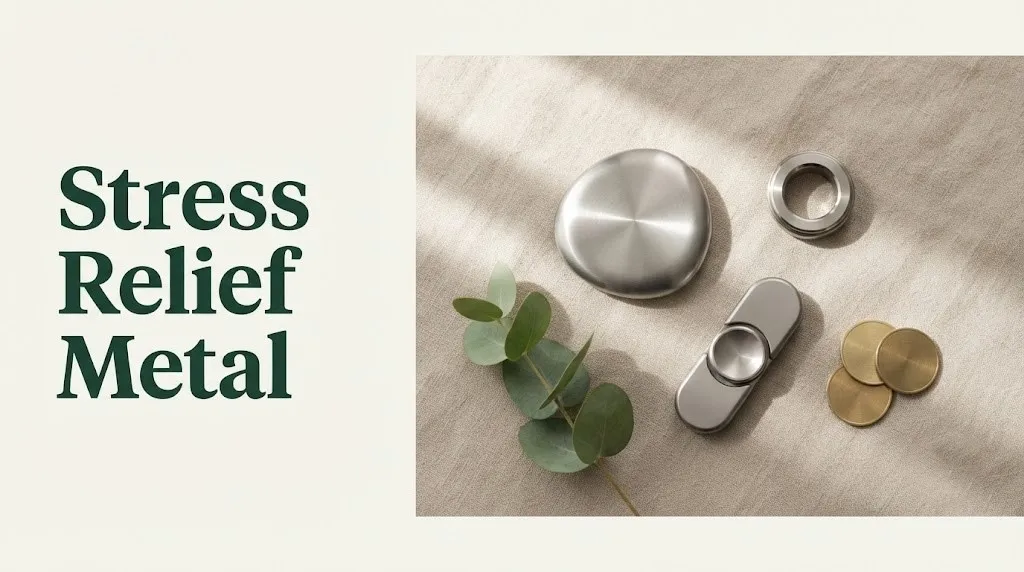
The term covers several distinct product categories: fidget spinners and sliders, worry stones, acupressure rings, and magnetic jewelry. Each uses a different mechanism, but all rely on the same basic idea: occupying your hands with a small, controlled, repetitive motion.
It’s worth separating this from an unrelated technical term. In manufacturing, “stress relieving” also describes a heat-treatment process used to reduce internal tension in welded or machined steel parts. That’s an industrial process with nothing to do with mental wellness, and it’s easy to land on the wrong content if you’re not specific about which “stress relief metal” you mean.
For this article, the focus is entirely on the wellness category: objects people carry, wear, or hold to manage everyday tension, not steel manufacturing.
Individual variation note: People with sensory processing differences, including many autistic individuals and people with ADHD, often already engage in repetitive self-soothing behavior known as stimming. For this group, a metal fidget object isn’t a novelty; it’s often a more socially discreet version of something they already do naturally.
Quick Tip:
- Look for products marketed with clear material specs (stainless steel 316L, titanium grade 5) rather than vague “premium metal” language
- Avoid products with loose small parts if you have young children in the house
- Treat “clinically proven” claims on packaging with skepticism unless a specific study is cited
Metal Stress Relief: How These Tools Physically Work
Metal stress relief tools work through tactile and proprioceptive input, meaning the sensory feedback your hands and joints get from touch, pressure, and movement.
That input travels through the peripheral sensory nervous system to the brain, where it can compete for attention with anxious or ruminative thoughts. This isn’t unique to metal, but metal objects add weight, temperature contrast, and mechanical resistance that plastic versions typically lack, which many users report as more satisfying and grounding.
According to the National Institute of Mental Health, occupying attention with a structured, repetitive task is one behavioral strategy some people use to manage momentary anxious arousal, though NIMH’s guidance frames this as a supportive coping behavior, not a treatment.
The weight of metal also matters physiologically in a small way. Heavier objects provide stronger proprioceptive feedback (joint and muscle sense of position and force), which some occupational therapy literature associates with a calming sensory effect, particularly in sensory-seeking individuals.
| Material | Typical Weight Feel | Common Claim |
|---|---|---|
| Stainless steel | Moderate to heavy | Durable, cool to the touch, strong tactile feedback |
| Titanium | Light for its strength | Hypoallergenic, premium feel |
| Brass | Heavy, warms with use | Nostalgic, satisfying weight |
| Aluminum alloy | Light | Affordable, less tactile feedback |
Individual variation note: People with arthritis or reduced hand grip strength may find heavier metal tools uncomfortable to manipulate for long periods; lighter titanium or aluminum designs are usually a better fit.
Stress Relief Metals: The Materials Used and Why They Matter
The metal a stress relief product is made from directly affects its durability, skin safety, and how satisfying it feels to use.
Stainless steel, usually 316L grade, is the most common choice because it resists corrosion, doesn’t tarnish with hand oils, and has a smooth, cool-to-the-touch feel that many users find calming on contact. It’s also relatively affordable to manufacture at scale.
Titanium shows up in higher-end fidget rings and sliders because it’s lighter than steel for the same strength and is naturally hypoallergenic, which matters for the next material consideration.
Brass and copper appear in worry stones and coin-style fidgets. Both metals develop a patina and warm quickly in the hand, which some users describe as a more “alive” tactile experience than steel. Copper in particular has no established evidence for any therapeutic effect beyond touch and weight; despite folk claims, there’s no controlled research supporting copper jewelry as having a measurable effect on cortisol or inflammation.
A 2020 review published in the Journal of Behavioral Medicine examining self-regulation tools broadly noted that material choice in tactile objects influences user engagement and consistency of use more than it influences any measurable physiological outcome.
Safety note: Nickel is a common component in cheaper metal alloys and is the most frequent cause of contact dermatitis from jewelry and handheld metal objects. Anyone with a known nickel allergy should look specifically for nickel-free or titanium products.
Key Takeaway: The metal itself doesn’t have a proven calming chemical effect; the weight, texture, and durability are what make metal versions feel more satisfying than plastic to most users.
Metal Fidget Toys for Stress Relief: What the Research Actually Says
Metal fidget toys for stress relief have limited direct clinical research, but they draw on a broader, better-studied body of work on fidgeting, attention, and sensory self-regulation.
Research on fidgeting predates the commercial fidget toy trend by decades. Studies on classroom attention and hyperactivity have long observed that small movements, tapping, doodling, object manipulation, can help some individuals sustain focus during low-stimulation tasks, particularly those with ADHD.
That’s a meaningfully different claim than “this product reduces anxiety,” which is the language most product listings use. The American Psychological Association has not endorsed fidget toys as an anxiety treatment; its public stress-management guidance centers on evidence-backed approaches like physical activity, structured relaxation techniques, and cognitive behavioral strategies.
What fidget toys can plausibly do, based on the sensory self-regulation literature, is offer a brief, low-effort behavioral distraction and a discreet outlet for restless energy. That’s a real, usable benefit. It’s just a smaller and more specific claim than most marketing copy suggests.
Evidence quality snapshot:
| Claimed Benefit | Evidence Level |
|---|---|
| Provides tactile distraction during restlessness | Supported by observational and behavioral research |
| Improves focus during low-stimulation tasks in ADHD | Preliminary, mixed clinical study results |
| Reduces cortisol or measurable stress hormones | No direct human trial evidence |
| Treats or manages diagnosed anxiety disorders | Not supported; not a substitute for therapy |
Individual variation note: For someone with generalized anxiety disorder, a fidget tool may reduce momentary restlessness without touching the underlying anxious cognition that a clinician would target with cognitive behavioral therapy (CBT).
How Metal Fidget Toys Help With Anxiety
Metal fidget toys can help with anxiety by giving anxious energy a physical, repetitive outlet instead of letting it build up unaddressed.
When the body’s sympathetic nervous system activates during stress, it often produces physical restlessness, fidgeting, pacing, jaw clenching, as a byproduct of heightened arousal. A fidget tool doesn’t stop that arousal at the hormonal level, but it gives the resulting restlessness somewhere specific and quiet to go.
There’s also an attentional component. Manipulating a small object requires just enough focus to compete with racing or ruminative thoughts, which some cognitive behavioral frameworks describe as a grounding technique, similar in principle to counting objects in a room during a panic episode.
Metal specifically adds a sensory layer that plastic often lacks: temperature change. A cool piece of steel warming in your palm provides a distinct, trackable sensation that some therapists use informally as a grounding cue for anxious moments, similar to holding an ice cube, though metal is far gentler and doesn’t carry the same skin-safety concerns.
Numbered sequence for using one during acute anxious moments:
- Hold the object and notice its temperature against your palm for 10 seconds
- Begin the repetitive motion (spin, slide, or rub) slowly and deliberately
- Pair the motion with slow diaphragmatic breathing, four counts in, six counts out
- Continue for 60 to 90 seconds before checking whether restlessness has eased
- If anxiety persists beyond a few minutes, shift to a longer breathing or grounding exercise
Individual variation note: People experiencing panic attacks with strong physical symptoms (chest tightness, dizziness) need breathing-focused or medically evaluated intervention first; a fidget tool alone is not sufficient for panic-level symptoms.
Key Takeaway: A metal fidget tool is a distraction and grounding aid for mild, situational restlessness, not a mechanism that lowers cortisol or treats an anxiety disorder.
Best Metal Stress Relief Toys for Adults
The best metal stress relief toys for adults are ones matched to how you actually fidget: spinning, sliding, clicking, or rubbing.
Fidget sliders and haptic coins suit people who prefer quiet, subtle motion appropriate for meetings or shared workspaces. Spinners suit people who want more kinetic movement and don’t mind a visible fidget. Worry stones and coins suit people who want the simplest, most discreet option, just a smooth object to rub between fingers.
Weight preference matters more than most buying guides acknowledge. Heavier stainless steel or brass pieces give stronger proprioceptive feedback, which sensory-seeking individuals often prefer. Lighter titanium or aluminum pieces suit people who find heavy objects distracting or tiring to hold for long periods.
| Type | Best For | Discretion Level |
|---|---|---|
| Fidget slider | Office or classroom use | High |
| Fidget spinner | Visible fidgeting, kinetic release | Low |
| Worry stone/coin | Pocket carry, subtle rubbing | Very high |
| Fidget ring | Constant wear, no need to reach for it | High |
Individual variation note: Adults in client-facing or quiet office roles generally do better with sliders, rings, or worry stones; visible spinners are more disruptive in shared professional spaces and can draw unwanted attention.
Metal Worry Stone for Stress: An Old Practice, New Material
A metal worry stone for stress is a small, smooth handheld object rubbed repeatedly with the thumb to provide calming tactile input.
Worry stones predate the fidget toy trend by centuries; smooth stones used for repetitive touch appear across multiple cultural traditions as informal anxiety-management tools, long before any clinical research existed on the behavior. Metal versions are simply a modern material update on that same repetitive-touch principle.
The mechanism is identical to other tactile fidgets: repetitive sensory input competing with anxious attention. Metal worry stones add a consistent temperature and smoother long-term durability than natural stone, which can chip or wear unevenly.
There’s no evidence that a worry stone produces any effect beyond the psychological and attentional benefit of repetitive touch. It doesn’t interact with any hormone pathway directly. Its value is behavioral, not chemical.
Safety note: Because worry stones are a single solid piece with no moving parts, they carry lower choking and pinch-injury risk than spinners or sliders, making them a reasonable starter option for younger teens under adult guidance.
Magnetic Stress Relief Rings: What the Evidence Actually Shows
Magnetic stress relief rings have no controlled clinical evidence supporting any physiological stress-reduction effect from the magnets themselves.
Magnetic therapy broadly, including magnetic bracelets and rings marketed for pain and stress relief, has been studied for other conditions like arthritis pain, and those trials have generally found effects no better than placebo. The Mayo Clinic notes that while magnetic therapy is popular, well-designed studies have not demonstrated a reliable therapeutic benefit for pain or stress conditions.
What magnetic fidget rings and sliders do provide is a satisfying mechanical action: the click or snap of magnets connecting and separating gives strong sensory feedback, similar in principle to popping bubble wrap. That tactile satisfaction is real and can be genuinely engaging, but it’s a mechanical sensation, not a magnetic health effect.
Bullet points on what to know before buying:
- The “magnetic therapy” claim on stress relief jewelry is not supported by controlled human trials
- The tactile click-and-release action is the actual source of any calming effect, not magnetism
- Small, strong magnets (often neodymium) pose a serious ingestion hazard if swallowed, particularly for young children, and can cause internal injury requiring emergency surgery if multiple magnets are swallowed
- Keep magnetic fidget products away from pacemakers and other implanted medical devices per manufacturer warnings
Individual variation note: Anyone with an implanted medical device such as a pacemaker should ask their cardiologist specifically about magnet proximity guidelines before using strong magnetic fidget products regularly.
Acupressure Metal Rings for Stress: Mechanism and Evidence
Acupressure metal rings, often sold as spiky spring-coil rings, are designed to stimulate finger pressure points believed in traditional acupressure practice to support relaxation.
The physiological mechanism claimed by acupressure practice involves stimulating specific points to influence energy flow, a concept rooted in traditional Chinese medicine rather than Western physiology. Western researchers studying acupressure more broadly, largely in the context of nausea and pain, have found modest evidence for some applications, but stress-specific acupressure research on finger rings specifically is very limited.
What is measurable is the mechanical effect: sliding a coiled metal ring up and down a finger applies consistent, rhythmic pressure, which produces a genuine massage-like sensation regardless of whether the traditional acupressure framework holds up to controlled trials.
A 2022 review in Stress and Health examining tactile self-soothing interventions broadly found that rhythmic pressure and touch-based self-massage techniques showed modest, short-term reductions in self-reported tension, though the review noted most included studies were small and lacked long-term follow-up.
Quick Tip:
- Use the ring by sliding it slowly from base to tip of the finger, repeating for 30 to 60 seconds per finger
- Avoid rings that pinch tightly enough to cause numbness or discoloration
- Discontinue use if you notice skin irritation, which can indicate a metal sensitivity
Individual variation note: People with poor circulation or diabetic neuropathy should use pressure-based finger tools cautiously, since reduced sensation can mask a ring that’s fitting too tightly.
Metal Fidget Toys vs. Plastic Fidget Toys: Which Actually Helps More
Neither material has been shown in controlled research to reduce stress more effectively; the real difference is durability, tactile feedback, and user preference.
Metal versions tend to feel heavier and cooler, which many users report as more satisfying, and they hold up to repeated daily use far better than plastic, which tends to crack or lose smooth rotation over months of use. That durability matters for consistency, since a tool you keep using is more useful than one that breaks and gets abandoned in a drawer.
Plastic fidgets are typically quieter in certain designs, cheaper to replace, and lighter, which some users with hand fatigue or arthritis prefer over heavier metal pieces.
| Factor | Metal | Plastic |
|---|---|---|
| Durability | High, resists wear for years | Lower, cracks or loosens over months |
| Tactile feedback | Stronger, cooler, heavier | Lighter, less pronounced |
| Noise level | Varies by design | Often quieter for basic spinners |
| Cost | Higher upfront | Lower upfront, frequent replacement |
| Allergy risk | Present with nickel-containing alloys | Generally low, unless BPA is a concern |
Individual variation note: Children under 5 should generally avoid small metal fidget parts entirely regardless of material, given choking hazard risk with detachable pieces; soft, oversized sensory toys are a safer category for that age group.
Stainless Steel and Titanium Stress Relief Jewelry
Stainless steel and titanium stress relief jewelry refers to wearable fidget items, usually rings or bracelets, that combine everyday jewelry with a functional fidget mechanism.
These products are designed for constant, subtle use throughout the day rather than being pulled out only during acute stress. A spinner ring, for example, has an outer band that rotates freely around an inner band, allowing near-silent fidgeting during a meeting, class, or conversation without anyone noticing.
Titanium is the preferred material for people with metal sensitivities because it’s biologically inert and rarely triggers contact dermatitis, unlike cheaper alloys that may contain nickel. Stainless steel, particularly surgical-grade 316L, is the next best option for sensitive skin.
According to the American Academy of Dermatology, nickel allergy is one of the most common causes of allergic contact dermatitis, and jewelry is a frequent trigger, which makes material transparency genuinely important for anyone planning to wear a fidget ring daily rather than use it occasionally.
Numbered guide to fitting a spinner ring properly:
- Measure your ring size using a standard jewelry sizing tool or printable guide
- Choose a slightly looser fit than your standard ring size, since spinner rings need room to rotate freely
- Test the rotation before regular wear; it should spin smoothly without catching
- Remove during activities involving machinery or heavy manual work
- Clean periodically with mild soap and water to prevent skin oil buildup affecting rotation
Individual variation note: People who work with their hands in manual labor or medical settings requiring frequent glove changes may find wearable fidget rings impractical compared to a pocket-carried worry stone or slider.
Metal Stress Relief Toys for ADHD
Metal stress relief toys are commonly used by people with ADHD as a discreet outlet for the physical restlessness that often accompanies the condition.
Fidgeting has a documented, though still developing, research relationship with attention in ADHD. Some studies on children and adults with ADHD have found that permitting small movements during tasks can, for some individuals, correlate with modestly better task engagement, though results are mixed and highly individual rather than universal.
The National Institute of Mental Health describes ADHD as involving differences in attention regulation and impulse control tied to executive function circuitry in the brain; it does not list fidget toys as a treatment, and standard ADHD management includes behavioral therapy and, when appropriate, medication under a physician’s guidance.
A metal fidget tool for someone with ADHD functions best as a supplementary self-regulation aid alongside, not instead of, an established treatment plan developed with a clinician.
Bullet list of practical fit factors for ADHD-specific use:
- Quiet, low-visual-distraction designs (sliders, rings) generally work better in classroom or work settings than spinners, which can distract others
- Weighted metal designs may provide stronger proprioceptive feedback for sensory-seeking individuals with ADHD
- Consistency matters more than the specific product; using the same tool regularly builds a reliable self-regulation habit
Individual variation note: A child recently diagnosed with ADHD should have fidget tool use discussed with their pediatrician or treating clinician, since some school settings have specific policies on classroom fidget items.
Key Takeaway: Fidget tools can support attention and restlessness management for some people with ADHD, but they supplement clinical treatment; they don’t replace it.
Are Metal Stress Relief Toys Safe for Kids?
Metal stress relief toys are generally safe for older children and teens but carry real risks for younger children due to small parts, sharp edges, and magnets.
The main hazards are choking on small detachable pieces, cuts from poorly finished metal edges on cheaper products, and, most seriously, magnet ingestion in products with multiple small magnetic components. The Consumer Product Safety Commission has issued specific warnings about high-powered small magnets, since swallowing more than one can cause the magnets to attract each other through intestinal walls, requiring emergency surgery.
Age-appropriate guidance table:
| Age Group | Recommended Product Type | Avoid |
|---|---|---|
| Under 5 | Soft sensory toys, not metal fidgets | Small metal parts, magnets |
| 5 to 8 | Solid single-piece worry stones under supervision | Multi-part magnetic sets |
| 9 to 12 | Sliders, spinner rings, simple spinners | Loose small magnets |
| Teens and adults | Full range, including magnetic and multi-piece designs | Poorly finished sharp-edged imports |
Safety note: If a child swallows a magnet or small metal component, contact a pediatrician or poison control immediately rather than waiting to see if symptoms develop, since magnet ingestion can cause internal damage before obvious symptoms appear.
Individual variation note: Children with a history of putting objects in their mouths, common in some autism spectrum presentations, need extra caution regardless of stated age recommendations on packaging.
How to Choose a Metal Stress Relief Toy
Choosing a metal stress relief toy comes down to matching the material, mechanism, and discretion level to how and where you’ll actually use it.
Start with material safety if you have any known metal sensitivity: titanium or surgical-grade stainless steel first, cheaper unlabeled alloys last. Next, consider where you’ll use it most; a loud spinner is a poor fit for a quiet office, while a worry stone or ring works almost anywhere.
Numbered buying checklist:
- Confirm the metal type is stated clearly on the listing (avoid vague “alloy” descriptions with no specifics)
- Check for a smooth, burr-free edge finish in reviews or product photos
- Match the mechanism (spin, slide, click, rub) to your actual fidgeting habit, not the one that looks most interesting online
- For magnetic products, verify the magnets are securely sealed inside the housing, not loose or detachable
- Check weight specifications if you have hand fatigue or arthritis; lighter titanium designs are gentler for extended use
Bullet list of red flags to avoid:
- No stated material composition
- Reviews mentioning sharp edges or pinching
- Loose magnetic components in multi-piece sets
- Claims of “clinically proven anxiety reduction” without any cited source
Individual variation note: Older adults managing arthritis should prioritize lightweight titanium or aluminum designs with larger, easy-to-grip surfaces over small, fiddly precision pieces.
Metal Stress Relief Gifts
Metal stress relief gifts work best when matched to the recipient’s actual stress triggers and lifestyle rather than chosen purely for novelty.
For someone in a busy office job, a discreet slider or spinner ring is more practical than a visible spinner. For a student, a durable, inexpensive worry stone or basic spinner withstands daily backpack wear better than delicate jewelry-style pieces. For a person managing ADHD or sensory processing differences, a weighted, high-feedback design like a heavier stainless steel slider tends to be appreciated more than a lightweight novelty item.
Gift-giving checklist by recipient:
| Recipient | Good Fit | Consider Avoiding |
|---|---|---|
| Office worker | Spinner ring, quiet slider | Loud spinners, oversized designs |
| Student/teen | Durable basic spinner, worry stone | Fragile jewelry-style pieces |
| Person with ADHD | Weighted slider or ring | Delicate, low-feedback options |
| Older adult | Lightweight titanium, large grip | Small fiddly precision parts |
Individual variation note: Before gifting a metal fidget tool to someone managing a diagnosed anxiety disorder, it’s worth checking with them directly, since some people find fidget tools genuinely helpful while others find unsolicited “anxiety gifts” mildly stigmatizing.
What Metal Stress Relief Tools Cannot Do
Metal stress relief tools cannot treat a diagnosed anxiety disorder, lower cortisol on a measurable physiological level, or replace professional mental health care.
Their actual, evidence-supported role is narrow: a behavioral distraction and tactile grounding aid for mild, situational restlessness. That’s a genuinely useful function, but it doesn’t touch the underlying cognitive or biological processes involved in generalized anxiety disorder, panic disorder, or clinical burnout.
If stress or anxiety is persistent, escalating, or interfering with sleep, work, or relationships, a fidget tool is not an adequate response on its own. That level of symptom warrants evaluation by a licensed clinical psychologist or a primary care physician, who can screen for an underlying anxiety disorder and discuss options including cognitive behavioral therapy or, when appropriate, medication.
Bullet list of signs that a metal fidget tool is not enough:
- Anxiety symptoms lasting most days for several weeks or longer
- Physical symptoms like chest tightness, rapid heartbeat, or panic episodes
- Stress affecting sleep, appetite, or ability to function at work or school
- Reliance on the object growing while underlying worry stays the same or worsens
If you are in crisis or experiencing thoughts of self-harm, contact the 988 Suicide and Crisis Lifeline by calling or texting 988 at any time. This service is free, confidential, and available 24 hours a day.
Individual variation note: For someone managing a diagnosed mental health condition, a fidget tool can reasonably sit alongside therapy and, if prescribed, medication, but it should never be the only intervention in place.
Frequently Asked Questions About Stress Relief Metal
Does metal stress relief actually work?
Metal stress relief tools can provide a genuine, if modest, behavioral distraction through tactile and proprioceptive input during momentary restlessness.
There’s no evidence they lower stress hormones directly.
They work best as a supplement to, not a replacement for, evidence-based stress management.
What is the best metal for stress relief toys?
Titanium and surgical-grade stainless steel (316L) are generally the best choices because they resist corrosion and rarely trigger skin allergies.
Brass and copper are common in worry stones and coins for their weight and warmth.
Avoid unlabeled “alloy” products, since these often contain nickel, a common allergen.
Are metal fidget toys better than plastic ones?
Metal fidget toys are more durable and provide stronger tactile and temperature feedback than plastic versions.
Neither material has been shown to reduce stress more effectively in controlled research.
The better choice depends on personal preference, hand comfort, and noise level needed for your setting.
Can metal stress relief rings help with anxiety?
Metal stress relief rings can help manage momentary restlessness by giving anxious energy a quiet, repetitive outlet.
They are not a treatment for generalized anxiety disorder or panic disorder.
Persistent anxiety symptoms should be evaluated by a licensed clinical psychologist or primary care physician.
Are metal stress relief toys safe for kids?
Metal stress relief toys are generally safe for older children and teens when made from smooth, single-piece designs without small detachable parts.
Products with loose magnets or small pieces pose a choking and ingestion hazard for children under 5.
Swallowed magnets require immediate medical attention, since multiple magnets can cause internal injury.
What is a metal worry stone used for?
A metal worry stone is a small handheld object rubbed with the thumb to provide calming, repetitive tactile input during stress.
It works through distraction and sensory grounding rather than any direct hormonal effect.
It’s considered one of the lowest-risk fidget options since it has no moving or detachable parts.
Final Thoughts
If you’re considering a metal stress relief tool, pick one that matches how you actually fidget, spinning, sliding, or rubbing, rather than the flashiest option online. Start with titanium or surgical-grade stainless steel if you have sensitive skin, and skip anything with loose magnets if kids are in the house.
Use it the way it’s actually supported by evidence: as a quiet, low-effort outlet for restlessness, not a fix for ongoing anxiety.
If stress has been building for weeks rather than minutes, a fidget ring in your pocket isn’t the tool for that job. A conversation with a licensed clinical psychologist or your primary care physician is the next real step.