Can Stress Cause an Abnormal EKG? What It Means in 2026
Yes, stress can cause an abnormal EKG, most often by triggering sinus tachycardia or minor repolarization changes rather than structural heart disease. Acute stress hormones speed up your heart rate and can create electrical patterns that look concerning on paper but usually resolve once your nervous system calms down.
This matters because misreading a stress-related EKG finding as a heart attack, or dismissing a genuine cardiac issue as “just anxiety,” both carry real risk. According to the American Heart Association, catecholamines released during acute stress can transiently alter heart rate, blood pressure, and even ventricular repolarization patterns captured on a tracing.
Below, you’ll get the specific physiological pathway connecting stress to EKG changes, which findings are typically benign, which ones need urgent cardiology evaluation, and how to prepare for testing if anxiety tends to spike your readings.
What is an abnormal EKG?
An abnormal EKG is any electrocardiogram tracing showing electrical patterns outside the expected range for heart rate, rhythm, or wave shape. The test measures the heart’s electrical activity through electrodes placed on the skin, capturing each phase of the heartbeat as a wave pattern.
“Abnormal” is a broad label. It can mean anything from a harmless variant to a life-threatening arrhythmia.
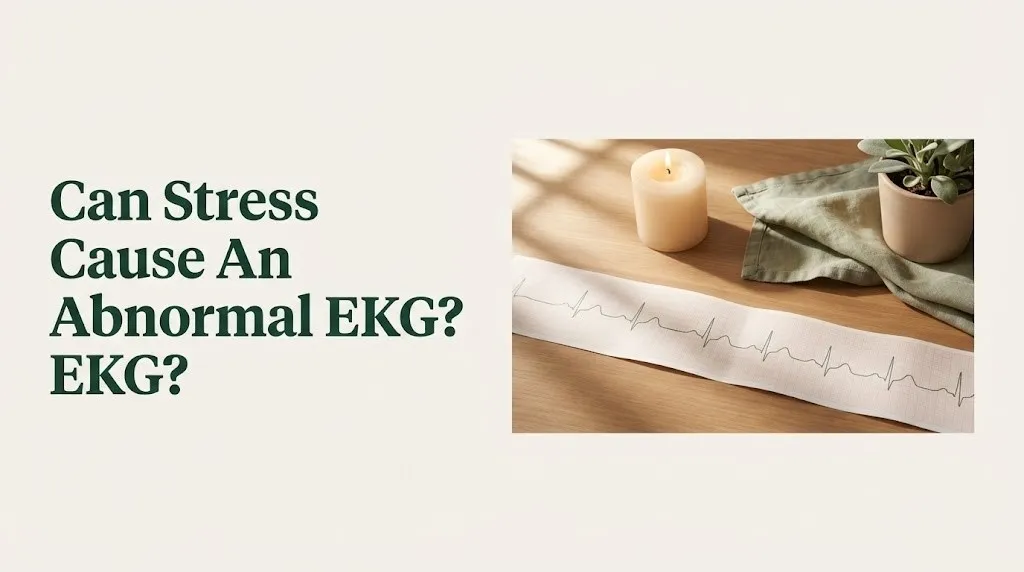
Common categories include rate abnormalities (too fast or too slow), rhythm abnormalities (irregular beating), and wave-shape abnormalities (changes in the ST segment, T wave, or QT interval). A single abnormal reading does not automatically mean disease.
Context determines significance: your age, symptoms, medical history, and what you were doing right before the test all factor into interpretation.
| EKG Finding Type | Example | Typically Benign? |
|---|---|---|
| Rate | Sinus tachycardia | Often, if transient |
| Rhythm | Premature ventricular contraction | Usually, if isolated |
| Wave shape | ST-segment elevation | Requires urgent evaluation |
A primary care physician or cardiologist reviews the tracing alongside your symptoms and history before deciding whether further testing is warranted. People with a personal or family history of heart disease need a lower threshold for follow-up, since the same finding carries more weight in that context.
How does stress affect the heart?
Stress affects the heart primarily through the SAM axis (sympathetic-adrenal-medullary axis), which releases epinephrine and norepinephrine from the adrenal medulla within seconds of a perceived threat. These catecholamines bind to receptors in the heart’s conduction system and increase both the rate and force of contraction.
Think of your heart’s electrical system like a metronome that a stress hormone can suddenly speed up. The sinoatrial node, the heart’s natural pacemaker, fires more frequently under catecholamine influence, which is why anxious moments come with a pounding, rapid pulse.
Alongside the SAM axis, the slower-acting HPA axis releases cortisol from the adrenal cortex, which can influence blood pressure and vascular tone over hours rather than seconds.
The combined effect can shift how the heart repolarizes between beats, sometimes producing subtle ST-T wave changes on a tracing.
Quick Tip:
- Elevated resting heart rate before testing often reflects recent caffeine, movement, or anticipatory anxiety, not cardiac disease
- Diaphragmatic breathing for 60 seconds before an EKG can lower sympathetic activation measurably
- People on beta-blockers or stimulant medications should tell the technician, since these alter baseline heart rate independent of stress
Individual variation matters here: postmenopausal women show a documented higher incidence of stress-triggered cardiac events like Takotsubo syndrome, which is discussed later in this article.
Can anxiety cause an abnormal EKG?
Anxiety can cause an abnormal EKG by producing the same catecholamine surge as acute stress, most commonly showing up as a faster-than-normal heart rate or occasional extra beats. This is distinct from anxiety causing structural heart damage, which it does not do on its own.
According to the National Institute of Mental Health, roughly 31 percent of U.S. adults experience an anxiety disorder at some point in their lives, and generalized anxiety disorder and panic disorder are the two conditions most frequently linked to cardiac-mimicking EKG findings in the clinical literature.
The physiological overlap between panic symptoms and cardiac symptoms is real: chest tightness, shortness of breath, and a racing pulse can stem from either the heart or the nervous system, which is exactly why the EKG exists as an objective check.
Clinicians distinguish anxiety-related findings from cardiac disease by looking at pattern consistency (does it resolve with calming) and by correlating symptoms with risk factors like age, smoking history, or family history of coronary disease.
People with diagnosed panic disorder may need to disclose this before testing, since a known history helps a cardiologist interpret borderline findings appropriately rather than ordering unnecessary repeat workups.
Key Takeaway: A racing or irregular-feeling heartbeat during an anxious episode is usually your nervous system, not your heart, malfunctioning, but any new or unexplained EKG finding still deserves a professional look.
Can stress cause heart palpitations?
Stress can cause heart palpitations by triggering catecholamine release that increases both heart rate and the force of each contraction, making beats more noticeable. Palpitations are a subjective sensation and do not always correspond to a measurable EKG abnormality.
The sensation often comes from a combination of a genuinely faster heart rate plus heightened bodily awareness during anxious states, a phenomenon sometimes called interoceptive sensitivity in the behavioral medicine literature.
Palpitations tied to stress typically:
- Start and stop with the stressful trigger rather than occurring randomly
- Feel like pounding, fluttering, or a skipped beat rather than sustained chest pain
- Resolve within minutes once the stressor passes or calming techniques are used
- Occur alongside other stress symptoms like sweating, tense muscles, or racing thoughts
Palpitations accompanied by chest pain, fainting, or shortness of breath that does not improve within a few minutes are different from typical stress palpitations and warrant same-day evaluation by a primary care physician or urgent care.
People with underlying thyroid conditions experience amplified palpitation frequency because excess thyroid hormone independently increases catecholamine sensitivity, so this population needs thyroid function checked alongside any stress evaluation.
Can stress cause sinus tachycardia?
Yes, stress is one of the most common causes of sinus tachycardia, defined as a heart rate above 100 beats per minute that still originates from the heart’s normal pacemaker. This is the single most frequent stress-related EKG finding reported in clinical settings.
Sinus tachycardia from stress is considered a physiological response rather than a disease process. The sinoatrial node is simply firing faster because catecholamines are telling it to.
| Feature | Stress-Related Sinus Tachycardia | Pathological Tachycardia |
|---|---|---|
| Onset | Gradual, tied to trigger | Often sudden |
| Rhythm origin | Normal (sinus node) | May be abnormal (atrial or ventricular) |
| Resolution | With calming or rest | Persists despite rest |
| Associated symptoms | Mild, anxiety-linked | Chest pain, syncope, severe dyspnea |
A 2022 review in Psychosomatic Medicine noted that acute psychological stress reliably elevates heart rate in laboratory settings, supporting a well-established, mechanistically direct connection between stress exposure and sinus rate increases.
Adolescents and young adults tend to show more dramatic heart rate swings under stress than older adults, partly due to higher baseline autonomic reactivity, so a rate spike that looks alarming in a 19-year-old may be entirely typical for their age group.
Can stress cause T-wave inversion?
Stress can be associated with T-wave inversion, a change in how the heart repolarizes between beats, though this finding always warrants further evaluation to rule out cardiac causes first. T-wave inversion is not automatically dismissed as “just stress.”
The T wave represents ventricular repolarization. Catecholamine surges can alter the timing of this electrical recovery phase, and in some documented cases of extreme emotional stress, this produces measurable T-wave changes.
This is the mechanism behind Takotsubo syndrome (stress-induced cardiomyopathy), a condition first described in Japan, where a sudden emotional shock produces temporary heart muscle weakness and EKG changes that can closely mimic a heart attack.
Evidence quality here is supported by clinical case series and observational cardiology data rather than large randomized trials, since the condition is by nature unpredictable and acute.
Because T-wave inversion overlaps with signs of ischemia, a cardiologist typically orders additional testing such as cardiac enzymes or an echocardiogram before attributing the finding to stress alone. Postmenopausal women represent the population most frequently diagnosed with Takotsubo syndrome, likely related to estrogen’s role in vascular and catecholamine regulation.
Can stress cause premature ventricular contractions?
Stress can trigger premature ventricular contractions (PVCs), extra heartbeats that originate from the heart’s ventricles rather than its normal pacemaker. Occasional PVCs are common and usually harmless in people without underlying heart disease.
Catecholamines increase the excitability of heart muscle cells, which can cause the ventricles to fire an extra beat outside the normal rhythm sequence. This often feels like a skipped beat or a hard thump.
To tell whether PVCs need further workup:
- Note frequency: occasional PVCs (a handful per day) are lower concern than frequent PVCs (thousands per day)
- Note triggers: caffeine, alcohol, poor sleep, and acute stress are common, reversible triggers
- Note associated symptoms: dizziness, chest pain, or fainting alongside PVCs raises urgency
- Track duration: PVCs that persist for weeks despite stress reduction deserve cardiology review
- Bring a symptom log to your appointment noting timing relative to stress, caffeine, and sleep
According to the Cleveland Clinic, frequent PVCs, generally defined as more than 10 percent of total heartbeats in a 24-hour period, can in rare cases contribute to a weakened heart muscle over time and should be monitored with a Holter monitor.
People with structural heart disease or a history of heart attack should treat any new PVC pattern as a reason for prompt evaluation rather than assuming stress is the sole cause.
Can stress cause a false positive EKG?
Stress can contribute to what looks like a false positive EKG by producing rate and rhythm changes that mimic disease patterns without any underlying structural problem. This is sometimes called a stress artifact rather than a true false positive, since the electrical changes are real, just not caused by disease.
Bold Research Finding: GE HealthCare’s clinical reporting notes that anxiety-related autonomic changes have been documented to produce nonspecific ST-T wave findings that resolve on repeat testing once a patient is calmer.
Technical factors also contribute to apparent false positives: shallow, rapid breathing during an anxious episode can shift electrode contact and introduce baseline wander or noise into the tracing, which technicians distinguish from a true cardiac signal.
Repeat testing is the standard solution. Most EKG protocols allow a second tracing after a brief rest period if the first one shows unexpected findings in someone with no cardiac risk factors and no symptoms.
Women are more likely than men to have anxiety-related findings misattributed as definitive normal, according to reporting cited by GE HealthCare, which has contributed to documented cases of missed cardiac events being dismissed as “just anxiety.” This cuts both ways: stress can produce misleading findings, but genuine cardiac disease should never be assumed away based on anxiety history alone.
Key Takeaway: An EKG abnormality during a stressful moment is common and often reversible, but repeat testing and a full symptom history are what actually confirm whether stress, not disease, is the cause.
Stress vs heart attack EKG differences
Stress-related EKG changes typically involve rate and minor repolarization shifts that resolve with calming, while a heart attack produces specific, persistent ST-segment elevation or depression patterns tied to blocked blood flow. The distinction is made by a cardiologist using the full clinical picture, not the EKG alone.
| Feature | Stress-Related Changes | Heart Attack Pattern |
|---|---|---|
| Chest pain | Often absent or mild, comes and goes | Persistent, pressure-like, may radiate to arm/jaw |
| EKG pattern | Sinus tachycardia, nonspecific ST-T changes | ST-elevation or new left bundle branch block |
| Onset | Tied to psychological trigger | Often sudden, unrelated to mood |
| Response to rest | Improves | Does not improve |
| Cardiac enzymes | Normal | Elevated (troponin) |
The American Heart Association emphasizes that troponin blood testing, not the EKG in isolation, is what confirms or rules out an actual heart attack in ambiguous cases.
Chest pain lasting more than a few minutes, radiating to the jaw or arm, accompanied by sweating, nausea, or shortness of breath, is never something to self-diagnose as stress. Call emergency services immediately in that scenario.
Older adults and people with diabetes sometimes experience “silent” heart attacks with minimal chest pain, which makes relying on symptom severity alone to distinguish stress from cardiac emergency unreliable in these populations specifically.
What does an abnormal EKG from stress look like?
An abnormal EKG from stress most commonly shows sinus tachycardia, occasional premature beats, or mild nonspecific ST-T wave changes, all of which typically normalize once the person calms down. It rarely shows the dramatic, sustained patterns associated with true cardiac events.
Visually, a stress-affected tracing often has a faster-than-usual rate with otherwise regular spacing between beats, distinguishing it from chaotic or wildly irregular patterns seen in serious arrhythmias.
Quick Tip:
- A heart rate in the 100 to 130 range during an anxious moment is common and usually not concerning on its own
- Look for symptom correlation: does the finding match how you felt right before testing
- Ask your technician for a repeat tracing after five minutes of quiet rest if you felt unusually anxious
A 2021 study referenced in the Journal of Behavioral Medicine found that acute psychological stress in laboratory conditions reliably produced measurable heart rate variability changes, supporting the idea that autonomic shifts are visible and quantifiable, not imagined.
People taking stimulant medications for ADHD or using over-the-counter decongestants may show stress-like EKG patterns even at rest, so medication history should always be part of the interpretation, not just perceived stress level.
Can panic attacks cause abnormal EKG?
Panic attacks can cause an abnormal EKG through the same intense catecholamine surge seen in acute stress, often producing marked sinus tachycardia and sometimes transient chest discomfort that mimics cardiac symptoms. This is well documented in emergency medicine literature on panic disorder presentations.
Panic attacks activate the amygdala, the brain’s threat-detection center, which rapidly signals the hypothalamus to trigger the SAM axis. Heart rate can spike from a resting rate into the 130 to 150 range within seconds.
This is part of why panic attacks and heart attacks are so frequently confused, both by patients and, occasionally, in emergency room triage before full workup.
Distinguishing features include:
- Panic attacks often peak within 10 minutes and then subside, while cardiac chest pain typically persists or worsens
- Panic attacks frequently include a sense of impending doom paired with tingling or dizziness, which can also occur with cardiac events, making self-diagnosis unreliable
- A history of prior panic attacks with similar symptom patterns supports (but never confirms) a stress-based explanation
According to the Anxiety and Depression Association of America, panic disorder affects about 2 to 3 percent of U.S. adults annually, and repeated emergency visits for panic-related chest symptoms are common before a formal diagnosis is made.
Anyone experiencing their first-ever panic-attack-like episode, especially after age 40 or with cardiac risk factors, should be evaluated in an emergency setting rather than assuming it is anxiety.
Can stress cause a heart attack?
Chronic and acute stress can contribute to a heart attack, primarily by raising blood pressure, promoting inflammation, and in rare cases triggering plaque rupture in someone with existing coronary artery disease. Stress alone, without underlying arterial disease, more commonly causes Takotsubo syndrome rather than a classic heart attack.
The American Heart Association identifies chronic stress as a contributing risk factor for cardiovascular disease, working alongside high blood pressure, elevated cortisol, and stress-related behaviors like smoking, poor sleep, and inactivity.
Acute emotional shock, such as grief or sudden extreme fear, has been specifically linked to Takotsubo cardiomyopathy, sometimes called “broken heart syndrome,” which produces heart attack-like symptoms and EKG changes without blocked arteries.
Evidence quality: the stress-cardiovascular disease link is supported by large observational studies and is considered well-established as a contributing risk factor, though stress is rarely, if ever, the sole cause absent other risk factors.
People over 50, smokers, those with diabetes, and postmenopausal women carry higher baseline cardiovascular risk, meaning the same stress exposure carries more weight for these groups than for a healthy 25-year-old.
Managing chronic stress through regular physical activity, adequate sleep, and evidence-based techniques like CBT supports cardiovascular health, but it does not replace blood pressure management or treatment for diagnosed coronary artery disease.
When is an abnormal EKG an emergency?
An abnormal EKG is an emergency when it appears alongside chest pain, fainting, severe shortness of breath, or a heart rate that will not slow below 150 beats per minute at rest. These combinations require immediate emergency evaluation rather than waiting for a scheduled appointment.
Specific findings that always warrant emergency care:
- New ST-segment elevation, which can indicate an active heart attack
- Ventricular tachycardia, a rapid and potentially dangerous rhythm originating in the ventricles
- Third-degree heart block, where electrical signals fail to pass properly between heart chambers
- Chest pain lasting more than a few minutes, especially with sweating, nausea, or radiating pain
If you are experiencing chest pain with these features, call emergency services immediately rather than driving yourself to a hospital.
For less severe but still concerning findings, such as isolated PVCs or mild sinus tachycardia without symptoms, a same-week appointment with a primary care physician or cardiologist is generally appropriate.
Older adults and people with diabetes may not experience classic chest pain during a genuine cardiac event, so unexplained fatigue, jaw discomfort, or shortness of breath in these groups should be taken as seriously as chest pain itself.
Key Takeaway: Persistent chest pain, fainting, or a racing heart that will not slow down are the specific red flags that separate a stress-related EKG finding from a true emergency.
How to calm down before an EKG test
Calming down before an EKG mainly involves activating the parasympathetic nervous system through slow, deliberate breathing in the minutes before the test. This directly counteracts the sympathetic activation that produces stress-related rate changes.
To reduce pre-test anxiety:
- Practice diaphragmatic breathing for two to three minutes: inhale through the nose for four counts, hold for two, exhale for six
- Arrive 10 to 15 minutes early to avoid the rushed feeling that itself triggers catecholamine release
- Avoid caffeine for at least two hours before the test, since caffeine independently raises heart rate
- Tell the technician if you feel unusually anxious so they can note it and consider a repeat tracing
- Sit quietly for five minutes before electrode placement rather than talking or checking your phone
A 2020 study in Psychoneuroendocrinology found that brief structured breathing exercises measurably reduced salivary cortisol and heart rate within minutes, supporting this as an evidence-based, low-risk pre-test strategy.
People with claustrophobia or a needle/medical procedure phobia may need additional grounding techniques, such as counting objects in the room, since breathing alone may not fully address a specific phobic trigger.
How to prepare for an EKG if you have anxiety
Preparing for an EKG with anxiety means combining practical logistics with nervous-system-calming techniques so your baseline reading reflects your actual cardiac status. Preparation reduces the odds of an inconclusive or misleading result.
Quick Tip:
- Write down your current medications and supplements, since stimulants and thyroid medications affect baseline heart rate independent of anxiety
- Mention any history of panic disorder or generalized anxiety disorder to your technician or ordering physician beforehand
- Schedule testing earlier in the day if anxiety tends to build as the day goes on
Beyond the day of testing, longer-term stress management supports more stable cardiac readings over time. Regular aerobic exercise, consistent sleep, and structured practices like mindfulness-based stress reduction (MBSR) have documented effects on resting heart rate and heart rate variability.
According to the American Psychological Association, structured relaxation training has shown measurable reductions in physiological stress markers across multiple controlled studies, supporting its use as a legitimate preparatory tool rather than a placebo gesture.
If anxiety around medical testing is frequent or severe enough to interfere with getting necessary care, a licensed clinical psychologist can help using structured, evidence-based approaches like CBT specifically for medical anxiety, which is different from general stress management advice and tends to be more effective for this specific problem.
If you are in crisis or experiencing thoughts of self-harm, contact the 988 Suicide and Crisis Lifeline by calling or texting 988 at any time. This service is free, confidential, and available 24 hours a day.
================================================================
Frequently Asked Questions About Stress and Abnormal EKGs
Can stress really make an EKG look abnormal even if my heart is healthy?
Yes, stress hormones like epinephrine can raise your heart rate and slightly alter repolarization patterns even in a structurally healthy heart.
This most often shows up as sinus tachycardia or minor, nonspecific ST-T changes.
A repeat tracing after calming down usually confirms whether stress was the cause.
What heart rate is considered too fast on an EKG from stress?
A heart rate above 100 beats per minute is classified as tachycardia, and stress commonly pushes readings into the 100 to 130 range.
Rates consistently above 150 at rest, or that do not slow with calming, need prompt evaluation.
Context and accompanying symptoms matter more than the number alone.
Does anxiety cause permanent EKG changes?
No, anxiety-related EKG changes are typically temporary and resolve once the stress response subsides.
Permanent structural changes require an underlying cardiac condition, not anxiety alone.
Recurrent findings still warrant a cardiology evaluation to rule out other causes.
How can I tell if my abnormal EKG is from stress or a real heart problem?
A cardiologist distinguishes the two using symptom pattern, cardiac risk factors, repeat testing, and sometimes blood tests like troponin.
Stress-related changes tend to resolve with rest and calming techniques.
Persistent chest pain, fainting, or symptoms that worsen are signs pointing away from stress alone.
Can a panic attack cause the same EKG changes as a heart attack?
A panic attack can cause rapid heart rate and chest discomfort that superficially resembles heart attack symptoms.
The underlying EKG patterns and blood test results are typically different upon full evaluation.
Anyone unsure should seek emergency evaluation rather than guessing.
Should I tell my doctor I was anxious before my EKG?
Yes, disclosing anxiety before an EKG helps your doctor interpret borderline findings more accurately.
It can prompt a repeat tracing rather than unnecessary further testing.
This is especially useful if you have a history of panic disorder or generalized anxiety disorder.
================================================================
An abnormal EKG during a stressful period is common, and in most healthy people, it reflects a temporary catecholamine surge rather than heart disease. The single most useful thing you can do is separate the pattern from the panic: note whether your symptoms resolve with calm breathing and rest, and bring that specific timeline to your doctor.
If you’re prone to anxiety around medical testing, practice diaphragmatic breathing before your next EKG and mention your anxiety history to the technician upfront.
Persistent chest pain, fainting, or a heart rate that won’t settle are never things to self-diagnose as stress. Get that evaluated the same day, every time.