Can Stress Cause Jaw Pain in 2026? The Full Science
Stress can cause jaw pain, and it does so through a direct neuromuscular pathway that turns psychological tension into physical tightness in the muscles that control your jaw. This is not a vague mind-body connection. It is a measurable chain of events from your brain’s stress centers to the motor neurons that fire your masseter and temporalis muscles.
According to the American Academy of Orofacial Pain, stress is one of the most commonly identified contributing factors in both temporomandibular disorders and bruxism, the clinical term for teeth grinding and jaw clenching. The American Psychological Association’s 2025 Stress in America survey found that 34% of adults reported physical symptoms of stress including muscle tension, with jaw pain and headache among the most frequently mentioned. Dental clinics consistently report increased bruxism-related visits during periods of widespread societal stress.
You will learn exactly how your brain converts a stressful day into an aching jaw, why some people clench visibly while others do it entirely without noticing, the difference between awake stress clenching and sleep bruxism, how stress hormones interact with the jaw joint itself, how to tell if your jaw pain is stress-related or something that needs a dentist urgently, and the specific relaxation techniques and treatments that the evidence supports. This is the neuromuscular explainer your jaw has been waiting for.
Can Stress Cause Jaw Pain
Stress can cause jaw pain by increasing the baseline tension in your masticatory muscles, the powerful muscles on the sides of your head that close your jaw, through direct activation of the sympathetic nervous system. When you are stressed, your jaw muscles contract more, rest less, and eventually become painful from sustained overuse.
The masseter and temporalis muscles are among the strongest muscles in the human body relative to their size. They are designed for the intermittent, high-force work of chewing, not for sustained contraction. Under stress, these muscles receive increased excitatory input from the brain’s motor systems. The result is that your jaw muscles maintain a level of tension even when you are not consciously clenching. Over hours and days, this sustained partial contraction produces the same kind of soreness you would feel in your legs after standing all day.
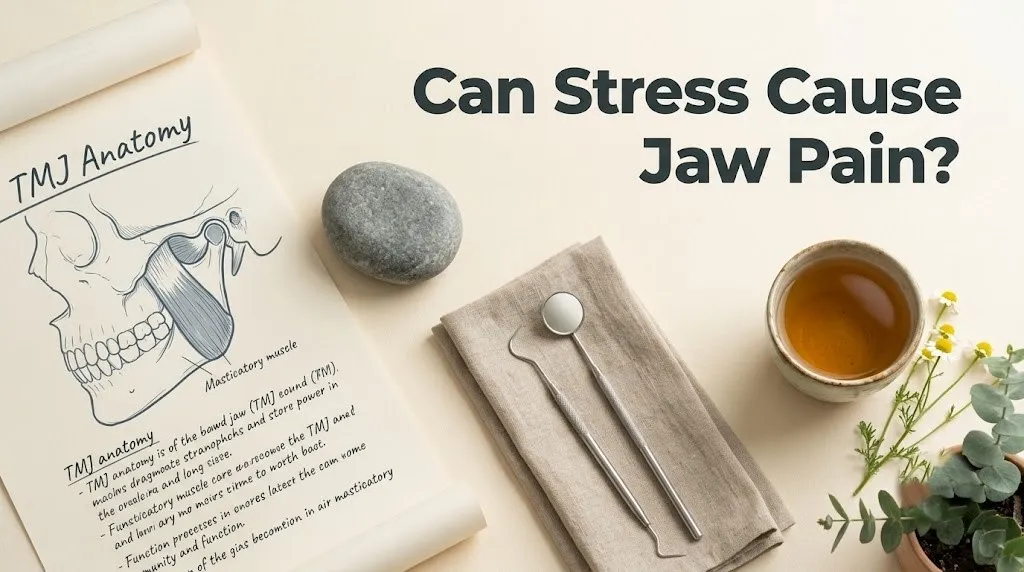
The pain from stress-related jaw tension typically presents as a dull ache in the cheeks, temples, or in front of the ears. It may be worse in the morning if you clench during sleep, or worse in the evening if you clench during the workday. The pain is muscular in origin, arising from the muscle tissue itself rather than from the teeth or the jaw joint, though prolonged muscle tension can eventually refer pain to those structures.
Key Takeaway: Your jaw muscles respond to psychological stress the same way your shoulders do. They tighten up, stay tight, and eventually hurt. The difference is you can see your shoulders. Your jaw clenching may be invisible to you.
Does Stress Cause Jaw Pain
Yes, stress does cause jaw pain, and the connection is one of the most consistently observed relationships in orofacial pain medicine. Dental researchers and clinicians have documented the stress-jaw pain link for decades, and the underlying neuromuscular mechanisms are well understood.
The evidence for this connection comes from multiple research directions. Epidemiological studies show that populations under high stress, including students during exam periods, military personnel during deployment, and workers in high-demand occupations, report elevated rates of jaw pain and TMJ symptoms. Laboratory studies show that experimentally induced stress produces measurable increases in masticatory muscle activity, even when participants are not asked to clench. Polysomnography studies in sleep laboratories document increased jaw muscle activity during REM sleep in individuals under stress.
A study published in the Journal of Orofacial Pain found that individuals with high scores on the Perceived Stress Scale were over three times more likely to report jaw pain than those with low stress scores. The relationship remained after controlling for other factors including age, sex, and dental status. The finding has been replicated across multiple populations and study designs, making the stress-jaw pain connection one of the more robust findings in psychosomatic medicine.
Can Your Jaw Hurt from Stress
Your jaw can hurt from stress even if you never consciously notice yourself clenching or grinding. Many people with stress-related jaw pain are unaware of the muscle activity causing it because clenching often occurs outside conscious awareness, either as a background habit during the day or involuntarily during sleep.
The unawareness of clenching is one of the most challenging aspects of stress-related jaw pain. You may visit your dentist complaining of jaw soreness, morning headaches, or tooth sensitivity, and be surprised to learn that you are clenching or grinding. The dentist sees the evidence on your teeth, worn enamel, abfraction lesions at the gum line, scalloping on the tongue, before you feel the behavior that causes it.
This disconnect between awareness and action happens because jaw clenching, unlike shoulder shrugging or fist clenching, involves muscles that are active during many non-stress activities including speaking, swallowing, and chewing. Your brain can increase baseline muscle tone in the jaw without generating a conscious sensation of effort. The proprioceptive feedback from these muscles is less acute than from the muscles of your hands or limbs, meaning you can maintain tension for hours without noticing until pain develops.
If you have unexplained jaw soreness and cannot tell whether you are clenching, pay attention to what your jaw is doing right now. Is there a gap between your upper and lower teeth? In a relaxed jaw, the teeth should not be touching at rest. If your teeth are together as you read this, you are clenching.
Can Stress Make Your Jaw Hurt
Stress can make your jaw hurt worse when you already have a jaw condition, and it can create jaw pain de novo in someone with no prior history of jaw problems. The worsening effect operates through the same neuromuscular and inflammatory pathways that initiate stress-related jaw pain.
For someone with existing temporomandibular disorder, stress acts as a flare trigger. The muscles around the TMJ are already sensitized and the joint may have underlying inflammation or mechanical dysfunction. Stress increases muscle tension, which loads the joint more heavily, which increases pain, which increases stress. This feedback loop is one of the reasons TMJ disorders can be difficult to treat. The pain produces stress, and the stress produces more pain.
For someone with no prior jaw problems, stress can initiate the process. A period of high occupational stress, a family crisis, or an anxiety disorder can produce sustained jaw clenching sufficient to cause muscle pain, and if the stress persists, the pain can become chronic. The transition from acute stress-related muscle soreness to chronic orofacial pain involves central sensitization, where the nervous system becomes more responsive to pain signals over time.
Key Takeaway: Stress makes existing jaw pain worse and can create new jaw pain in someone who never had it before. The direction of causality runs both ways: stress causes pain, and pain causes stress.
How Stress Causes Jaw Muscle Tension
Stress causes jaw muscle tension through a cascade that begins in the emotional processing centers of the brain and ends at the motor endplates of the masticatory muscles. The pathway involves the amygdala, the hypothalamus, the sympathetic nervous system, and the trigeminal motor nucleus, which is the collection of neurons in the brainstem that controls jaw movement.
The process starts when the amygdala detects a threat, whether that threat is a genuine physical danger or a psychological stressor like an impending deadline. The amygdala signals the hypothalamus, which activates two parallel stress pathways. The HPA axis releases cortisol, and the sympathetic nervous system releases epinephrine and norepinephrine. Both pathways influence muscle function.
The sympathetic nervous system directly increases muscle tone. Epinephrine and norepinephrine bind to beta-adrenergic receptors on muscle fibers and on the motor neurons that control them, increasing their excitability. A motor neuron that is more excitable will fire at a lower threshold, meaning even background neural activity that would normally be subthreshold can trigger muscle contraction. The masticatory muscles receive particularly dense sympathetic innervation compared to other skeletal muscles, making them disproportionately responsive to stress.
At the brainstem level, stress can also alter the activity of the trigeminal motor nucleus. Inputs from stress-sensitive brain regions including the amygdala can modulate the firing patterns of these motor neurons, increasing the drive to the jaw-closing muscles specifically. This is why the jaw tends to clench shut under stress rather than hang open.
Think of your jaw muscles under stress like a car with the idle set too high. The engine is ready to go at any moment, burning fuel and generating heat even while parked. Your jaw is doing the same thing: maintaining tension, burning energy, and generating metabolic byproducts that eventually produce pain.
The Sympathetic Nervous System and Jaw Clenching
The sympathetic nervous system is the primary mediator of stress-induced jaw clenching. It increases the excitability of the motor neurons controlling the jaw muscles, raises baseline muscle tone, and primes the jaw for the fight-or-flight response. This system evolved to prepare the body for physical action. In the modern stress environment, that physical action rarely comes, and the preparation itself becomes the problem.
The fight-or-flight response prepares the entire body for movement. Heart rate increases, blood pressure rises, and skeletal muscles throughout the body receive increased neural drive. The jaw is part of this response. Clenching the jaw stabilizes the head and neck, which is biomechanically useful before running or fighting. In a genuine emergency that resolves with physical action, the clenching stops and the muscles recover.
In chronic psychological stress, the emergency signal never turns off. The sympathetic nervous system maintains elevated output for hours or days at a time, and the jaw muscles maintain elevated tone throughout. This sustained low-level contraction is metabolically demanding. The muscle fibers consume energy, produce metabolic waste products, and eventually develop micro-damage that registers as pain.
The research supporting this pathway includes studies showing that beta-blocker medications, which block the effects of epinephrine and norepinephrine, can reduce stress-related jaw clenching in some individuals. A study published in the Journal of Oral Rehabilitation found that participants given a beta-blocker showed reduced masseter muscle activity during a standardized stress task compared to placebo, providing direct evidence for the catecholamine pathway in stress-related jaw tension.
Stress Bruxism Awake Versus Sleep Clenching
Stress-related bruxism exists in two distinct forms, awake bruxism and sleep bruxism, which have different mechanisms, different relationships to stress, and different management strategies. Understanding which type you have determines what will help.
Awake bruxism is semi-voluntary or habitual jaw clenching and teeth grinding that occurs during waking hours. It is often triggered by concentration, stress, anxiety, or frustration. The person may be partially aware of the behavior or entirely unaware until pain develops. Awake bruxism responds well to awareness training, behavioral modification, and stress management. It is the type most directly tied to day-to-day psychological stress.
Sleep bruxism is involuntary rhythmic jaw muscle activity during sleep, classified as a sleep-related movement disorder. It involves both clenching and grinding, occurs primarily during light sleep and REM sleep, and is influenced by a combination of stress, sleep architecture, genetics, and possibly neurotransmitter systems. Sleep bruxism is less directly responsive to stress management alone because it occurs during unconsciousness.
| Characteristic | Awake Bruxism | Sleep Bruxism |
|---|---|---|
| Awareness | May be partially aware or unaware | Completely unaware during episodes |
| Stress link | Strong, direct correlation with daily stress | Moderate, influenced by stress plus other factors |
| Muscle activity | Sustained clenching, less grinding | Rhythmic contractions, more grinding |
| Management priority | Awareness training, stress reduction, habit reversal | Mouth guard for tooth protection, sleep hygiene, possibly medication |
| Response to stress reduction | Good | Variable |
Many people have both types. The awake clenching may reduce with stress management while the sleep bruxism continues to require a mouth guard for protection.
Key Takeaway: If your jaw hurts most in the evening, you are likely an awake clencher. If it hurts most in the morning, you are likely a sleep bruxer. The treatment approach differs accordingly.
Cortisol, Inflammation, and TMJ Disorders
Cortisol contributes to jaw pain not only through its effects on muscle tension but also through its complex relationship with inflammation in the temporomandibular joint itself. The TMJ is a synovial joint, similar in structure to the knee or hip, and it is susceptible to inflammatory processes that stress hormones can influence.
In the short term, cortisol is anti-inflammatory. This is why corticosteroid medications are used to treat inflammatory flare-ups, including TMJ inflammation. However, chronic stress produces a state of cortisol resistance, where tissues become less responsive to cortisol’s anti-inflammatory signals. The result is that pro-inflammatory cytokines including interleukin-6 and tumor necrosis factor-alpha are produced with less suppression.
These cytokines can accumulate in the synovial fluid of the TMJ, promoting inflammation of the joint lining and breakdown of the cartilage that cushions the joint surfaces. A stressed individual who also clenches their jaw is subjecting an inflamed, vulnerable joint to increased mechanical loading. The combination of biochemical vulnerability from inflammation and mechanical overload from clenching is what drives TMJ disorder progression.
Research published in the Journal of Orofacial Pain has measured elevated inflammatory markers in the synovial fluid of TMJ patients reporting high stress compared to those with low stress and comparable mechanical findings on examination. This suggests that stress adds an inflammatory dimension to TMJ pathology that is partially independent of the mechanical loading from clenching.
Stress Jaw Pain on One Side or Both Sides
Stress-related jaw pain can occur on one side or both sides, and the pattern provides clues about whether the pain is primarily muscular, primarily joint-related, or a combination of both. Most stress-related jaw pain from clenching is bilateral, but unilateral pain is also common.
Bilateral pain affecting both sides of the face, often in the cheek area and temples, is the most typical pattern for stress-induced muscle tension. The masseter and temporalis muscles on both sides are affected because stress increases sympathetic output bilaterally. The pain is usually described as a dull ache or tightness rather than a sharp, localized pain.
Unilateral pain on one side can occur even with bilateral clenching if the jaw mechanics are asymmetric. If you have a slight malocclusion, a missing tooth, or a habit of favoring one side when chewing, the mechanical load during clenching may distribute unevenly, producing pain primarily on one side. Unilateral pain can also indicate that the pain is arising from the TMJ itself rather than from the muscles, as joint pathology is often asymmetric.
True unilateral joint pain that is sharp, localized directly over the TMJ in front of the ear, and accompanied by clicking, popping, or locking is more likely to represent internal derangement of the joint rather than stress-related muscle tension alone. However, stress can worsen the pain from any existing joint problem.
How to Tell if Your Jaw Pain Is from Stress
You can identify whether your jaw pain is likely stress-related by looking at the timing, the pattern, the associated symptoms, and the response to simple self-assessment tests. Stress-related jaw pain tends to correlate with stressful periods, involves the muscles more than the joint itself, and responds to conscious relaxation.
To check if your pain is stress-related, notice whether the pain tracks with your stress levels. Keep a simple log for one week, rating your jaw pain from one to ten each evening and your stress level from one to ten. If the two ratings rise and fall together, stress is likely a major contributor. Pain that is consistently present regardless of stress level suggests a structural problem that stress may worsen but does not primarily cause.
Check your resting jaw position right now. In a relaxed state, your teeth should not be touching, your lips should be gently closed or slightly parted, and your tongue should rest against the roof of your mouth behind your front teeth. If your teeth are together, you are clenching. If you notice this repeatedly throughout the day, you have identified the likely mechanism of your pain.
Check for other signs of clenching. Scalloping on the sides of your tongue, where the tongue presses against clenched teeth, is a telltale sign. Waking with a headache that resolves within 30 minutes of rising is characteristic of sleep bruxism. Tooth sensitivity without visible decay, especially affecting multiple teeth, can result from the enamel wear of grinding.
Jaw Pain from Anxiety and Emotional Stress
Anxiety and emotional stress produce jaw pain through the same neuromuscular pathways as other forms of stress, but with a few distinguishing features. Anxiety disorders including generalized anxiety disorder are associated with higher baseline muscle tension and more frequent and intense jaw clenching episodes.
The anticipatory nature of anxiety means that the jaw muscles may be tensed not just in response to actual stressors but in anticipation of potential stressors. A person with generalized anxiety disorder may spend hours each day with elevated jaw muscle tone, not because anything stressful is happening in the moment, but because their nervous system is in a state of vigilant anticipation. This sustained tension over months and years produces chronic jaw pain that can be difficult to attribute to any specific trigger.
Panic attacks can produce acute jaw clenching as part of the sympathetic surge. Some people report jaw soreness following panic episodes as a delayed symptom, similar to the muscle aches that can follow intense physical exertion. The clenching during a panic attack is typically intense but brief, and the muscle soreness that follows usually resolves within a day or two.
For people whose jaw pain is driven primarily by anxiety, treatment of the underlying anxiety disorder through cognitive behavioral therapy, medication when prescribed by a psychiatrist, or other evidence-based approaches may reduce jaw pain more effectively than dental interventions alone.
Key Takeaway: If your jaw pain is constant rather than episodic, and if it is accompanied by persistent worry, restlessness, and difficulty concentrating, the root cause may be an anxiety disorder driving chronic muscle tension.
TMJ Disorder and Stress Connection
The connection between stress and temporomandibular disorder is one of the most studied relationships in orofacial pain medicine. Stress is not the sole cause of TMJ disorders, which involve a complex interplay of biomechanical, genetic, hormonal, and psychological factors, but it is one of the most important modifiable contributors.
Temporomandibular disorder is an umbrella term for conditions affecting the jaw joint and the muscles that move it. The most common types are myofascial pain involving the masticatory muscles, internal derangement of the joint itself involving disc displacement, and degenerative joint disease including osteoarthritis of the TMJ. Stress can contribute to all three types through different mechanisms.
In myofascial pain, stress increases muscle tension as described throughout this article. The taut bands of muscle fiber and trigger points characteristic of myofascial pain develop and persist under sustained contraction. Stress reduction directly addresses this mechanism.
In internal derangement, stress contributes indirectly. The increased muscle tension from stress loads the joint more heavily, potentially worsening any existing disc displacement. Stress-induced inflammation may also affect the retrodiscal tissues behind the disc, which are richly innervated and highly sensitive.
In degenerative joint disease, the role of stress is least direct but still relevant. Chronic inflammation partially driven by stress-related cortisol dysregulation may accelerate cartilage breakdown in susceptible individuals. The evidence for this pathway is preliminary and based primarily on animal models and association studies.
How to Relieve Stress-Related Jaw Pain
You can relieve stress-related jaw pain through a combination of immediate physical interventions that relax the muscles, behavioral modifications that reduce clenching, and stress management practices that lower the baseline sympathetic drive. The most effective approach combines all three.
To relieve acute jaw pain, apply a warm compress to the sides of your face for 10 to 15 minutes. Heat increases blood flow to the muscles, helps metabolic waste products clear, and reduces muscle spasm. Some people prefer cold therapy, which can reduce inflammation in the joint. Try both and use whichever provides more relief.
For behavioral modification during the day, practice the lips together, teeth apart posture. Place a reminder note on your computer monitor or set a phone alarm every 30 minutes as a cue to check your jaw position. Each time the alarm sounds, consciously relax your jaw, let your teeth separate, and take one slow breath. This interrupts the clenching habit and retrains your baseline jaw position.
Over-the-counter anti-inflammatory medication including ibuprofen or naproxen can help with acute pain, but these should not be used daily without consulting a primary care physician or dentist. They address the pain but not the clenching behavior that causes it.
Jaw Relaxation Exercises for Stress
Specific jaw relaxation exercises can reduce muscle tension, interrupt the clenching habit, and provide relief within minutes. These exercises are most effective when practiced regularly during calm moments so that they become automatic when stress hits.
To perform progressive jaw muscle relaxation, clench your teeth together firmly for five seconds, paying attention to the sensation of tension in your masseter and temporalis muscles. Then release completely and let your jaw go slack for ten seconds. Notice the contrast between the tension and the relaxation. Repeat this sequence three to five times. This exercise trains your brain to recognize the sensation of jaw tension so you can catch clenching earlier.
To perform a jaw massage, use your fingertips to apply gentle pressure to the masseter muscles, located at the angle of your jaw just below your cheekbones. Press into any tender areas with steady, moderate pressure for 10 to 15 seconds until you feel the muscle soften. Follow this with gentle circular movements. Perform this massage once daily, ideally in the evening.
To perform tongue positioning for jaw relaxation, place the tip of your tongue on the roof of your mouth just behind your front teeth. Keep your tongue there and allow your teeth to separate. Your lips can be closed. This position, called the N-spot or rest position, is the natural relaxed posture for the jaw. Practice maintaining this position for one minute at a time, gradually extending to longer periods.
Key Takeaway: The single most effective jaw relaxation exercise is simply becoming aware of your clenching. Set a reminder, check your jaw position, and consciously separate your teeth. Do this 10 times a day.
Mouth Guards and Dental Treatments for Stress Bruxism
Mouth guards, also called occlusal splints, are a dental treatment for stress bruxism that protects the teeth from damage and can reduce muscle activity in some individuals. They do not stop the clenching behavior itself. They manage its consequences.
An occlusal splint is a custom-fitted acrylic appliance worn over the teeth, usually at night but sometimes during the day for severe awake bruxism. It creates a physical barrier between the upper and lower teeth, preventing enamel wear, fractures, and the transmission of grinding forces to the jaw joint. For tooth protection, mouth guards are highly effective and are the standard of care for sleep bruxism.
The effect of mouth guards on the clenching behavior itself is variable. Some people clench less with a splint in place, possibly because the altered sensory feedback reduces the drive to clench. Others clench the same amount or even more against the splint. A mouth guard should be considered a protective device rather than a treatment for the underlying stress that drives the clenching.
A dentist or TMJ specialist can fabricate a custom splint after evaluating your bite and jaw function. Over-the-counter boil-and-bite mouth guards are less expensive but provide an imprecise fit that can sometimes worsen jaw pain by altering the bite relationship. A custom splint is worth the investment for anyone with confirmed sleep bruxism.
When to See a Dentist or Doctor for Stress Jaw Pain
See a dentist when jaw pain lasts more than two weeks despite self-management, when you notice tooth wear or damage, when you have clicking, popping, or locking in the jaw joint, or when the pain interferes with eating or speaking. See a doctor or go to the emergency department when jaw pain is accompanied by chest pain, left arm pain, shortness of breath, or sweating.
A dentist can evaluate your jaw pain by examining your teeth for wear patterns, palpating your masticatory muscles for tenderness, assessing your jaw range of motion, and listening for joint sounds. They may take dental X-rays or recommend a cone beam CT scan if they suspect joint pathology. The dentist can also fabricate a custom occlusal splint and refer you to an orofacial pain specialist or physical therapist if needed.
The most serious condition that can be mistaken for stress-related jaw pain is a heart attack. Jaw pain that appears suddenly, is not related to chewing or clenching, and is accompanied by chest pressure, shortness of breath, sweating, or pain radiating to the left arm is a medical emergency requiring immediate evaluation. This is true regardless of your age or fitness level. Jaw pain can be the only presenting symptom of cardiac ischemia in some people, particularly women.
If jaw pain is part of a pattern of chronic pain involving multiple body areas, headache, fatigue, and poor sleep, a primary care physician can evaluate for underlying conditions including fibromyalgia, which can present with prominent jaw and facial pain that stress worsens.
If you are in crisis or experiencing thoughts of self-harm, contact the 988 Suicide and Crisis Lifeline by calling or texting 988 at any time. This service is free, confidential, and available 24 hours a day.
Frequently Asked Questions About Stress and Jaw Pain
Can stress really cause jaw pain or is it something else?
Stress really causes jaw pain through increased muscle tension in the masseter and temporalis muscles driven by sympathetic nervous system activation. This is a well-documented physiological mechanism, not a vague association. However, jaw pain can also arise from dental infections, joint disorders, and referred pain, so a dentist evaluation is appropriate when pain persists despite stress management.
How do I know if my jaw pain is from stress or a dental problem?
Stress-related jaw pain typically correlates with stressful periods, is bilateral, presents as a dull ache in the cheeks and temples, and responds to conscious jaw relaxation. Dental pain from infection or decay is usually localized to a specific tooth, may be sharp or throbbing, and worsens with hot or cold stimuli. A dentist can distinguish between these causes through examination and imaging.
Can anxiety cause jaw pain even if I don’t feel like I’m clenching?
Anxiety can cause jaw pain even without conscious awareness of clenching because the sympathetic nervous system increases baseline muscle tone in the masticatory muscles below the threshold of conscious perception. Your teeth may be touching lightly throughout the day without your noticing, producing sustained muscle tension that causes pain by evening. Many people with anxiety-related jaw pain are surprised to discover they are clenching.
Why does my jaw hurt when I wake up after a stressful day?
Morning jaw pain after a stressful day is characteristic of sleep bruxism, where psychological stress from the day increases rhythmic jaw muscle activity during sleep. The muscles work against each other and against the teeth for minutes at a time during the night, producing soreness that is most noticeable upon waking. A morning headache that resolves quickly is a supporting sign.
What is the fastest way to relieve stress-related jaw pain?
Apply a warm compress to the sides of your face for 10 to 15 minutes while consciously maintaining a lips together, teeth apart jaw position. Follow this with gentle massage of the masseter muscles using your fingertips in circular motions. Over-the-counter anti-inflammatory medication can help with acute pain but does not address the underlying clenching.
When should I worry that jaw pain is a heart attack and not stress?
Go to the emergency department immediately if jaw pain appears suddenly without a clear musculoskeletal cause and is accompanied by chest pressure, shortness of breath, sweating, nausea, or pain radiating to the left arm or shoulder. Jaw pain can be the only presenting symptom of a heart attack, particularly in women. Stress-related jaw pain builds gradually, correlates with clenching, and is not accompanied by these systemic symptoms.
Your jaw carries the burden of your stress in ways you may not notice until it hurts. The connection is direct and neuromuscular. Stress hormones increase the excitability of the nerves that fire your jaw muscles. Your masseter and temporalis muscles respond by staying partially contracted for hours, and the sustained tension produces the dull ache you feel in your cheeks and temples.
The most effective thing you can do today is to become aware of your jaw position. Right now, check whether your teeth are touching. If they are, separate them gently, rest your tongue on the roof of your mouth, and let your jaw hang slack. Do this ten times a day. Place a reminder somewhere visible. At night, if you wake with jaw pain, see a dentist about a custom occlusal splint to protect your teeth while you work on the stress that drives the clenching. The jaw relaxation is immediate. The stress reduction takes practice, but your jaw will thank you for both.