Funny Stress Relief Memes in 2026: Why Laughter Works
Funny stress relief memes are not just a distraction from your stress. They trigger measurable physiological changes that reduce cortisol, increase endorphins, and activate your parasympathetic nervous system. That quick scroll through stress memes when you’re overwhelmed is doing something real in your body, and understanding the mechanism makes it a tool you can use intentionally rather than just a habit you fall into.
Research published in Psychoneuroendocrinology has documented that genuine laughter reduces serum cortisol levels measurably within 30 minutes and that the effect persists for over an hour after the laughter ends. The Mayo Clinic recognizes laughter as a stress management tool with documented benefits including muscle relaxation, improved immune function, and decreased stress hormone levels. A 2023 study in the Journal of Behavioral Medicine found that participants who engaged with humorous content during a controlled stress task showed faster cardiovascular recovery than those who viewed neutral content.
This article explains the specific physiology of why stress memes work, how different types of stress humor affect you differently, the distinction between scrolling alone and sharing with others, and the honest limits of humor as a stress management strategy. You’ll learn when laughter genuinely helps and when it crosses into avoidance of something that needs more serious attention.
If you are in crisis or experiencing thoughts of self-harm, contact the 988 Suicide and Crisis Lifeline by calling or texting 988 at any time. This service is free, confidential, and available 24 hours a day.
Funny Stress Relief Memes
Funny stress relief memes are images, typically with text overlay, that use humor to depict relatable stressful situations in a way that makes the viewer laugh and feel less alone in their experience. They function as a form of accessible, zero-cost stress relief that can be consumed in seconds and shared instantly.
The defining feature of stress relief memes that distinguishes them from general humor is their relatability. A meme that says “Me: I’ll handle this calmly. Also me: immediately spiraling” works because you recognize yourself in it. That recognition is psychologically active. It validates your experience. It tells you that other people feel this too. This validation is a form of social support, even when you’re alone with your phone, because your brain processes the shared experience as connection.
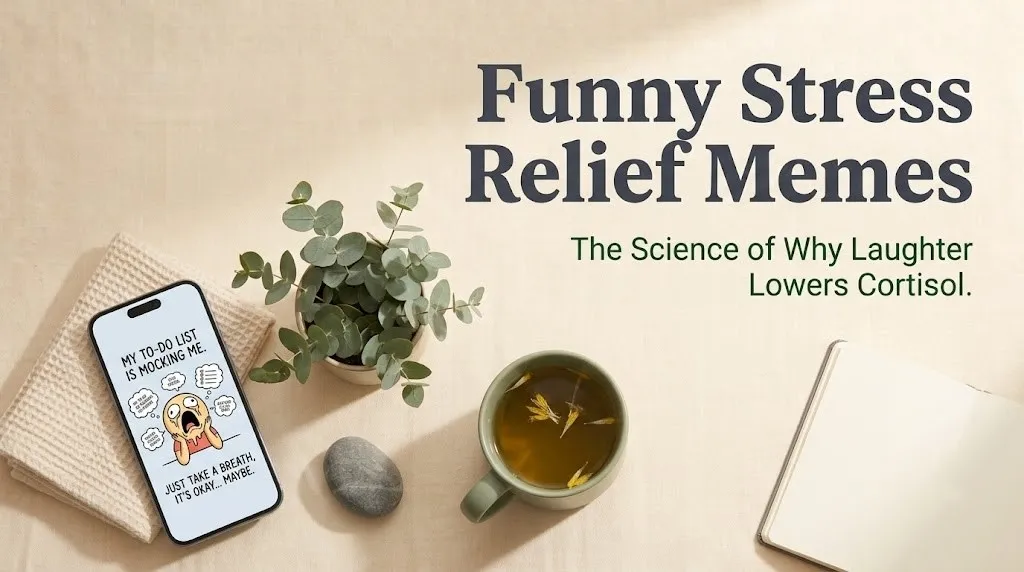
The format of memes is particularly suited to stress relief because of its brevity and accessibility. You don’t need 20 minutes to watch a comedy special. You don’t need to be in the right mood for a funny movie. A meme delivers its humor in under three seconds of viewing. This low barrier to entry matters when stress has depleted your mental energy. When you’re too exhausted to do anything proactive about your stress, you can still look at a funny picture on your phone and get a measurable stress reduction.
The variety of stress meme content means almost anyone can find something that resonates. Work stress memes for the office worker. Parenting stress memes for the exhausted parent. Student stress memes for the exam-crammer. Financial stress memes for the budget-stressed. This specificity matters because humor that accurately reflects your particular situation produces a stronger relief response than generic humor that could apply to anyone.
Stress Relief Meme
A stress relief meme is a single unit of humorous content designed or shared with the intention of reducing stress through laughter and relatability. The term encompasses the vast ecosystem of stress-related humor content that circulates on social media platforms, messaging apps, and online communities.
The psychological mechanism of a single stress relief meme operates through what humor researchers call the benign violation theory. A meme presents a violation, something wrong or stressful like your inbox having 300 unread emails, in a way that makes it feel benign, safe to laugh at because it’s depicted with exaggerated humor and shared by others who also find it funny. The threat is acknowledged but rendered non-threatening through the humorous frame. Your brain processes the stressful content differently when it’s wrapped in humor.
The immediacy of the stress relief from a single meme is one of its key advantages. Unlike meditation or exercise, which require practice and time to produce stress reduction, a funny meme can shift your physiological state within seconds. Your facial muscles move into a smile or laugh. Your breathing pattern changes. Your autonomic nervous system begins to shift. This rapid response makes memes useful as an acute intervention, something you can deploy in the moment when stress spikes, while waiting for your longer-term stress management practices to take effect.
The algorithm-driven nature of meme consumption has both benefits and risks. On the benefit side, the content you see is increasingly tailored to your specific sense of humor, maximizing the laughter response. On the risk side, endless scrolling can become a form of avoidance. The key is intentionality. Consciously choosing to look at stress memes for five minutes as a stress break is different from losing an hour to passive scrolling that leaves you feeling worse than when you started.
Stress Relief Memes
Stress relief memes as a category represent one of the most widely used but least studied stress management tools of the digital age. Millions of people use them daily. The informal, user-generated nature of meme culture has kept it largely outside the scope of formal stress research, but the principles that make humor effective for stress relief apply directly to meme consumption.
The collection and curation aspect of stress memes adds another layer to their effectiveness. Many people maintain saved collections of favorite stress memes on their phones. They return to specific memes that reliably make them laugh. This curation creates a personalized stress relief toolkit that is always available. Unlike a breathing app that you might forget to use, your saved memes are there when you open your camera roll. The act of curating also reinforces the stress relief. Choosing which memes to save involves re-engaging with the humor and strengthening the positive association.
The community aspect of stress meme culture cannot be separated from its individual effects. Stress meme accounts on social media platforms function as informal support communities. The comments sections are filled with people tagging friends, sharing variations, and expressing solidarity. “This is me.” “Sent this to my work bestie.” “Finally someone gets it.” These interactions, brief as they are, constitute genuine social connection around shared stressful experiences. The validation of knowing you’re not alone in your stress is itself stress-reducing, independent of the humor.
The generational and cultural specificity of memes means their effectiveness varies between populations. A stress meme that resonates deeply with a 25-year-old may be incomprehensible to a 65-year-old. The formats, references, and humor styles are culturally bound. This specificity is actually a strength for the populations that share the cultural context. The more precisely a meme reflects your particular experience and humor sensibilities, the stronger the laughter and validation response. Generic stress humor simply cannot produce the same effect.
Key Takeaway: Stress relief memes work through the combination of humor-induced physiological changes, relatable content that validates your experience, and social connection through shared cultural understanding, with effects measurable in cortisol reduction within 30 minutes of genuine laughter.
Stress Memes
Stress memes are humorous images that depict stressful situations in exaggerated, relatable ways. They differ from stress relief memes only in emphasis. Stress memes focus on depicting the stress itself. Stress relief memes emphasize the relief or the humor in the situation. In practice, the terms overlap heavily and most content serves both functions.
The depiction of stress in memes serves a cognitive function that psychologists call cognitive reappraisal. When you see your overwhelming workload depicted as a dumpster fire with a dog sitting calmly beside it saying “this is fine,” you’re being invited to reappraise your situation. The meme reframes the stress from something threatening and overwhelming to something absurd and, crucially, shared. This reframe doesn’t change your workload. It changes your relationship to it, and that cognitive shift has physiological consequences.
The exaggeration in stress memes is psychologically important. A meme doesn’t show a mildly cluttered desk. It shows a desk buried under papers with the caption “just a quick task they said.” The exaggeration creates distance from the actual stressor. Your desk isn’t that bad. The gap between the meme’s depiction and your reality makes your situation feel more manageable by comparison. This is a form of downward social comparison, but with a fictional character instead of another person.
The specific formats of stress memes have their own psychological properties. The “expectation versus reality” format directly addresses the gap between what you hoped would happen and what actually happened, a major source of stress. The “me explaining to my brain” format externalizes internal conflict, making it something you can observe and laugh at rather than something you’re trapped inside. The “starter pack” format collects related stressors into a single image, creating a sense of coherent pattern rather than random assault. Each format processes stress through a different cognitive lens.
Funny Stress Memes
Funny stress memes prioritize humor over accuracy, exaggeration over realism, and the goal is laughter first with stress relief as the natural consequence. The distinction from general stress memes is one of degree. Funny stress memes aim for the strongest possible comedic response.
The humor in these memes operates through several established comedy mechanisms. Recognition humor: “That’s exactly what my boss does.” Incongruity humor: “This cat represents my mental state during budget season.” Superiority humor: “At least I’m not this person.” Relief humor: addressing taboo or suppressed feelings about stress that are rarely spoken aloud. The combination of multiple humor types in a single meme increases the probability of triggering genuine laughter rather than just mild amusement.
The intensity of the humor response matters physiologically. A small exhale through your nose produces minimal physiological change. A genuine laugh that involves your diaphragm, changes your breathing pattern, and produces sound triggers the full cascade of stress hormone reduction, endorphin release, and parasympathetic activation. Funny stress memes that produce genuine laughter are measurably more effective at reducing stress than mildly amusing content that produces only a smile.
The subjectivity of humor means that the same meme can produce wildly different responses in different people. What makes one person laugh uncontrollably may leave another person completely unmoved. This is not a failure of the meme. It’s the nature of humor, which depends on personal experience, cultural context, current mood, and individual differences in humor processing. Finding the specific stress memes that reliably make you laugh is a process of personal discovery, and the ones that work for you may be completely different from the ones that work for your friends.
Stress Humor
Stress humor is the broader category of comedy that derives its material from stressful experiences. It encompasses memes but also stand-up comedy, sitcoms, humorous essays, and casual jokes among friends. The unifying feature is that the source of the humor is the shared experience of stress.
Stress humor has a long history predating internet memes by centuries. Gallows humor, the joking about dire circumstances by those experiencing them, is documented in some of the earliest written records. First responders, healthcare workers, and military personnel have long used dark humor as a coping mechanism for trauma exposure. What memes have done is democratize and accelerate this process, making stress humor instantly available to anyone with a phone and a stressful situation.
The function of stress humor in different professions and life contexts varies in tone and intensity. Healthcare workers use darker humor than office workers because their stressors involve life and death. Parents use humor about the absurdity of child-rearing challenges. Students use humor about academic pressure. The specificity of professional and contextual stress humor makes it more effective for the in-group than for outsiders, which is why workplace-specific meme accounts have such dedicated followings.
The line between adaptive stress humor and maladaptive deflection is real but often subtle. Adaptive stress humor processes the stress. You laugh at the situation, feel a release, and can engage with the actual problem more effectively afterward. Maladaptive deflection uses humor to avoid engaging with the problem at all. You laugh and scroll past, never addressing the stressor that produced the need for humor in the first place. The difference is not in the humor content but in what happens after you stop laughing.
Stress Relief Humor
Stress relief humor is humor specifically intended or used for the purpose of reducing stress. The intention can come from the creator, the consumer, or both. When you specifically search for “stress relief memes,” you’re engaging with humor as a deliberate stress management tool rather than passively encountering something funny.
The intentionality of use changes the psychological effect. Research on coping strategies distinguishes between problem-focused coping, addressing the stressor directly, and emotion-focused coping, managing the emotional response to the stressor. Stress relief humor is emotion-focused coping. It doesn’t change your deadline, your difficult conversation, or your financial situation. It changes how you feel about those things, which can make you more capable of addressing them effectively.
The timing of stress relief humor matters for its effectiveness. Using humor as an immediate intervention during a stress spike can prevent the escalation of the stress response. Your boss sends a frustrating email. Instead of immediately responding, you look at a work stress meme, laugh, feel your shoulders drop, and then respond more calmly. The humor didn’t solve the problem. It interrupted the stress cascade before it could fully activate your sympathetic nervous system and flood your system with cortisol and epinephrine.
The dose matters too. A few minutes of stress relief humor during a break is restorative. An hour of scrolling that replaces addressing the actual stressor is avoidant. The same activity can be adaptive or maladaptive depending on duration, context, and what happens afterward. Healthy use of stress relief humor is time-limited and serves as a bridge to more active coping, not as a replacement for it.
Stress Relief Funny
Stress relief funny content encompasses all humorous material consumed with the goal of feeling less stressed. It includes memes but extends to funny videos, comedy clips, humorous podcasts, and any other form of comedy that produces laughter and the associated stress reduction.
The variety of formats available for stress relief funny content means you can match the format to your current capacity. When you’re too drained to read, a 30-second video clip requires less cognitive effort than a meme that requires reading text. When you’re too overstimulated for video, a simple image meme is less demanding. When you need background relief while doing other tasks, a comedy podcast provides ongoing low-grade humor that doesn’t require visual attention. Having multiple formats available increases the likelihood that you can access humor-based stress relief in whatever state you’re in.
The curated nature of modern content consumption means your stress relief funny content can be highly personalized. Algorithm-driven feeds learn what makes you laugh and deliver more of it. This personalization increases the effectiveness of each viewing session because the content is targeted to your specific humor preferences. The downside is that algorithms can also trap you in endless scrolling that extends far beyond the stress relief purpose you initially had.
The portability of stress relief funny content on smartphones means this tool is available in almost any situation. Stressed in a waiting room? Memes. Stressed on public transit? Memes. Stressed at 2 AM when you can’t sleep? Memes. This accessibility is unparalleled among stress relief tools. No other evidence-based stress management technique is as immediately available in as many contexts as humor delivered through a phone.
Key Takeaway: Stress relief humor works best when used intentionally and time-limited, serving as a bridge to more active coping rather than a replacement for addressing stressors, with effectiveness dependent on format matching your current mental state.
Work Stress Memes
Work stress memes are a specific subgenre of stress humor that derives its material from workplace experiences. They are among the most popular and widely shared categories of stress memes because work is one of the most common sources of chronic stress for adults.
The American Psychological Association’s Stress in America survey consistently ranks work as a top source of stress for American adults. Work stress memes address specific workplace stressors: unreasonable deadlines, difficult managers, pointless meetings, email overload, work-life balance struggles, and the particular frustration of office culture. The specificity of these memes is their strength. A generic stress meme produces a generic response. A meme about the specific frustration of someone scheduling a meeting to prepare for another meeting produces a targeted response in anyone who has experienced that exact situation.
Work stress memes serve a subversive function in hierarchical workplace environments. They allow employees to express frustration about management, policies, and working conditions in a format that is deniable because it’s “just a joke.” The humor provides cover for legitimate criticism and emotional expression that would be professionally risky to state directly. This function has real psychological value. Suppressing negative emotions about work is itself stressful. Having an outlet that feels safe provides relief from the effort of constant professional presentation.
The community function of work stress memes is particularly important because work can be isolating. Your coworkers may share your frustrations, but discussing them openly carries risk. Work stress meme communities, whether internal Slack channels or external social media accounts, provide a space where the shared experience of work stress is acknowledged and validated. This validation reduces the loneliness that compounds occupational stress, and it does so without requiring you to expose yourself professionally.
Burnout Memes
Burnout memes address the specific experience of occupational burnout characterized by emotional exhaustion, depersonalization, and reduced personal accomplishment. The World Health Organization recognizes burnout as an occupational phenomenon resulting from chronic workplace stress that has not been successfully managed.
Burnout memes have a distinct tone that differs from general work stress memes. They are darker, more resigned, and often more cynical. A work stress meme might joke about a busy day. A burnout meme jokes about the existential depletion that makes even a slow day feel impossible. The humor serves a different function at this level of distress. It’s less about lightening the mood and more about acknowledging the depth of the exhaustion. When you’re burned out, a cheerful “you’ve got this” meme can feel invalidating. A meme that says “I have achieved nothing today and I’m exhausted” can feel like the first time someone has told you the truth.
The diagnostic value of burnout memes is underappreciated. What you find funny is a window into your psychological state. If you find yourself increasingly drawn to darker, more cynical burnout humor, and if lighter stress memes no longer produce the same relief, that shift may indicate that your stress has progressed from manageable to concerning. The memes you’re saving and sharing can serve as informal mood tracking. A collection that’s shifted from “haha work is crazy” to “I feel nothing and everything is pointless” is telling you something about your mental state.
The limitation of burnout memes is that they acknowledge the burnout without treating it. Laughing at a meme about being unable to get out of bed does not address the neuroendocrine dysregulation, the flattened cortisol awakening response, or the cognitive changes that characterize clinical burnout. Burnout memes may provide momentary relief, but they are not a treatment for burnout. If you consistently find burnout humor more relatable than any other kind, a conversation with a licensed clinical psychologist or your primary care physician about burnout assessment is appropriate.
Anxiety Memes
Anxiety memes address the experience of anxiety disorders and anxious thought patterns through humor. They are among the most shared mental health meme categories and have created communities where anxiety is discussed openly through the accessible format of humor.
Anxiety memes work differently from general stress memes because anxiety and stress, while related, are distinct experiences. Stress is typically a response to an identifiable external stressor. Anxiety often persists without a clear external trigger and involves anticipatory worry about future threats. Anxiety memes address this internal experience: overthinking, catastrophizing, social anxiety, intrusive thoughts, and the physical symptoms of anxiety. The humor targets the anxiety process itself rather than external stressors.
The destigmatizing function of anxiety memes is arguably as valuable as their stress relief function. Anxiety disorders affect approximately 19 percent of adults in the United States annually according to the National Institute of Mental Health, yet many people with anxiety feel isolated and ashamed of their symptoms. Anxiety memes that depict overthinking spirals, avoidance behaviors, and physical anxiety symptoms normalize these experiences. The message is not “this is fine” but “you’re not the only person whose brain does this.” For people with undiagnosed or newly diagnosed anxiety disorders, this normalization can be the first step toward recognizing that their experience has a name and is treatable.
The limitation of anxiety memes is that they can normalize symptoms without encouraging treatment. Finding a meme relatable does not constitute receiving care. Anxiety memes can also trigger rumination in some individuals. Repeated exposure to content about overthinking can prompt more overthinking rather than relieving it. For people with anxiety disorders, humor-based coping should be one tool among many, ideally alongside evidence-based treatment such as cognitive behavioral therapy from a licensed clinical psychologist.
Laughter Stress Relief
Laughter stress relief is the reduction in subjective and physiological stress that occurs as a result of genuine laughter. The mechanism is well-documented in psychoneuroimmunology research and operates through multiple converging pathways that affect stress hormones, the autonomic nervous system, and immune function.
The physiological sequence of laughter begins with a brief activation of the sympathetic nervous system. Heart rate increases. Blood pressure rises. Skeletal muscles contract. This is the physical effort of laughing. Immediately following the laugh, a parasympathetic rebound occurs. Heart rate drops below baseline. Blood pressure decreases. Muscles relax. This rebound is where much of the stress relief occurs. The net effect of a genuine laugh is parasympathetic activation that persists after the laughter ends.
Cortisol reduction is one of the most important and measurable effects of laughter. Studies have documented that watching a humorous video that produces genuine laughter reduces salivary cortisol within 30 minutes, with the reduction persisting for 60 to 90 minutes. The magnitude of cortisol reduction correlates with the intensity of the laughter. A polite chuckle produces minimal change. A deep, uncontrollable laugh produces a measurable drop. This dose-response relationship supports the idea that the physiological benefit of humor is proportional to how funny you actually find it.
Immune function improvements accompany the neuroendocrine changes. Research has shown that laughter increases natural killer cell activity, the immune cells that target virally infected and abnormal cells. Salivary immunoglobulin A, a first-line immune defense in the respiratory and oral mucosa, increases after laughter. These immune changes are thought to be mediated by the reduction in cortisol, which at chronically elevated levels suppresses immune function, and by the increase in endorphins, which have immune-enhancing effects.
Humor and Stress Relief
Humor and stress relief connect through psychological mechanisms that are distinct from, and complementary to, the physiological effects of laughter. The cognitive and emotional processing that humor enables provides stress reduction even when the humor doesn’t produce audible laughter.
Cognitive reappraisal is the primary psychological mechanism. Humor reframes a stressful situation in a way that changes its emotional impact. The situation itself hasn’t changed. Your interpretation of it has. This is the same mechanism that cognitive behavioral therapy uses, delivered through comedy rather than clinical intervention. When a meme reframes your overwhelming to-do list as a comically impossible mountain, the reframe reduces the emotional charge of the original stressor. It’s still a long list. It no longer feels like a personal failure.
Emotional release is the second mechanism. Stress involves the accumulation of negative emotional tension. Humor provides a safe outlet for expressing frustration, anger, fear, and sadness that might be inappropriate or risky to express directly. A work stress meme that says “I am one email away from quitting” expresses a genuine feeling in a format that is socially acceptable because it’s framed as humor. The feeling gets expressed rather than suppressed, and suppression of negative emotions is itself physiologically stressful.
Social connection through shared humor addresses the isolation that often accompanies stress. When you share a stress meme with a friend and they respond “this is literally me right now,” you’ve had a moment of genuine social connection around your shared experience. This connection releases oxytocin, the hormone associated with social bonding, which has its own stress-reducing effects. Oxytocin decreases amygdala reactivity and reduces HPA axis activation. Shared humor provides both the direct stress relief of laughter and the additional relief of social connection.
Psychology of Humor Stress
The psychology of humor as it relates to stress involves several established theories that explain why finding something funny changes your stress response. These theories address different aspects of humor and together provide a framework for understanding why stress memes work.
The benign violation theory, developed by researchers at the University of Colorado Boulder, proposes that humor occurs when something is simultaneously perceived as a violation, something wrong or threatening, and benign, something safe. A stress meme about burnout is a violation because burnout is genuinely distressing. It becomes benign because the exaggeration, the humor format, and the fact that others are laughing at it signal that it’s safe to laugh rather than cry. This simultaneous threat and safety is what produces the humor response.
The relief theory, dating back to Herbert Spencer and Sigmund Freud, proposes that laughter releases pent-up nervous energy. Stress involves the accumulation of psychological and physiological tension. Laughter discharges this tension. This theory aligns with the observed parasympathetic rebound after laughter and the subjective feeling of release that people describe after a good laugh. The laughter doesn’t just distract from stress. It actively dissipates the accumulated tension.
The superiority theory, with roots in Aristotle and Thomas Hobbes, proposes that humor arises from a sense of superiority over the subject of the humor. In stress memes, this often manifests as laughing at exaggerated depictions of stress that make your own situation look manageable by comparison. The meme character who has completely lost it makes your own partial loss of composure feel more controlled. This downward comparison, even with a fictional character, provides relief.
The incongruity theory proposes that humor arises when expectations are violated in a non-threatening way. A stress meme subverts your expectation of how to talk about stress. Instead of the serious, concerned tone that stress discussions usually involve, the meme treats existential dread as casually as commenting on the weather. This incongruity between the seriousness of the topic and the casualness of the treatment produces the humor response.
Cortisol Laughter
Cortisol laughter refers to the well-documented effect of genuine laughter in reducing circulating cortisol levels. This is the most direct physiological pathway by which humor-based stress relief operates, and the research supporting it is substantial.
Cortisol is produced by the adrenal cortex in response to adrenocorticotropic hormone from the pituitary gland, which is stimulated by corticotropin-releasing hormone from the hypothalamus. This entire HPA axis cascade is downregulated by laughter. Studies measuring salivary cortisol before and after humor interventions have consistently found reductions, with effect sizes that are clinically meaningful. The reduction is not permanent. Cortisol returns to its previous level within a few hours, which is why regular humor exposure produces more sustained benefit than a single funny event.
The mechanism of cortisol reduction involves multiple pathways. The parasympathetic rebound after laughter directly inhibits sympathetic activation of the adrenal medulla and cortex. Endorphins released during laughter have inhibitory effects on the HPA axis. The cognitive reappraisal that accompanies humor reduces the perceived threat level, which is what drives the stress response in the first place. Cortisol doesn’t drop because laughter chemically neutralizes it. It drops because laughter signals to your brain that the threat has passed.
The practical implication of cortisol research for stress meme use is that frequency and intensity both matter. A single meme that produces a mild exhale through your nose won’t move your cortisol meaningfully. Regular engagement with humor that genuinely makes you laugh, multiple times throughout the day, provides more sustained cortisol reduction. This is why people who describe themselves as regularly using humor to cope have lower baseline cortisol than those who don’t, controlling for stress levels.
Stress Coping Humor
Stress coping humor is the intentional use of humor as a strategy for managing stress. It is recognized in psychology as a form of emotion-focused coping and is measured by assessment tools including the Coping Humor Scale. Understanding humor as a coping strategy means moving from passive consumption to active, intentional use.
Adaptive humor coping involves several key features. It is time-limited rather than endless. It is used as a bridge to active problem-solving rather than a replacement for it. It processes the stressor rather than avoiding it entirely. It strengthens social connections rather than replacing them. Adaptive humor coping might look like taking five minutes to look at stress memes, laughing genuinely, feeling more relaxed, and then returning to the stressful task with reduced emotional charge and renewed capacity.
Maladaptive humor coping involves using humor to avoid, deflect, or minimize problems that need to be addressed. It’s the difference between laughing at a burnout meme and then talking to your manager about your workload versus laughing at burnout memes for two hours while the workload piles up unaddressed. The humor content is the same. The coping pattern is different. Humor becomes maladaptive when it consistently replaces rather than facilitates active coping.
The difference between adaptive and maladaptive use is often invisible to the user in the moment. Self-monitoring questions can help identify which pattern you’re in. Am I using this humor as a break before returning to the thing that’s stressing me out, or am I using it to avoid that thing entirely? After I stop laughing, do I feel more capable of handling my stress or more disconnected from it? Does my humor consumption strengthen my relationships or replace them? Honest answers to these questions distinguish coping from avoidance.
Key Takeaway: Humor is an evidence-based stress coping tool when used intentionally and time-limited as a bridge to active problem-solving, but it becomes maladaptive avoidance when it replaces addressing stressors and disconnects you from necessary action or professional support.
Frequently Asked Questions About Stress Relief Memes and Humor
Do stress relief memes actually help reduce stress?
Stress relief memes reduce stress by triggering laughter, which measurably lowers cortisol, increases endorphins, and activates the parasympathetic nervous system.
The physiological effects begin within seconds of genuine laughter and can persist for over an hour.
The effectiveness depends on finding memes that genuinely make you laugh rather than just acknowledge your stress.
Why does laughing at stress memes make you feel better?
Laughing at stress memes makes you feel better because humor reframes threatening situations as benign, providing cognitive reappraisal of your stressor.
The laughter itself triggers a parasympathetic nervous system rebound that lowers heart rate, reduces blood pressure, and relaxes muscles.
The relatability of stress memes validates your experience and reduces the isolation that compounds stress.
What happens to cortisol when you laugh?
Cortisol decreases measurably within 30 minutes of genuine laughter, with the reduction persisting for 60 to 90 minutes.
The effect is proportional to the intensity of the laughter, with deep, sustained laughs producing larger cortisol drops than mild amusement.
Regular humor exposure throughout the day produces more sustained cortisol reduction than a single laughter episode.
Is it healthy to use humor to cope with serious stress?
Humor is a healthy coping tool for serious stress when used as one strategy among many and when it facilitates rather than replaces active problem-solving.
Humor becomes unhealthy when it consistently avoids addressing stressors, when it minimizes genuine distress, or when it replaces seeking needed professional support.
If humor is your only coping strategy and your stress continues to worsen, a licensed clinical psychologist can help expand your coping toolkit.
Can sharing memes with friends help with stress more than viewing them alone?
Sharing memes with friends provides additional stress relief beyond viewing alone because shared laughter releases oxytocin, the social bonding hormone that reduces amygdala reactivity.
Social sharing validates your experience through another person’s recognition, which reduces the isolation of stress.
The combination of humor-induced parasympathetic activation and social connection-induced oxytocin release produces stronger stress relief than either alone.
When should humor not be used for stress relief?
Humor should not be used for stress relief when it becomes a primary avoidance strategy that prevents you from addressing stressors that need action.
If you find yourself spending hours scrolling memes while your responsibilities and stress continue to mount, humor has shifted from coping to avoidance.
If your stress is causing functional impairment for more than two weeks, or if you’re using humor to suppress feelings that need professional attention, contact a licensed clinical psychologist or your primary care physician.
That quick scroll through stress memes when you’re overwhelmed isn’t just digital procrastination. It’s a legitimate stress intervention that reduces cortisol, increases endorphins, and activates your parasympathetic nervous system. The laughter that a perfectly targeted meme produces changes your physiology measurably within minutes. Understanding the mechanism doesn’t make the memes less funny. It makes you more intentional about using them.
The next time stress spikes, try this: consciously decide to take a five-minute humor break. Open your saved memes or a stress meme account you follow. Find something that genuinely makes you laugh out loud. Notice how your body feels before and after. Then return to the stressor. That intentional pattern, using humor as a bridge rather than an escape, is what separates adaptive coping from avoidance.
If the only thing that makes your stress feel manageable is scrolling through increasingly dark burnout memes, that’s information worth paying attention to. The content that resonates with you is a window into your psychological state. If stress memes have shifted from funny to simply accurate, and if your stress is interfering with your daily functioning, reach out to a licensed clinical psychologist. The right professional can help you build a stress management toolkit that includes humor and extends far beyond it.